Recommended resources
The freely available resources this lesson will direct you to.
- How To Answer "Tell Me About Yourself" During A Consulting Interview + Examplewww.youtube.com
- How to Answer 'Tell Me About Yourself' in Data Science Interviews: Easy Tips for Successwww.youtube.com
- Associate Consultant 2027-28 - Analytics (London Office) in London - OC&C Strategy Consultants UKcareers.occstrategy.com
- Your Personal Marketing Plan (for master’s students) – Office of Career Strategy – Yale Universityocs.yale.edu
Hello again. Last lesson, you turned experience from your internships, research, projects, and sponsorship work into evidence-backed CV bullets. An interview introduction uses the same evidence, but it has a different job: give the interviewer a clear reason to understand your move from data science into analytics strategy consulting.
Today you’ll build a spoken answer to “Tell me about yourself.” It should be concise enough to invite a conversation, specific enough to sound like you, and careful not to claim business impact you have not measured. The deeper questions—“Why analytics consulting?” and “Why OC&C?”—have their own lessons coming up. Here, you need a credible bridge to both.
1. Give your background a direction
A chronological account might cover your degree, two internships, research paper, certifications, four financial and ML projects, and sponsorship role. All are potentially useful; together, they would make a poor opening. The interviewer needs a through-line, not your CV read aloud.
Watch Emma Ding’s How to Answer “Tell Me About Yourself” in Data Science Interviews for a compact way to connect background, employer, and role. Her example targets data-science interviews; adapt the structure to a consulting role rather than borrowing its wording.
How to Answer 'Tell Me About Yourself' in Data Science Interviews: Easy Tips for Success
Emma Ding lays out a three-part answer and demonstrates how its parts connect.
Watch the opening structure for how to select relevant background rather than list everything. Continue through the role connection, then watch the worked example. Notice how each experience earns its place by supporting the destination.
Yale’s Office of Career Strategy makes a related point: a career-transition story should link your studies and experiences to the work you want next, in language your audience can follow.
Your Personal Marketing Plan (for master’s students) – Office of Career Strategy – Yale University
Read Yale’s guidance to see why a professional introduction needs both a reason for the transition and evidence for it.
Under “Why Are You Interested in this Career? Crafting Your Story,” read the career-story guidance. Then read the paragraph immediately before “What Relevant Skills Do You Bring?”, from “The narrative that you develop” through the audience advice. Focus on what you would retain—and what you would translate—for an interviewer who does not work in your research area.
For your answer, a useful through-line is: I can do analytical work, and I want to use it to inform consequential business choices. That is a statement of direction, not a claim that your projects have already changed a client’s strategy. Your examples should make the direction believable.
2. Build the bridge to this role
OC&C’s description of its analytics practice is unusually helpful here. It does not describe analysts as people who only produce models; it describes people who work with complex data, draw insights and recommendations, and communicate them to clients.
Associate Consultant 2027-28 - Analytics (London Office) in London - OC&C Strategy Consultants UK
Read OC&C’s role description to identify what your introduction must connect: technical analysis and strategic advice.
In “About OC&C,” find the paragraph beginning “Our London office is looking for Associate Consultants” and ending with the sentence about communicating findings persuasively to clients, just before “What Makes Us Different.” Read the analytics description. Pay particular attention to the work between examining data and advising a client.
Your experience offers several possible bridges, but each proves something different. Intrusion-detection research supports your ability to develop and present analytical work. The options-pricing and P&L dashboard supports an interest in financial questions; it does not, on the facts available, prove that someone used it to make a trading decision. Sponsorship proposals and negotiations provide evidence of communicating a proposition to stakeholders, though they are not an analytics project.
Choose two or three pieces of evidence that work together, rather than trying to mention every skill. One technical example establishes the foundation; a second can show commercial interest or communication. Then say explicitly why you want to bring that combination into consulting. Without that final connection, “I studied data science and built a dashboard” leaves the interviewer to supply your motivation for you.
3. Shape a spoken introduction
The Grammarly image below presents a general elevator-pitch structure. It is useful as a memory aid, but an interview is not a sales call: you do not need to end by asking for a meeting. Replace its call to action with a brief statement of why the role is your next step.
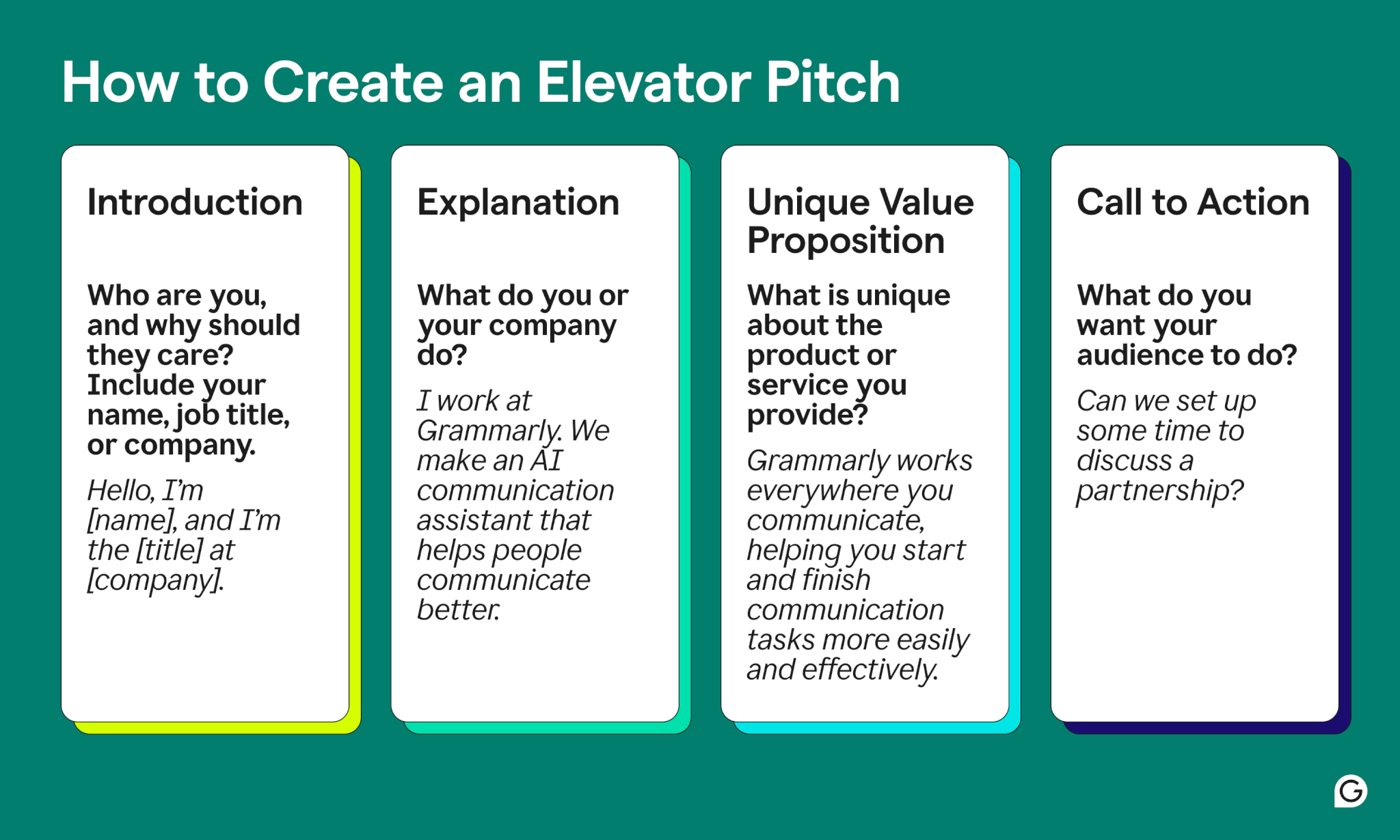
For a roughly one-minute answer, give the interviewer four things:
- Present identity: your computer-science and data-science background.
- Selected evidence: one or two experiences that show what you can do.
- Connecting insight: what draws you beyond producing a technical output.
- Destination: the kind of analytics consulting work you want to do.
Here is a draft based on the facts you have shared:
“My background is in computer science and data science at VIT, and I’m interested in work where analysis helps shape a decision. I conducted data-driven intrusion-detection research and led the authorship of a paper presented at IMACSI’25, which gave me experience developing and communicating analytical work. I’ve also built an options-pricing and P&L dashboard, reflecting my interest in financial questions, and negotiated sponsorships for Reviera’25, which involved making a case to external stakeholders. I’m now looking to combine those analytical and communication skills in strategy consulting: working through complex data, identifying what matters commercially, and explaining a recommendation a client can act on. That combination is what attracts me to OC&C’s analytics team.”
This is a model draft, not a script you must adopt. Its first sentence tells the interviewer where you are coming from and where the answer is going. The middle supplies evidence without a tool list or an unverified metric. The final sentences distinguish your desired work from a role that ends when the model is built.
If three examples feel crowded when spoken, drop the least relevant one. A shorter introduction with a clear thread is stronger than a fuller one that sounds like a compressed CV. For a brief opening—such as a one-way video response with a tight limit—you could keep just the research and financial project:
“My background is in computer science and data science at VIT. Through intrusion-detection research, including leading the authorship of a conference paper, I’ve developed experience doing and communicating analytical work. I’ve also explored financial questions through an options-pricing and P&L dashboard. I’m interested in OC&C Analytics because I want to take that technical foundation into client problems, connecting evidence to a commercial recommendation rather than stopping at the analysis.”
Notice what neither version says: that the dashboard improved investment returns, that the research prevented real-world attacks, or that you have already advised clients on strategy. Those would require evidence you have not supplied. Ambition belongs in the closing; established achievements belong in the evidence.
4. Deliver it as an opening, not a recital
A strong written paragraph can sound strained aloud. In How To Answer “Tell Me About Yourself” During A Consulting Interview, My Consulting Offer warns against both the disjointed “laundry list” and memorising a response word for word.
How To Answer "Tell Me About Yourself" During A Consulting Interview + Example
Watch My Consulting Offer’s guidance for two delivery checks: selecting a coherent story and keeping it conversational.
Watch the common pitfall to hear why a life-history list obscures your point. Then watch the delivery advice on avoiding a memorised-sounding answer. Use the ideas as checks on your introduction, not as a reason to add a long anecdote.
Prepare signposts, not exact sentences: background; research evidence; commercial or financial evidence; consulting direction. Rehearse once at a normal speaking pace. If you run long, remove an example before speeding up. If a phrase such as “developing and communicating analytical work” feels unnatural, replace it with words you would actually say while preserving the claim.
An introduction should also leave room for follow-up. An interviewer might ask what the paper found, what the dashboard displays, or what you contributed to a sponsorship negotiation. Keep your opening accurate enough that you can answer each of those questions comfortably. OC&C’s instruction to anonymise your submitted CV does not mean you must conceal your name or background in an interview.
Key takeaways
Your personal introduction is a selective argument, not a career inventory: establish your analytical foundation, support it with credible examples, and state why you want to connect analysis to client decisions. Keep the role connection explicit, the impact claims verifiable, and the spoken delivery natural.
Next, you’ll develop the distinction this introduction only signals: why analytics consulting, rather than a purely technical data-science role, is the work you want to pursue.