Recommended resources
The freely available resources this lesson will direct you to.
Hello and welcome back!
In the previous module, we built a comprehensive toolkit for analyzing a property's current market position. We learned how to create a scoring model to compare opportunities and even how to write Python scripts to pull live demographic and market data from APIs. This put us in a strong position to evaluate what a property is worth today.
Now, we pivot from the present to the future. This lesson marks the beginning of Module 5, Time Value of Money and Cash Flow Projections. Over the next few lessons, we will learn how to forecast an investment's financial performance over many years and use that forecast to make a sound investment decision.
Today's lesson covers the single most important principle in financial analysis: the Time Value of Money (TVM). By the end of this lesson, you will be able to calculate the present value (PV) and future value (FV) of real estate cash flows. Mastering this concept is the foundation for everything that follows, from projecting multi-year returns to valuing an entire property based on its income potential.
1. The Time Value of Money: Why a Euro Today is Worth More Than a Euro Tomorrow
Let's start with a simple question: would you rather receive €100,000 today or the exact same amount five years from now? The answer is obvious—you'd take the money today. The "why" behind this choice is the essence of the Time Value of Money.
Breaking down net present value in commercial real estate
The article 'Breaking down net present value in commercial real estate' from Altus Group gives a clear explanation of this core principle. It introduces the two main reasons why money today is more valuable than money in the future.
Please read the section 'The basics of net present value' up to (but not including) the 'Present value' subsection. Focus on the two key reasons provided for TVM.
As the article explains, the two primary reasons are:
- Inflation: Over time, the general increase in prices erodes the purchasing power of money. The €100,000 you receive in five years will buy you less than it would today.
- Opportunity Cost: Money received today can be invested to earn a return. By waiting five years, you miss out on the potential earnings you could have generated during that time.
These concepts lead to two related calculations: Future Value (FV), which calculates the future worth of money you have today, and Present Value (PV), which calculates the current worth of money you will receive in the future.
Net Present Value (NPV) explained
This short video, 'Net Present Value (NPV) explained' by The Finance Storyteller, provides a great visual and numerical walkthrough of the relationship between Present Value and Future Value.
Watch the first two minutes of the video (from 00:00 to 02:20). Pay close attention to how compounding is used to find the Future Value and discounting is used to find the Present Value.
2. Calculating Future Value (FV)
Future Value tells you what a sum of money invested today will grow to over a specific period, given a certain rate of return. This process is known as compounding.
The formula for Future Value is:
Where:
- = Future Value
- = Present Value (the initial amount of money)
- = The periodic interest rate or rate of return
- = The number of periods (e.g., years)
Example:
Imagine you are considering buying a small plot of land outside a growing city for €50,000. Based on your market analysis, you project that land values in this area will appreciate at an average rate of 4% per year. What would the land be worth in 10 years?
In 10 years, you can project the land to be worth approximately €74,012. This projected future sale price is a critical component of real estate analysis, often called the reversion value.
3. Calculating Present Value (PV)
Present Value is the reverse of Future Value. It tells you what a future sum of money is worth today. This process is called discounting, and it is far more common in investment analysis because it helps us value future income streams in today's euros.
The formula is a simple rearrangement of the FV formula:
Here, the rate is referred to as the discount rate. It represents the minimum rate of return an investor expects to earn on their investment to justify the risk. It's a crucial and somewhat subjective number that we will dedicate the entire next lesson to defining. For now, we'll use a given rate.

PV of a Single Cash Flow
Example:
Suppose you're analyzing a deal where you expect to sell a property for €400,000 at the end of a 7-year holding period. If your required rate of return (your discount rate) is 5%, what is the present value of that future sale?
This means that the €400,000 you hope to receive in 7 years is only worth €284,272 to you today, given your 5% required return.
PV of Multiple Cash Flows
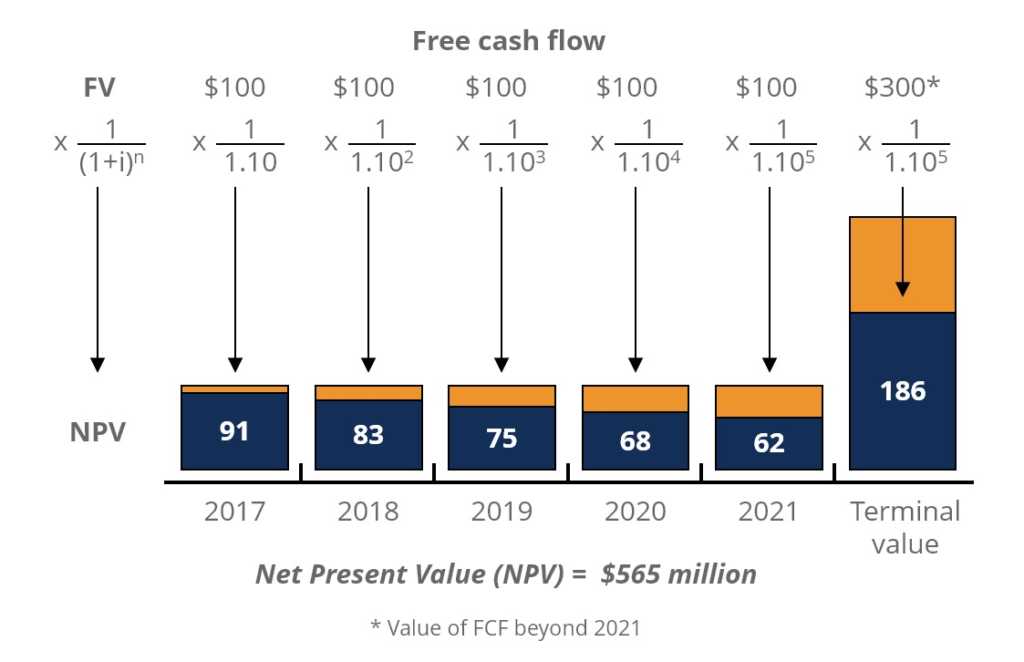
Real estate investments don't just produce a single cash flow at the end. They generate a stream of cash flows over the holding period (from rent) and then a final lump sum from the sale. The total Present Value of an investment is the sum of the present values of all its individual future cash flows.
Breaking down net present value in commercial real estate
The same Altus Group article we saw earlier provides an excellent table demonstrating this concept.
Read the 'Present value' subsection. Focus on the first table, which shows how a recurring cash flow of $100 received each year has a different (and lower) present value the further out in time it is received.
This concept of summing up discounted future cash flows is the absolute core of investment valuation.
Test your understanding!
You are evaluating a small garage space as an investment. You project that it will generate a net cash flow of €1,200 two years from now. If your personal discount rate is 6%, what is the present value of that cash flow?
Show answer
Using the PV formula:
The €1,200 you expect to receive in two years is worth €1,067.99 to you today.
4. Modeling PV and FV with Python
As a software engineer, you know that manual calculations are prone to error and don't scale. For analyzing real estate deals with multi-year projections, we'll use Python. The numpy_financial library is the standard tool for this.
If you don't have it installed, run:pip install numpy-financial
Let's model the PV of a hypothetical 5-year investment. Assume the following annual pre-tax cash flows (from rent) and a final sale price.
- Discount Rate: 7%
- Annual Net Cash Flow (Years 1-4): €8,000
- Annual Net Cash Flow (Year 5): €8,000
- Projected Sale Price (End of Year 5): €250,000
Our stream of future cash flows is:
- Year 1: €8,000
- Year 2: €8,000
- Year 3: €8,000
- Year 4: €8,000
- Year 5: €8,000 (rent) + €250,000 (sale) = €258,000
We can calculate the PV of this entire stream using numpy_financial.npv.
Important Note: The npv function in this library assumes the first cash flow happens at the end of the first period. It calculates the sum of discounted future cash flows, which is exactly the definition of Present Value. The "Net" in "Net Present Value" (NPV) typically involves subtracting the initial investment, which we will cover in a later lesson. For today, we are just using it to find the PV of a future stream.
import numpy_financial as npf

# Define our inputs
discount_rate = 0.07
cash_flows = [
    8000,    # Year 1
    8000,    # Year 2
    8000,    # Year 3
    8000,    # Year 4
    258000   # Year 5 (rent + sale)
]

# Calculate the Present Value of the cash flow stream
present_value = npf.npv(discount_rate, cash_flows)

print(f"The discount rate is: {discount_rate*100:.2f}%")
print(f"Future cash flows: {cash_flows}")
print(f"The Present Value of this investment is: €{present_value:,.2f}")

# The output will be:
# The discount rate is: 7.00%
# Future cash flows: [8000, 8000, 8000, 8000, 258000]
# The Present Value of this investment is: €216,427.81
This Python script tells us that the entire stream of future cash flows from this property, discounted at 7%, is worth €216,427.81 today. This figure gives you a valuation benchmark for how much you should be willing to pay for the property. This type of analysis is far more sophisticated than the simple metrics we've used so far. The article "Build a Home Buying Investment e-Analyser by Numpy in Colab" shows how you can expand this simple script into a full-blown analyzer comparing different financing scenarios, which is a great example of where these skills can lead.
Conclusion
Today, we established the foundational concept for all serious investment analysis: the Time Value of Money. Understanding and applying PV and FV calculations moves you from static, single-period metrics to a dynamic, multi-year view of an investment's value.
Key Takeaways:
- Money has a time value due to inflation and opportunity cost.
- Future Value (FV) calculates the future worth of a present sum through compounding.
- Present Value (PV) calculates the present worth of a future sum (or stream of sums) through discounting.
- The discount rate is the required rate of return used to calculate PV.
- The PV of an investment is the sum of the present values of all its projected future cash flows.
- The
numpy_financiallibrary in Python is a powerful tool for these calculations.
Preview of the Next Lesson:
Our PV calculation hinged on a critical input: the discount rate. A higher discount rate leads to a lower present value, and vice-versa. But where does this number come from? In our next lesson, we will focus exclusively on how to define and estimate a property-specific discount rate, exploring the factors that influence it, such as risk, inflation, and market conditions.