Recommended resources
The freely available resources this lesson will direct you to.
Hello and welcome back to our course on real estate investment metrics.
In our previous lesson, we built a complete multi-year pro forma statement to project the annual cash flows you would receive during the investment's holding period. We ended with Pre-Tax Cash Flow (CFBT), the money in your pocket before income taxes.
However, the annual cash flow is only one part of your total return. The other major component is the cash you receive when you eventually sell the property. This lesson focuses on a single, crucial learning outcome: to calculate the reversion value, which is the projected sale price and subsequent cash flow at the end of your holding period. Mastering this is essential, as it's often the largest single cash inflow in an investment's lifecycle.
1. Estimating the Future: The Reversion Value
"Reversion" refers to the property reverting to cash upon sale. To project our total investment return, we need a logical way to estimate what a property might be worth 5, 7, or 10 years in the future. We can't know for certain, but we can make an educated forecast using the same logic a future buyer would: by looking at the property's income.
The standard professional method for this is the Exit Cap Rate Method. Let's start with a video that introduces this core concept.
How To Set The Exit Cap Rate On A Real Estate Deal
This video from 'Break Into CRE' clearly explains why we need to estimate a future sale price and how the exit cap rate is used to do it.
Watch the first 1 minute and 42 seconds (00:00 - 01:42). Focus on understanding what the exit cap rate approach is and the basic formula that connects Net Operating Income (NOI) to the sale price.
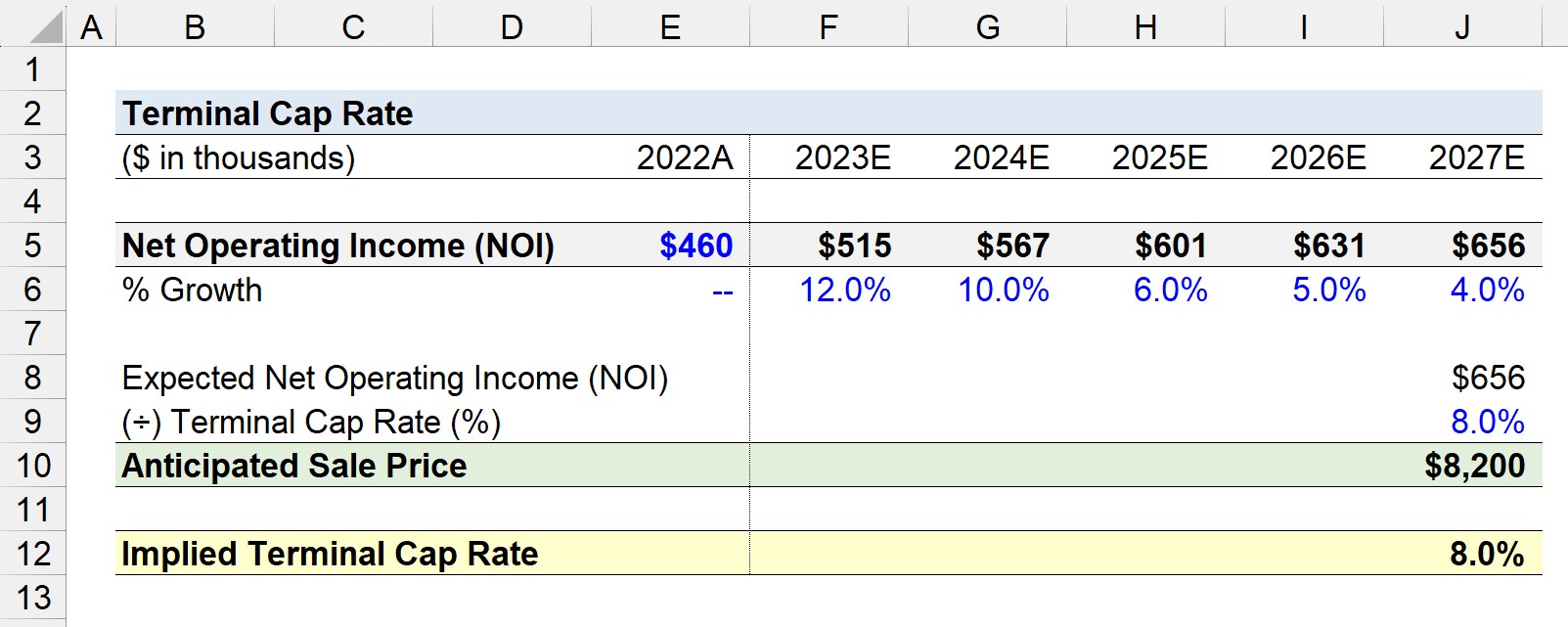
As the video explained, the formula is a simple rearrangement of the cap rate formula you learned in Module 3:
A key detail here is the use of the NOI in the year after sale. For example, if you plan to hold the property for 5 years and sell at the end of Year 5, you would use the projected NOI for Year 6 in the formula. Why? Because a new buyer is purchasing the future income stream of the property, and their first full year of ownership will be Year 6.
2. The Art and Science of Setting the Exit Cap Rate
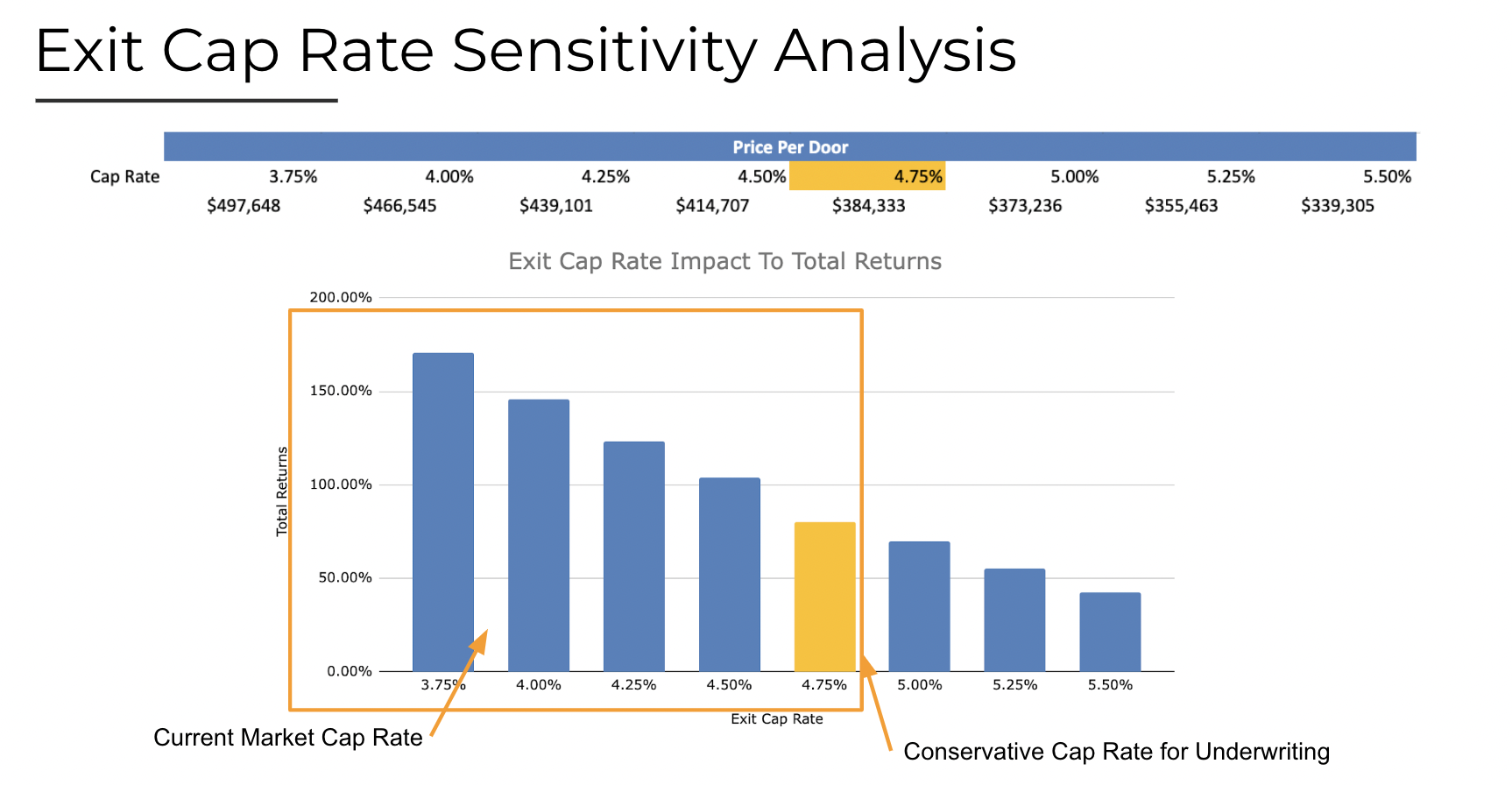
The most challenging part of this calculation is choosing a realistic Exit Cap Rate. This rate is your assumption about what the market will look like and what return a future buyer will demand when you sell.
This web page from Wall Street Prep provides an excellent summary of the concept, also referring to it as the "terminal cap rate" or "reversion cap rate".
Exit Cap Rate | Formula + Calculator
This article, 'Exit Cap Rate | Formula + Calculator,' reinforces the definition and formula we just discussed. It also introduces a critical best practice for setting your exit cap rate assumption.
Read the sections titled 'What is Exit Cap Rate?', 'Exit Cap Rate Formula', and 'How to Project Cap Rates'. Pay special attention to the rationale for setting the exit cap rate higher than the entry cap rate.
As the resources highlight, a common and conservative practice is to assume the Exit Cap Rate will be higher than the cap rate at which you purchased the property (the "Going-In Cap Rate").
There are several reasons for this conservative stance:
- Aging Property: The building will be older and may be less attractive than it was when you bought it.
- Rising Interest Rates: If interest rates rise over your holding period, borrowing costs for the next buyer will be higher, which generally pushes cap rates up (and prices down).
- Margin of Safety: By assuming a less favorable sale environment (higher cap rate = lower price), you are building a buffer into your projections. If the market is better than expected, your returns will be too.
A widely used rule of thumb is to increase the cap rate by a small amount for each year of the holding period.
Rule of Thumb: Add 0.10% (10 basis points) to the Going-In Cap Rate for each year you hold the property.
- Example: If you buy a property at a 5.0% cap rate and plan to hold it for 7 years, you might project an exit cap rate of:
5.0% + (7 years * 0.10%/year) = 5.7%
Let's watch a bit more of the 'Break Into CRE' video to see this rule of thumb in action.
How To Set The Exit Cap Rate On A Real Estate Deal
This segment demonstrates the 'annual cap rate expansion' rule of thumb and explains the logic behind it.
Watch the segment from 02:51 to 04:15. This provides a practical example of applying the basis point addition rule.
3. From Sale Price to Net Cash in Your Pocket
The Projected Sale Price is just the starting point. To find the final cash flow you receive from the sale (the Reversion Cash Flow), you must subtract two major items: the costs of selling and the remaining mortgage balance.
Reversion Cash Flow = Projected Sale Price - Costs of Sale - Remaining Mortgage Balance
Costs of Sale
These are the transaction costs incurred to sell the property. In Spain, these typically include:
- Real Estate Agency Commission: Often 3-5% of the sale price.
- Legal Fees: For handling the transaction.
- Taxes on Sale: This is a critical and substantial cost in Spain. There are two main taxes:
- Plusvalía Municipal (IIVTNU): A local tax on the increase in the value of the land.
- Capital Gains Tax (in your IRPF): A tax on the profit made from the sale, paid as part of your personal income tax return.
We will dedicate an entire module (Module 10) to calculating these taxes precisely. For now, in our pro forma, we can use an estimate. A reasonable ballpark for total costs of sale in Spain, including commissions and taxes, is often between 8% and 12% of the sale price.
Remaining Mortgage Balance
When you sell the property, you must use a portion of the proceeds to pay off the outstanding principal on your mortgage loan. You can find this value on the amortization schedule you learned to build in Module 2.
4. A Worked Example
Let's put all the pieces together and calculate the reversion cash flow for the property from our last lesson.
Recap of Projections & New Assumptions:
- Holding Period: 5 Years
- NOI in Year 5: €88,587
- NOI Annual Growth Rate: 2.0%
- Going-In Cap Rate (Assumption): 6.0%
- Total Costs of Sale (Estimate): 9% of Sale Price
- Remaining Mortgage Balance at end of Year 5 (from amortization schedule): €275,800
Step 1: Calculate the NOI for the year after sale (Year 6)
This is the income the new buyer will receive in their first year.
Step 2: Determine the Exit Cap Rate
Using our rule of thumb:
Step 3: Calculate the Projected Sale Price (Terminal Value)
Step 4: Calculate the Net Sale Proceeds
First, find the total costs of sale.
Then, subtract these costs from the sale price.
Step 5: Calculate the Final Reversion Cash Flow
This is the cash that goes to you, the equity holder, after the bank is paid.
This reversion cash flow of €989,226 is the final cash flow event in our 5-year investment timeline.
Test your understanding!
You are analyzing a property you plan to hold for 10 years.
- Your projected NOI in Year 10 is €45,000.
- You assume NOI will grow by 2.5% annually.
- You purchased the property at a 5.5% going-in cap rate. You decide to use the "10 bps per year" rule of thumb.
- You estimate total costs of sale will be 10% of the sale price.
- At the end of Year 10, the remaining mortgage balance will be €410,000.
Calculate the final Reversion Cash Flow.
Show answer
- NOI in Year 11: €45,000 * 1.025 = €46,125
- Exit Cap Rate: 5.5% + (10 years * 0.10%) = 5.5% + 1.0% = 6.5%
- Projected Sale Price: €46,125 / 0.065 = €709,615
- Costs of Sale: €709,615 * 0.10 = €70,962
- Net Sale Proceeds: €709,615 - €70,962 = €638,653
- Reversion Cash Flow: €638,653 - €410,000 = €228,653
Conclusion
In this lesson, you learned the standard methodology for forecasting the single largest cash flow in a real estate investment: the sale. By projecting a future NOI and making an educated, conservative assumption about the exit cap rate, you can calculate a logical reversion value.
Key Takeaways:
- The Reversion Value is the projected cash flow from selling the property.
- It is calculated using the Exit Cap Rate Method:
Sale Price = NOI in Year N+1 / Exit Cap Rate. - A conservative Exit Cap Rate is typically set higher than the Going-In Cap Rate, often by adding 0.10% for each year of the holding period.
- Reversion Cash Flow is the cash you ultimately receive after subtracting costs of sale (commissions, taxes) and the remaining mortgage balance from the sale price.
Preview of the Next Lesson:
We have now modeled all the expected cash flows over the entire investment lifecycle: the series of annual Pre-Tax Cash Flows and the final Reversion Cash Flow. In our next lesson, we will learn how to use the "time value of money" to bring all these future cash flows back to today's value and evaluate the entire investment with the Net Present Value (NPV) metric.