Recommended resources
The freely available resources this lesson will direct you to.
Welcome to the first lesson in Rebuilding Essential Algebra Skills. This module establishes the habits that make later work with equations, functions, polynomials, and graphs much more reliable.
Today’s goal is to evaluate numerical and algebraic expressions correctly. That means you will learn to recognize what an expression is, apply the order of operations without common PEMDAS mistakes, and substitute values for variables before calculating.
Expressions, evaluation, and why order matters
An expression is a mathematical combination of numbers, variables, and operations. It does not include an equals sign.
Examples:
An equation does include an equals sign and states that two expressions have the same value, such as:
For now, you are not solving equations. You are evaluating expressions: finding their numerical value.
Consider:
If someone adds first, they get . If someone multiplies first, they get . The arithmetic in both attempts may be accurate, but mathematics needs one agreed-upon answer. The order of operations is the convention that provides it.
Math Antics - Order Of Operations
Watch “Math Antics – Order Of Operations” from mathantics for a visual, concise explanation of why order matters and how the full rule works.
Watch why order matters to see how different calculation orders can create conflicting answers. Then watch the full rule, paying special attention to parentheses, exponents, and the explanation that multiplication and division share one priority level.
The usual memory aid is PEMDAS:
- Parentheses and other grouping symbols
- Exponents
- Multiplication and Division, from left to right
- Addition and Subtraction, from left to right
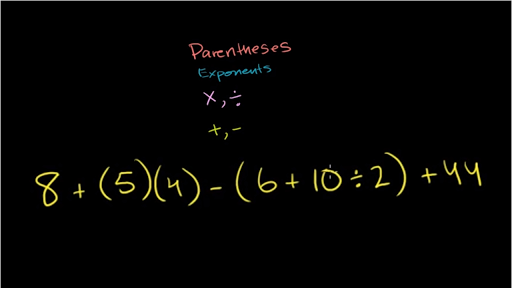
A more accurate way to say the rule is not “multiplication before division” or “addition before subtraction.” Instead:
- Multiplication and division have equal priority. Work left to right.
- Addition and subtraction have equal priority. Work left to right.
For example:
Division and multiplication are tied, so begin with the operation farthest left:
It would be incorrect to multiply and first. That would change the structure of the original expression.
Similarly:
Subtraction and addition are tied, so calculate left to right.
Grouping symbols and exponents
Parentheses, brackets, and braces are grouping symbols. They tell you that the material inside belongs together. Evaluate grouped material before operations outside it.
For nested grouping, work from the innermost group outward.
Start with the innermost parentheses:
Then simplify the brackets:
Finally, add and subtract from left to right:
Notice that parentheses can mean two different things depending on context:
- In , they group .
- In , they indicate multiplication: .
Adjacent factors also indicate multiplication:
Exponents come after grouping symbols but before ordinary multiplication, division, addition, and subtraction. An exponent tells you to multiply a base by itself repeatedly:
Compare these two expressions carefully:
In the first expression, the exponent applies only to . In the second, the parentheses make the entire base. Parentheses change the meaning.
Here is a full numerical example:
First handle the grouped expressions. Inside the second parentheses, division comes before addition:
Now simplify the remaining parentheses:
Addition and subtraction are now all that remain, so work left to right:
The value of the expression is:
A useful working habit is to rewrite the entire expression on each line, changing only the piece you evaluated. This makes lost negatives, skipped terms, and incorrect order much easier to catch.
Evaluating expressions with variables
A variable is a letter that represents a number. In an expression such as
the value depends on the value assigned to . To evaluate it when , substitute for every :
The parentheses in are important: they show that is multiplied by the substituted value.
2.2 Evaluate, Simplify, and Translate Expressions
Read the opening portion of OpenStax’s “Evaluate, Simplify, and Translate Expressions” to reinforce the substitution process, including expressions with multiple variables and exponents.
In the subsection “Evaluate Algebraic Expressions,” read from the definition of evaluation through Examples 2.13–2.18. Focus on the sequence: substitute each specified value, use parentheses around the substituted number when multiplication is implied, and only then apply the order of operations. Pay particular attention to the example that distinguishes a variable with an exponent from an exponent applied after a negative sign.
A careful substitution example
Evaluate the expression below when and :
Step 1: Substitute every variable value. Because is negative, use parentheses:
Step 2: Evaluate the exponent.
Step 3: Multiply.
Step 4: Subtract.
The parentheses around ensured that the exponent applied to the negative value as a whole.
Multiple variables
Evaluate:
when , , and .
Substitute every value:
Multiply:
Subtracting a negative is addition:
The substitution step is not optional. You cannot evaluate a variable expression to one number until each variable has been assigned a value.
Common mistakes to prevent
| Mistake | Why it fails | Better habit |
|---|---|---|
| Calculating strictly from left to right | It ignores operation priorities. | Complete grouping, exponents, multiplication/division, then addition/subtraction. |
| Doing multiplication before division every time | They have equal priority. | For multiplication and division, move left to right. |
| Doing addition before subtraction every time | They also have equal priority. | For addition and subtraction, move left to right. |
| Forgetting parentheses when substituting a negative | The negative may no longer be treated as part of the number. | Write as wherever you substitute it. |
| Treating as | Adjacent factors mean multiplication. | Read as “three times .” |
| Removing terms while rewriting | The expression has been changed. | Copy the whole expression each line and alter only the evaluated part. |
Before accepting a final answer, use this quick check:
- Did I substitute every variable?
- Did I use parentheses around negative substitutions?
- Did I calculate exponents before ordinary multiplication?
- Did I work multiplication/division and addition/subtraction left to right?
- Does the size and sign of my answer seem reasonable?
Key takeaways
To evaluate an expression:
- Substitute the given values for variables.
- Simplify grouping symbols from the inside outward.
- Evaluate exponents.
- Multiply and divide from left to right.
- Add and subtract from left to right.
PEMDAS is a useful memory aid, but the most important detail is that and are tied, as are and . Negative substitutions deserve parentheses so the expression’s meaning stays intact.
Next, you will use these same order-of-operations habits while solving multistep linear equations with variables on both sides.