Recommended resources
The freely available resources this lesson will direct you to.
Introduction
Hello, and welcome back. In our last lesson, we dissected W.V.O. Quine's attack on the first "dogma of empiricism"—the distinction between analytic and synthetic truths. We saw him argue that the idea of truth "by virtue of meaning alone" is a metaphor that cannot be given a clear, non-circular definition. This critique left the logical positivist program, which relied heavily on this distinction, on very shaky ground.
Today, we'll examine Quine's assault on the second dogma, reductionism, and explore the revolutionary picture of knowledge he proposed to replace the old empiricist framework. This lesson fulfills the learning outcome: Describe Quine's holistic 'web of belief' model of scientific theories.
Quine's model is not just a destructive critique; it's a constructive alternative with profound consequences. Instead of seeing knowledge as a building constructed brick-by-brick on a foundation of sense-data, Quine pictures it as a vast, interconnected web. This shift has massive implications for your specific interests in the philosophy of logic and mathematics, as it repositions them from being a special class of a priori truths to being deeply embedded, but revisable, parts of our total scientific theory.
1. The Second Dogma: Reductionism
The second dogma Quine attacks is reductionism. This is the belief that every meaningful statement can be translated into a statement (or a logical construct) about immediate experience. This was the central project of the logical positivists: to show how scientific language could be boiled down to a language of observation, thereby verifying its meaning.
Quine argues that this is just as misguided as the analytic-synthetic distinction. He proposes a counter-suggestion that has become one of the most famous ideas in 20th-century philosophy: confirmation holism.
The core idea of holism is that our statements about the world are not tested against experience one by one. Instead, they face the "tribunal of experience" as a group, or a "corporate body."
Willard V. O. Quine - Two Dogmas of Empiricism
This first video introduces the second dogma, reductionism, and Quine's holistic counter-suggestion. It sets the stage for understanding why a new model of knowledge is needed once we abandon the idea that sentences can be tested in isolation.
Watch the clip from 43:22 to 45:16. Focus on the core contrast Quine draws between the reductionist view (each statement is testable individually) and his own 'counter suggestion' that statements face experience 'only as a corporate body'.
This rejection of sentence-by-sentence verification leads directly to Quine's alternative model. If sentences are not tested individually, how is our knowledge structured and how does it relate to experience?
2. The Web of Belief Metaphor
Quine’s answer is a powerful metaphor: our knowledge is a "man-made fabric," a "field of force," or, most famously, a web of belief.
Let's visualize this model first.
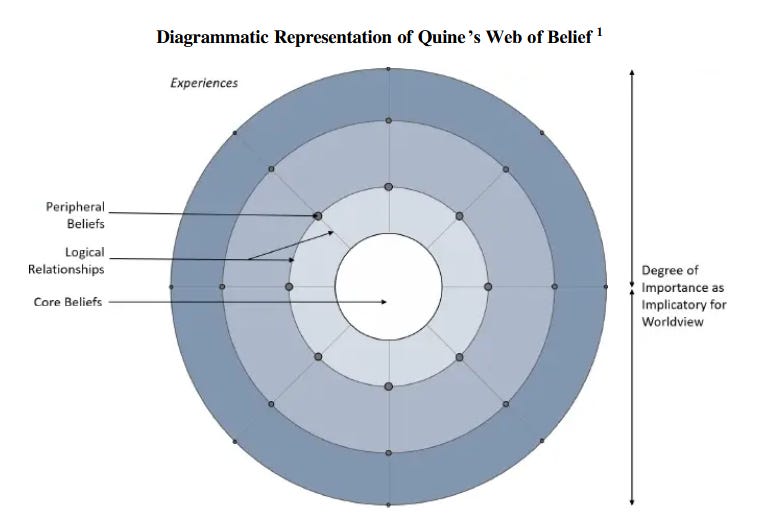
The key components of this web are:
- The Periphery: The outer edges of the web consist of beliefs that are most directly related to sensory experience. These are specific statements about observations, like "The needle on this dial is pointing to 7."
- The Core (or Center): At the heart of the web are our most general and fundamental beliefs. These include the laws of logic, mathematical truths, and the most abstract principles of physics.
- Interconnections: Beliefs are not isolated points; they are connected to each other by logical rules and explanatory relationships. A belief about physics might depend on a mathematical theorem, which in turn depends on the laws of logic.
- Experience at the Boundary: Experience makes contact with the web only at the periphery. A new observation doesn't directly challenge a law of logic; it challenges a peripheral belief.
The following reading from the Stanford Encyclopedia of Philosophy explains how this holistic picture accounts for the special status we grant to logic and mathematics without calling them analytic.
Willard Van Orman Quine - Stanford Encyclopedia of Philosophy
This text explains how Quine's holism provides an alternative to the analytic/synthetic distinction. It clarifies why logic and mathematics are at the center of the web and why they appear necessary.
Read the subsection titled '3.2 Quine’s Alternative'. Focus on how the web metaphor explains the apparent 'necessity' and 'a priori' status of truths like those in arithmetic. Why are we so reluctant to revise them?
3. How the Web Responds to Experience
The real power of the web of belief model comes from how it explains scientific change. What happens when we have a "recalcitrant experience"—an observation that conflicts with a prediction made by our web of beliefs?
According to the old reductionist view, that observation would falsify a specific statement. But in Quine's holistic model, the conflict creates a tension across the entire system. The observation tells us that something is wrong, but it doesn't tell us what. We have a choice about which belief(s) to revise to restore consistency.
This leads to two of Quine's most radical claims:
- "Any statement can be held true come what may, if we make drastic enough adjustments elsewhere in the system."
- "Conversely, by the same token, no statement is immune to revision."
This means that if we are faced with an experience that seems to contradict a cherished belief, we can always choose to save that belief by instead revising some other belief—perhaps by claiming our measuring instruments were faulty, or that we were hallucinating, or even, in an extreme case, by modifying a law of logic.
The following video provides an excellent, extended example from the history of science that illustrates this process of adjustment perfectly.
Quine: Two Dogmas of Empiricism
This segment explains how our 'total theory' confronts experience. It uses a memorable example from the philosopher of science Imre Lakatos about a 'planetary misbehavior' to show the range of choices a scientist has when an observation contradicts a theory.
Watch from 41:39 to 57:11. As you watch, pay close attention to the planetary misbehavior example. List the different revisions the Newtonian physicist considers to save Newton's theory from the conflicting observation. Notice how even the most fundamental beliefs are, in principle, up for revision.
4. Pragmatic Criteria for Revision: The Virtues of a Hypothesis
If any statement can be revised, how do we decide which one to alter? If a physicist can save Newton's laws by inventing a cloud of cosmic dust, doesn't that make science arbitrary?
Quine's answer is that our choices are not arbitrary; they are pragmatic. We are guided by a desire to maintain the web's overall predictive power and simplicity. We try to make the minimum revision necessary to accommodate the new experience while preserving as much of the web's structure as possible.
In their book, The Web of Belief, Quine and his co-author J. S. Ullian outlined five "virtues" that guide our choice of which hypothesis to revise. These virtues are the pragmatic principles that govern the evolution of our web of belief.
This chapter from Quine and Ullian's classic book, The Web of Belief, is the most direct and accessible source for understanding the pragmatic principles that guide scientific reasoning within Quine's model.
Read Chapter VI, 'Hypothesis' (starts on page 38). Focus on understanding the five virtues Quine and Ullian propose for a good hypothesis. As you read, think about how the Newtonian physicist in the Lakatos example was (or was not) applying these virtues. Conservatism: Disturb prior beliefs as little as possible. Modesty: Don't be more extravagant than you need to be. (Also related to Ockham's Razor). Simplicity: Prefer the simplest theory. Generality: Prefer theories that explain more phenomena. Refutability: The new theory must still be testable and not ad hoc.
These virtues are not absolute rules but guiding principles. When faced with a recalcitrant experience, we try to make a revision that scores highest on this combined set of virtues. Revising a law of logic scores very low on conservatism because it would force a chaotic revision of the entire web. Claiming a measurement was slightly off scores much higher. This is why core beliefs are revised so rarely—not because they are a different kind of truth, but because the pragmatic cost of revising them is astronomically high.
Test your understanding!
Imagine astronomers observe a distant star that appears to be in two places at once, contradicting the well-established belief (A) that a single object can only be in one place at a time. They consider two possible revisions to their web of belief:
- Revision 1 (Local): They hypothesize that there is an undiscovered massive object (like a black hole) between us and the star, whose immense gravity is bending the star's light, creating a gravitational lens effect. This explains the observation while keeping belief (A) intact.
- Revision 2 (Global): They hypothesize that belief (A) is false and that under certain quantum-gravitational conditions, macroscopic objects can exist in two places at once.
Using Quine's virtues (especially conservatism and simplicity), explain which revision scientists would likely prefer and why.
Show answer
Scientists would overwhelmingly prefer Revision 1.
-
Conservatism: Revision 1 is far more conservative. It introduces a new object (a black hole) but preserves the fundamental logical/metaphysical belief (A) that an object has a unique location. This belief is at the core of our web, and revising it would have vast, unpredictable consequences for physics and our everyday understanding of objects. Revision 2, by contrast, sacrifices a core belief, which is a radical, non-conservative move.
-
Simplicity/Modesty: At first glance, Revision 2 might seem simpler because it doesn't add a new object to our ontology. However, the "simplicity" Quine values is about the overall theoretical system. Revision 2 would require creating an entirely new, incredibly complex physics to explain when and how this "two places at once" phenomenon occurs, while Revision 1 uses the already-existing and well-understood framework of general relativity. Therefore, Revision 1 is the simpler and more modest adjustment to the overall theory.
In short, Revision 1 accommodates the recalcitrant experience with minimal disturbance to the web of belief, making it the superior choice on pragmatic grounds. Revising the core belief (A) would only be considered if Revision 1 (and all other conservative alternatives) repeatedly failed to explain subsequent observations.
Conclusion
Quine's web of belief presents a holistic and pragmatic picture of knowledge that stands in stark contrast to the foundationalist and reductionist views of the logical positivists. By dissolving the firm boundary between analytic and synthetic truths, he placed everything—from the most casual observation to the most abstract laws of mathematics—into a single, interconnected system.
Key Takeaways:
- Quine rejects reductionism (the second dogma), arguing that statements are not confirmed or disconfirmed in isolation.
- He proposes a holistic model where our knowledge forms a web of belief (or field of force).
- Core beliefs (logic, math) are at the center, insulated from experience, while peripheral beliefs are at the edge, in direct contact with experience.
- A recalcitrant experience creates tension in the web, forcing a revision, but logic does not dictate which belief must be revised.
- The choice of revision is pragmatic, guided by virtues such as conservatism, simplicity, and generality, which aim to maximize the explanatory power of the web while minimizing disruption.
- No statement, not even a law of logic, is in principle immune to revision.
Preview of the next lesson:
Having now examined Quine's critique of both of empiricism's dogmas and his own alternative model, we are in a position to make a direct comparison. The next lesson's objective is to contrast the positivist view of language with Quine's holistic empiricism, summarizing the profound shift in thinking that Quine initiated in analytic philosophy.