Recommended resources
The freely available resources this lesson will direct you to.
Introduction
In our last lesson, we explored the fundamental mechanics of Large Language Models: tokens, context windows, and the sampling parameters like temperature that control output generation. We established that LLMs are probabilistic systems, designed to predict the next most likely token based on the patterns they've learned. This probabilistic nature is what makes them powerful, but it's also the direct source of their most significant operational risk: hallucination.
This lesson will demystify this critical topic. Your goal is to be able to articulate the primary causes of LLM hallucinations and, more importantly, to identify the specific conditions within your document-intensive insurance workflows where this risk is most acute. Understanding this isn't just a technical exercise; it is fundamental to designing a robust system, managing executive and regulatory concerns, and challenging vendor claims. We will explore what hallucinations are, why they are a predictable outcome of how LLMs work, and where to look for them in your HNW new business process.
1. What Are Hallucinations?
First, let's establish a clear, business-focused definition. An LLM hallucination occurs when the model generates information that is confident-sounding and fluent, but is factually incorrect, nonsensical, or not grounded in the provided source material.
It is crucial to understand that this is not the AI equivalent of a malicious human lie. As the article from Roots.ai explains, hallucinations are not a sign of the system "running amok" but a predictable result of its design—generating probable answers, especially when faced with ambiguity.
AI Hallucinations in Insurance Workflows: What They Are, Why They ...
This article provides an excellent, non-technical introduction to hallucinations from an insurance industry perspective.
Read the introduction from the beginning to understand why hallucinations are a workflow design issue, not a mysterious bug. Then, review the section "What Are Examples of AI Hallucinations?" to see how this problem manifests in your specific domain.
The article provides excellent examples, such as an AI referencing a policy exclusion that doesn't exist or inventing a coverage limit. To build a more structured vocabulary for discussing these errors, we can categorize them.
Why Large Language Models Hallucinate
This video from IBM Technology breaks down hallucinations into four distinct types. Having this framework will help you classify and report on errors during your project's testing phase.
Watch the segment from the discussion of hallucination types. The video covers sentence contradiction, prompt contradiction, factual contradictions, and nonsensical information.
The following diagram provides a useful summary of the common causes and types of LLM hallucinations.
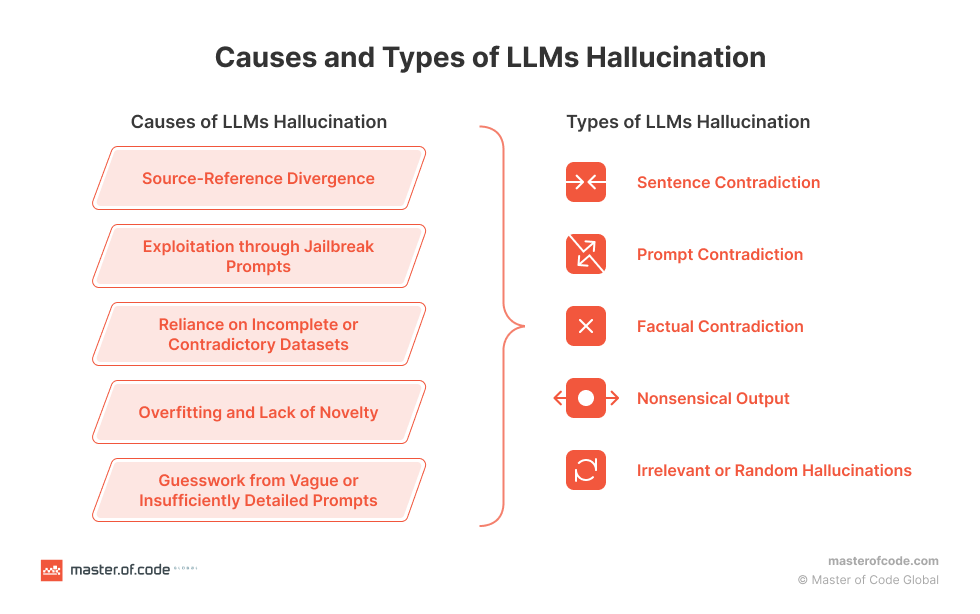
This image summarizes the primary causes of LLM hallucinations on the left and categorizes the resulting types of erroneous output on the right.
2. The Root Causes of Hallucination
Hallucinations are not random; they stem from a few core causes related to the model's architecture, its training data, and the instructions it's given.
Cause 1: Probabilistic Generation
As we discussed in the last lesson, LLMs are fundamentally pattern-completion engines. They generate text by predicting the most statistically likely next token. Their goal is coherence, not truth. This probabilistic nature means they will sometimes favor common words over exact transcription or even "correct" what they perceive as errors in a source document.
For a deeper look into how this plays out during document processing, the following article is insightful. It focuses on the challenges of using LLMs for Optical Character Recognition (OCR), a core task for your Document Ingestion Agent.
Why LLMs Suck at OCR | Pulse AI
This article from Pulse AI explains how the internal workings of LLMs lead to errors in data extraction tasks.
First, read the section "How Do LLMs 'See'" to understand that the process of converting an image to a format the LLM can understand is "lossy by design." Next, review the section "Where Do Hallucinations Come From?" which directly links the probabilistic text generation to specific error types. Finally, look at the concrete examples of subtle substitutions the model might make.
The example of the model substituting "rn" for "m" or "l1lI" for "1111" is a perfect illustration of this principle. The model isn't "seeing" the characters incorrectly; it's making a statistically plausible substitution based on its training, a substitution that could be catastrophic when processing a policy number or medical record ID.
Cause 2: Training Data Imperfections
LLMs are trained on vast datasets scraped from the internet, which are filled with biases, factual errors, and inconsistencies. The IBM video you watched earlier touched on this when mentioning that models are trained on sources like Reddit. If the training data is flawed, the model's responses will reflect those flaws.
Furthermore, the training data may not cover the specific, niche topics required for your use case. For example, a general model may have limited exposure to the specific wording of Hong Kong insurance regulations or the latest medical underwriting standards for a rare condition. When prompted on these topics, it may generalize from tangentially related information, effectively inventing a plausible-sounding but incorrect answer.
Cause 3: Ambiguous or Incomplete Inputs
This is the area where your system design has the most influence. Hallucinations are far more likely when the model is given unclear instructions or incomplete data. The Roots.ai article identifies three conditions that, when combined, create a perfect storm for hallucinations:
- Ambiguous or incomplete information: Insurance files are a prime example, full of unstructured notes, scanned forms with poor quality, and handwritten text.
- Diffuse or underspecified instructions: If a prompt is vague (e.g., "Summarize this case"), the model has too much freedom and may fill in gaps with fabricated details. This highlights the importance of precise prompt engineering, which we will cover in a later lesson.
- No explicit stopping rules: Models are trained to be helpful and provide an answer. If the system is not explicitly designed to allow "I don't know" or "Information not found" as a valid response, the model will continue generating tokens to create a coherent-looking answer, even if it has run out of factual information.
This third point is often visible as a "hallucinate at the last" problem, where a response starts factually correct but devolves into nonsense as the model is forced to keep generating text beyond its knowledge.

This diagram illustrates how an LLM's response can start with high factual accuracy and then suddenly degrade into hallucination as it continues generating text beyond its grounded knowledge.
3. Hallucination Risk in Your Insurance Workflow
Now, let's apply this understanding directly to your agentic orchestration layer. Identifying these specific risks is the first step toward building the necessary guardrails.
Document Ingestion and Medical Evidence Agents
These agents are on the front line, dealing with complex, multi-modal documents. Their reliability is paramount, as a single data extraction error can corrupt the entire downstream process. The primary risk here is not just basic OCR mistakes but a failure to understand visual and structural context.
Agentic Document Extraction | Intelligent Document Understanding with Visual Context
This video from LandingAI explains why traditional text extraction from documents is insufficient and leads to errors. It highlights the importance of visual context, which is directly relevant to your agents parsing insurance forms and reports.
Watch the first section of the video, from the explanation of traditional methods. Pay close attention to the mention of checkboxes, tables, and flowcharts, as these are common elements in insurance and medical documents.
As the video explains, simply extracting text while ignoring layout can lead to "incorrect, partial, or even hallucinated" answers. Consider these specific risks for your agents:
- Financial Assessment Agent: A misplaced decimal point in a financial statement (e.g.,
$1,234.56becomes$123456), as noted in the Pulse AI article, would completely invalidate a source of wealth calculation. - Medical Evidence Agent: Misinterpreting a dosage (
0.5mgbecomes5mg) from a scanned lab report could lead to a grossly incorrect risk assessment. Similarly, if the agent fails to correctly parse a table of lab results, it might associate the wrong value with a given test. - Document Ingestion Agent: Failing to recognize that a checkbox for "smoker" is ticked on a scanned application form is a hallucination of omission, with major underwriting implications.
These are not simple text errors; they are failures of visual and structural understanding, which is a known weak point for LLMs that are primarily trained on sequential text.
Underwriting and Compliance Agents
These agents rely on the data provided by the upstream agents and are tasked with applying rules and generating narratives.
- Underwriting Decision Agent: The greatest risk is ambiguity. If this agent is built on a general-purpose LLM without strict grounding (a topic we'll cover in depth with RAG), it might interpret an underwriting rule instead of strictly applying it. For instance, if a guideline is unclear about a specific combination of risk factors, the agent might hallucinate a precedent or a rule that doesn't exist, leading to an incorrect decision (e.g., approve, decline, apply a loading).
- Compliance/EDD Agent: When screening for adverse media, the agent might find articles about two different individuals with the same name and blend details from both, creating a composite, hallucinatory narrative that wrongly implicates your HNW client. This is an "entity linking" failure, where the model incorrectly assumes two mentions refer to the same person.
Conclusion
This lesson has established that LLM hallucinations are not a random curse but a direct consequence of their probabilistic design and training. You are now equipped to articulate the primary causes: the statistical nature of token generation, flaws in training data, and ambiguous inputs.
Most importantly, you can now identify the specific, high-risk conditions in your own initiative:
- Data Extraction from Complex Documents: The process of converting 2D visual documents into 1D text is "lossy," creating risks of subtle but critical errors in financial and medical data. Your agents need to be designed to account for this, not just assume the LLM "sees" the document perfectly.
- Ambiguity in Source Material: Vague policy language, incomplete case files, or unclear prompts create vacuums that LLMs are designed to fill, often with fabricated information.
- The Mandate to Always Answer: Without explicit instructions to stop or escalate when uncertain, an agent will generate a plausible but potentially false response.
Recognizing these risks is the first step. Your role as the initiative leader is not to eliminate hallucinations entirely—an impossible task—but to design a system that anticipates them and mitigates their impact through robust architecture, clear instructions, and human oversight.
In our next lesson, we will begin exploring the first layer of mitigation: model selection. We'll discuss the difference between large foundation models and smaller, fine-tuned models, and how to choose the right tool for the right job to manage both risk and cost.