Recommended resources
The freely available resources this lesson will direct you to.
Hello! This module is about breaking whole numbers into prime factors, then using those factorizations to compare numbers. We’ll begin with factors and multiples, use divisibility tests to find useful factor pairs, and finish by writing numbers as products of primes. You do not need to be quick at this yet: the aim is to understand why each step works.
This lesson should take about 35–40 minutes, including the short resource and a few questions at the end.
Factors, multiples and prime numbers
If two positive whole numbers multiply to make a number, they form a factor pair of that number. For example, , so 3 and 5 are factors of 15. We can also say that 15 is a multiple of both 3 and 5. These are two ways of looking at the same multiplication fact.
A factor divides a number exactly, with no remainder. The factor pairs of 15 are and , giving it four factors: 1, 3, 5 and 15.
How to find the factors of a number - BBC Bitesize
Read the BBC Bitesize explanation of factor pairs to see how multiplication facts can be pictured as rectangular arrays.
In “How to find factors and factor pairs using arrays,” begin with factor pairs. Read through the example for 15, stopping before Example 2 about 9. Focus on why turning a 3 by 5 rectangle around does not create a new factor pair.
A prime number is a whole number greater than 1 with exactly two factors: 1 and itself. For instance, 7 is prime. A number greater than 1 with other factors is composite: 15 is composite because 3 and 5 divide it.
Two details are worth remembering:
- 1 is neither prime nor composite. It has only one factor, not two.
- 2 is prime, and it is the only even prime. Every larger even number is divisible by 2 as well as by 1 and itself.
A prime factor is simply a factor that is prime. The prime factors of 12 are 2 and 3. But if you want to write 12 as a product of prime factors, you must include every factor needed to make 12:
Writing would name its distinct prime factors, but it would only make 6.
Divisibility tests: finding a first split
To break a number into factors, you need a factor pair. Divisibility tests help you find one without trying every possible division.
| Divisible by | Quick test | Example |
|---|---|---|
| 2 | Last digit is even: 0, 2, 4, 6 or 8 | 84 is divisible by 2. |
| 3 | Sum of the digits is divisible by 3 | For 84, , so 84 is divisible by 3. |
| 5 | Last digit is 0 or 5 | 85 is divisible by 5. |
Two other useful checks are that a number is divisible by 9 when its digit sum is divisible by 9, and by 10 when it ends in 0. Remember that 9 and 10 are not prime. They can help you find a factor pair, but they cannot be final factors in a prime factorization.
For example, 91 is odd, and , so the tests for 2 and 3 do not find a factor. It does not end in 0 or 5 either. That does not prove 91 is prime: . A divisibility test can quickly find a factor; failing a few tests does not rule out every other factor.
Building a factor tree
A factor tree repeatedly splits a number into factor pairs until every number at the ends of its branches is prime. At each split, the two numbers must multiply to give the number above them. Do not split a number into 1 and itself: that would leave you where you started.
Watch the Cognito video for the method in action. Notice how it keeps track of repeated factors, rather than listing each different prime just once.
How to Use Prime Factor Trees to find Prime Factors
Watch “How to Use Prime Factor Trees to find Prime Factors” by Cognito. It shows the difference between naming prime factors and writing the complete product, followed by two worked trees.
Watch the meaning of prime factors and the example with 12. Then follow the factor tree for 220, paying particular attention to why two different starting splits give the same final primes. Finish with the second example for 112 and its repeated factors of 2.
Here is a smaller pair of trees to inspect. In each tree, read all the numbers at the ends of the branches; the circle colours do not change which numbers are prime.
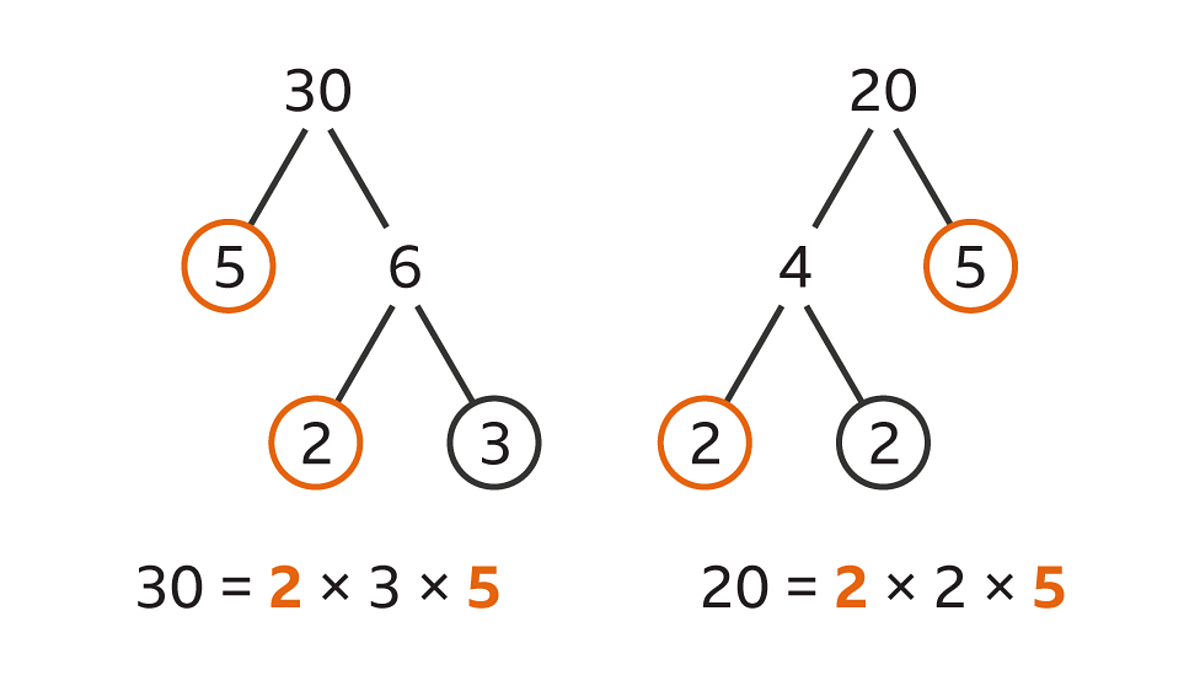
So , while . Both contain a 2 and a 5, but 20 needs a second 2 to make the correct product. We will use comparisons like this in the next lesson.
Your first split need not use a prime. You could split 30 into or ; continue splitting the composite branches and you reach the same prime factors.
From the tree to a checked answer
Let’s factorize 90 step by step. Its last digit is 0, so dividing by 2 is an easy start:
- . The 2 is prime, but 45 needs splitting.
- . The 5 is prime, but 9 needs splitting.
- . Both 3s are prime.
Now collect every final prime factor, usually in numerical order:
The repeated 3s can be shortened using a power:
Here means , not . This is just a compact way to record repeated multiplication; powers will receive more attention later in the course.
Always multiply back to check. In this case, . That check catches a common mistake: correctly identifying which primes appear but accidentally missing one of their repetitions.
If the number you start with is already prime, such as 13, there is nothing to split. Its prime factorization is simply 13.
Your turn: check understanding before moving on
Try these in order, showing either a factor tree or a series of valid factor pairs. For each product, check that it multiplies back to the starting number.
- List the factor pairs of 18. Which of its factors are prime? Then write 18 as a product of prime factors.
- Write 45 as a product of prime factors, first with every factor shown and then using a power.
- Write 84 as a product of prime factors. State which divisibility test helped you choose your first split.
- GCSE-style reasoning: A student writes . Multiply their factors to check the claim, then give the correct prime factorization of 180 and explain what went wrong.
Send your answers, including any steps you are unsure about. I’ll check the reasoning and explain mistakes before we move on.
What to keep in mind
A factor divides exactly; a multiple is a result in a number’s multiplication table. To write a positive integer as a product of prime factors, use divisibility tests to find factor pairs, keep splitting until every branch ends in a prime, and include repeated primes as many times as they occur. Finally, multiply your answer back to check it.
Once these factorizations feel secure, the next lesson will use them to find the highest common factor and lowest common multiple of two numbers.