Recommended resources
The freely available resources this lesson will direct you to.
Hello. In the previous lesson, you evaluated a single product opportunity: the customer problem, evidence, prioritization, outcome metrics, and the appropriate level of roadmap commitment.
This lesson moves up one level. A portfolio recommendation asks: Across several markets, product lines, or strategic arenas, where should we place our limited investment—and where should we deliberately reduce, redirect, or stop? For a Director, this is not an abstract corporate-strategy exercise. It is how product, engineering, sales, support, and finance receive a coherent set of priorities rather than a collection of individually reasonable requests.
By the end, you will be able to write a concise, decision-oriented portfolio recommendation that covers market attractiveness, ability to win, strategic choices, allocation, and continuation criteria.
From a good initiative to a coherent portfolio
A product opportunity recommendation might say:
“Fund a six-week validation effort for upgrade-readiness workflows.”
A portfolio recommendation must place that choice alongside competing uses of capital and leadership attention:
- Should the organization invest in managed cloud operations, sovereign deployments, core appliance modernization, or AI-assisted support?
- Which areas are attractive enough to justify investment?
- In which areas does the company have a credible advantage rather than merely a feature backlog?
- What will the organization not pursue?
- What evidence would cause it to increase, reduce, or end an investment?
The shift is important. A portfolio is not a list of products; it is a set of choices under constraint.
For an infrastructure organization, the units in a portfolio review might be:
- distinct product lines, such as an appliance, managed service, and observability product;
- customer or deployment arenas, such as regulated sovereign-cloud customers versus commercial cloud customers;
- major strategic bets, such as automation, expansion to a region, or a platform ecosystem;
- mature versus emerging offers that compete for the same engineering, sales, and support capacity.
Do not make the unit too small. A feature such as “add one dashboard” belongs in product prioritization. Do not make it so broad that no practical investment decision follows. “Enterprise infrastructure” is too broad. A useful unit has a defined customer, market, offer, and economic logic.
The key distinction is:
| Question | Portfolio-level answer |
|---|---|
| Is this a valuable customer problem? | It may be, but it must compete with other uses of capacity. |
| Can we deliver it reliably? | Delivery capability informs the recommendation but does not itself establish strategic value. |
| Where can we win? | In markets where customer value and our differentiated capabilities reinforce each other. |
| What should receive disproportionate investment? | Attractive arenas where the organization has, or can credibly build, a defensible advantage. |
| When do we stop? | When the strategic thesis, economics, or evidence fails to meet pre-agreed criteria. |
Your release-readiness and quality experience is especially relevant to the “ability to win” side of this analysis. Strong operational reliability, customer-escalation knowledge, upgrade expertise, and delivery discipline are genuine assets. But they become a competitive advantage only when they create distinctive customer value that is difficult for competitors to match—for example, lower operational risk, faster time to production, or trusted support during high-stakes changes.
Strategy requires choices, not an all-purpose improvement plan
Before using a matrix or scoring model, establish a disciplined view of strategy. Improving engineering efficiency, quality, and delivery speed is necessary. It is not automatically a strategy.
Read selected passages from Michael Porter’s “What Is Strategy?” in Harvard Business Review. The article will help you distinguish operational excellence from strategic positioning, and will give you language for making explicit choices and trade-offs in a portfolio recommendation.
In Section I, “Operational Effectiveness Is Not Strategy,” read the distinction between doing comparable work better and creating a strategically different position. Then, in Section II, “Strategy Rests on Unique Activities,” read the Southwest example. Focus on the point that a customer segment alone is not an advantage; the company needs a tailored system of activities that delivers a distinctive value proposition. Finally, in Section III, “A Sustainable Strategic Position Requires Trade-offs,” read the trade-offs discussion. Note the practical implication for a portfolio memo: every recommendation should clarify what the organization will not fund, build, or attempt in the planning horizon.
A strategy is not “be excellent at cloud, AI, security, support, and on-premises infrastructure.” That is an aspiration. Strategy makes choices such as:
- Focus the managed platform on highly regulated enterprises that need auditable operations and controlled upgrades.
- Use the installed base to fund migration and modernization rather than trying to win every greenfield deal.
- Enter a sovereign deployment segment only where the organization can obtain required certifications and build credible local partners.
- Defer broad AI features until there is customer evidence, data access, and a differentiated workflow—not merely general market excitement.
A strong portfolio creates fit: product capabilities, reliability practices, commercial model, partner ecosystem, talent, and customer segment reinforce one another. A weak portfolio spreads investment across unrelated requests and hopes aggregate activity will become strategy.
Assess two things separately: market attractiveness and ability to win
A useful portfolio screen evaluates each strategic arena on two independent dimensions:
- Market attractiveness: Is this market capable of creating economic and strategic value over the planning horizon?
- Ability to win: Does the organization have a credible and sufficiently differentiated position in that market?
The Bain sector-screen below expresses the idea in a simple two-by-two form.
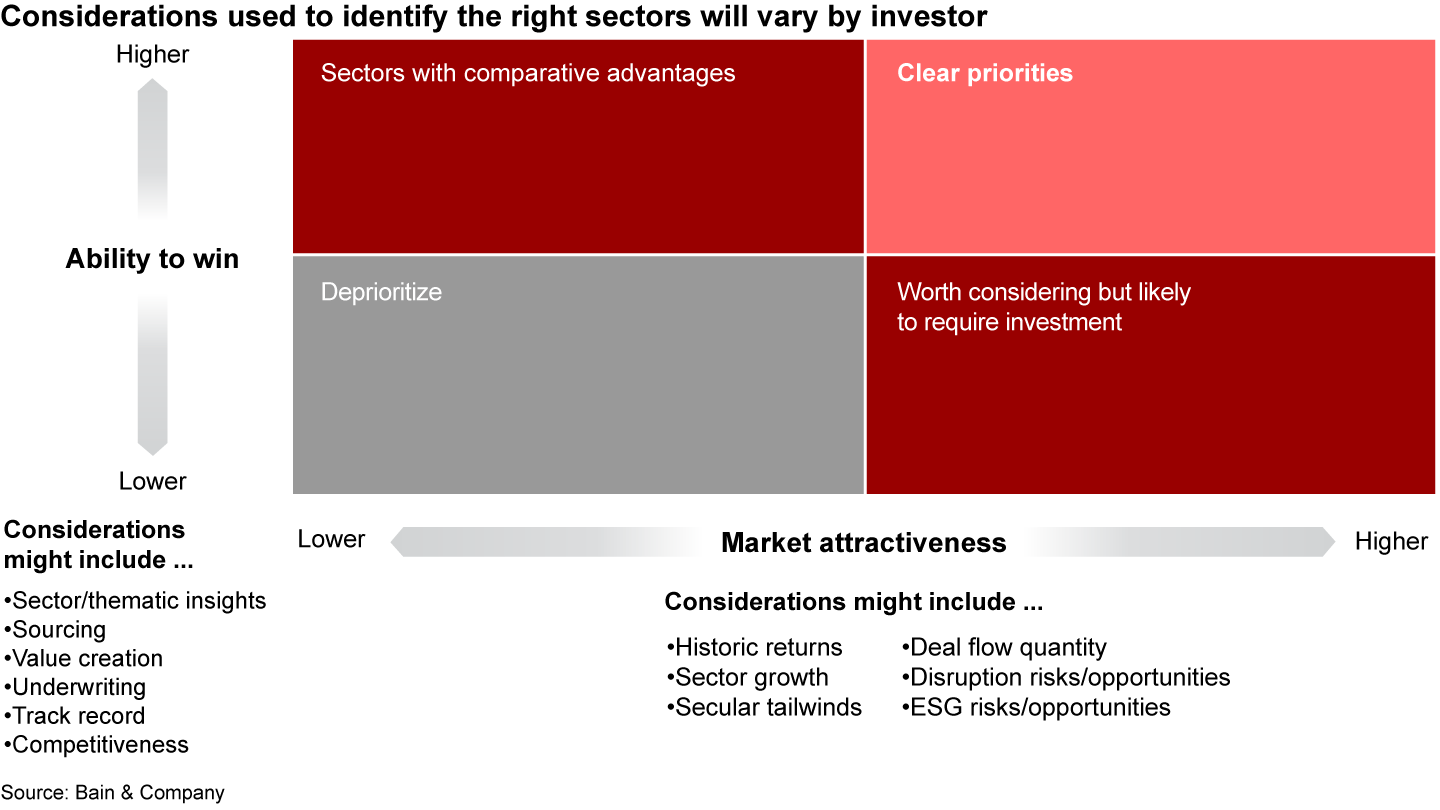
The exact orientation of axes can vary by framework. The important point is not whether attractiveness is vertical or horizontal; it is to keep the two judgments distinct.
- High attractiveness and high ability to win are clear investment priorities.
- High attractiveness but lower ability to win may justify a selective bet to close a specific gap, form a partnership, or acquire capability—but not an unlimited “catch up” effort.
- Lower attractiveness but high ability to win can be a valuable cash-generating or customer-retention business, but normally should not absorb most growth investment.
- Low attractiveness and low ability to win should be minimized, harvested, or exited unless a compelling strategic dependency exists.
GE McKinsey Matrix Explained With Step-By-Step Guide
Watch “GE McKinsey Matrix Explained With Step-By-Step Guide” from Cascade Strategy for a compact overview of portfolio screening. Treat the matrix as a decision aid rather than an automatic answer: your evidence, strategic commitments, and risks still determine the final recommendation.
Watch the purpose for the portfolio-allocation problem the matrix addresses. Continue with the two axes to see how attractiveness and business strength connect to invest, selective-invest, and harvest decisions. Then watch the application steps. Focus on the sequence: define criteria, score consistently, plot the portfolio, and translate the result into actual investment choices.
Market attractiveness: evaluate the arena, not your internal enthusiasm
For infrastructure and enterprise software, market attractiveness should include more than market size or growth. A large market can still be unattractive if buyers have extreme negotiating power, switching is easy, margins are weak, or differentiation is rapidly copied.
A practical scorecard can use five criteria:
| Market-attractiveness criterion | Director-level question |
|---|---|
| Demand and growth | Is the target segment growing, stable, or declining over the next two to three years? |
| Customer economics and urgency | Is the problem costly or risky enough that customers will adopt and pay for a solution? |
| Profit pool quality | Are margins, retention, and recurring revenue potential attractive after delivery and support costs? |
| Competitive structure | How intense are rivalry, substitutes, pricing pressure, and customer bargaining power? |
| External tailwinds and constraints | Do regulations, cloud adoption, cybersecurity needs, or regional requirements create opportunity or friction? |
For example, a sovereign-cloud infrastructure offering may score high on demand because regulation and data-residency requirements are increasing. Yet it may also involve long sales cycles, certification costs, local operations, and powerful procurement buyers. The conclusion should not be “high growth, therefore invest.” It should be a more nuanced judgment: attractive, but only if the company can meet the operating and certification requirements efficiently enough to earn an adequate return.
Ability to win: evaluate a system, not a slide of strengths
“Strong brand,” “great people,” and “excellent technology” are insufficient evidence. Ability to win should identify why the organization can create customer value better than alternatives.
Use criteria such as:
| Ability-to-win criterion | Evidence to seek |
|---|---|
| Customer trust and installed-base access | Renewal patterns, reference customers, adoption in target accounts, expansion opportunities |
| Differentiated product and operational capability | Unique automation, performance, reliability, security controls, or operational expertise |
| Cost and delivery position | Cost to deploy and support, implementation speed, service efficiency, repeatable delivery model |
| Ecosystem and route to market | Partners, cloud marketplaces, integrators, account coverage, regional access |
| Talent and organizational readiness | Product, engineering, security, support, and commercial capabilities required to execute |
| Evidence of momentum | Win-loss data, pipeline quality, product adoption, reliability outcomes, customer advocacy |
A capability must connect to the customer’s reason to choose you. For example:
- “We have strong release-readiness capability” is an internal claim.
- “We reduce disruption during mission-critical upgrades through tested lifecycle automation, known-issue intelligence, and accountable expert support” is a customer-facing advantage hypothesis.
- “Customers renew at higher rates and report fewer upgrade-related incidents than comparable alternatives” is evidence supporting that hypothesis.
For a simple first pass, score each criterion from 1 to 5 and calculate a weighted composite:
Here, is the agreed weight of a criterion and is the score for that arena. Weights for each axis should total 100 percent.
Do not disguise judgment as precision. A score of 3.7 is not “true” merely because it has a decimal. It is useful only if the team can explain:
- what evidence supports the score;
- which assumptions could change it;
- what capability gap prevents a stronger position;
- what investment would move the score; and
- whether that move is worth the opportunity cost.
Keep confidence in evidence as a separate field. A high-attractiveness score based on two sales anecdotes is not the same as one supported by customer research, pipeline data, retention patterns, and external market signals.
Convert the assessment into strategic postures and allocation
The matrix does not tell you exactly what to do; it frames the decision. The strategic posture must specify the type and level of investment.
| Portfolio posture | What it means in practice | What it does not mean |
|---|---|---|
| Invest and grow | Add capacity, accelerate differentiated roadmap items, expand sales or partners, and set growth milestones. | Funding every adjacent request or accepting weak economics. |
| Selectively invest | Fund a defined capability gap, regional entry, segment, partner model, or proof point with clear milestones. | Open-ended catch-up spending. |
| Defend and optimize | Protect valuable customers and margins, improve efficiency, and invest selectively to maintain advantage. | Neglecting reliability, security, or essential modernization. |
| Harvest and migrate | Limit new investment, protect obligations, maximize cash or retention, and move customers to strategic offers. | Abruptly abandoning customers or creating unmanaged technical risk. |
| Exit or avoid | Stop new commitments and redeploy people and capital. | Ignoring contractual, reputational, or platform-dependency responsibilities. |
A portfolio recommendation must then assign resources. The allocation should cover the investment that matters to the decision, not just engineering headcount. Depending on the context, include:
- product and engineering capacity;
- cloud, tooling, and capital expenditure;
- security, compliance, and certification effort;
- go-to-market and partner investment;
- support, services, and migration capacity;
- leadership attention.
This connects directly to the prior lesson on resource allocation. The portfolio tells you which strategic buckets deserve capacity. The resource-allocation plan then determines which teams, hiring choices, budgets, and timelines will make that allocation real.
Worked example: an enterprise data-platform portfolio
Assume a fictional infrastructure company has four strategic arenas competing for next year’s incremental investment:
| Arena | Market attractiveness | Ability to win | Recommended posture | Investment share |
|---|---|---|---|---|
| Managed data-platform operations | High | High | Invest and grow | 45% |
| Sovereign and regulated deployments | High | Medium | Selectively invest | 25% |
| Legacy integrated appliance | Low | High | Harvest and migrate | 20% |
| AI operations assistant | Medium | Low | Validate narrowly | 10% |
| Total | 100% |
This is not four independent recommendations. It is a system of choices:
- The managed platform receives the largest share because the market is attractive and the company already has a credible reliability and lifecycle-management advantage.
- Sovereign deployments receive targeted funding because demand is attractive, but the company must first close identifiable gaps in certification, regional operations, and partner coverage.
- The legacy appliance remains important for current customers and cash generation, but its role changes: fund contractual reliability and migration tools, not broad net-new platform expansion.
- The AI assistant receives a small validation allocation, not a full roadmap commitment. It has potential but lacks proven customer demand, differentiated data access, and a validated operating model.
The recommendation must also make the “no” visible:
Do not fund broad geographic expansion for sovereign deployments before the required certifications and repeatable delivery model exist. Do not commit to a general-availability AI assistant until customer workflow evidence and data-governance controls support a differentiated use case. Do not build major net-new features for the legacy appliance unless they directly support retention, safety, or migration.
That is strategy. It is specific enough to guide trade-offs when a senior customer, sales leader, or engineering team requests an exception.
Continuation criteria: decide in advance how the portfolio will change
A recommendation is incomplete if it says only where to invest today. It should also define the conditions for continuing, increasing, redirecting, or stopping each bet.
Continuation criteria serve two purposes:
- They prevent a portfolio from becoming permanent because of sunk cost or political sponsorship.
- They make uncertainty manageable by defining what evidence will resolve it.
Good criteria combine three dimensions:
| Dimension | Question |
|---|---|
| Customer and commercial evidence | Are target customers adopting, renewing, expanding, or paying at the level assumed? |
| Ability-to-win evidence | Are we closing the stated capability gap or showing differentiated outcomes versus alternatives? |
| Economic and operational evidence | Can we deliver, support, secure, and scale the offer with acceptable cost and risk? |
For the fictional portfolio, continuation criteria could be:
- Managed operations: Continue growth investment if adoption in the target segment, retention, service reliability, and unit economics meet the agreed annual plan. Reduce expansion investment if delivery or support costs rise faster than recurring revenue.
- Sovereign deployments: Release the next funding tranche only after obtaining priority certifications, securing two credible reference deployments, and demonstrating a delivery model that meets margin and operational targets. If those conditions are not met by the review date, shift to a partner-led model or narrow the target geography.
- Legacy appliance: Maintain investment only while the installed base generates sufficient cash and migration opportunities, with service obligations and reliability protected. Stop discretionary new feature development unless it supports contractual commitments, security, or migration.
- AI operations assistant: Expand only if a limited customer cohort shows measurable reduction in diagnostic effort, acceptable data-governance controls, and sustained usage in the relevant operational workflow. Otherwise, discontinue or retain only reusable components.
Notice that each criterion links back to the original thesis. “Achieve 20 percent growth” alone is not enough if growth was assumed to come from a regulated segment that remains inaccessible. “Ship the feature” is not enough if the feature does not change customer behavior or operating economics.
Write the one-page recommendation
A good one-page recommendation is not a miniature strategy deck. It is a document that lets an executive decide what to do, understand why, and know how the organization will revisit the decision.
Use this structure:
| Section | Content |
|---|---|
| Decision requested | State the planning horizon and the approval required. |
| Portfolio scope and thesis | Define the arenas and the overarching strategic logic. |
| Attractiveness and ability to win | Give the evidence-based diagnosis, including major uncertainty. |
| Strategic choices | State the posture for each arena and what the organization will not do. |
| Investment allocation | Allocate 100 percent of the relevant incremental capacity, budget, or leadership attention. |
| Continuation criteria | Define milestones and conditions to scale, redirect, harvest, or exit. |
| Risks and governance | Name material risks, accountable owners, and the portfolio-review cadence. |
Here is an illustrative version in the style you should aim for.
Decision requested: Approve the FY planning portfolio for the enterprise data-platform group, allocating incremental investment across managed operations, sovereign deployment, legacy appliance migration, and AI operations validation. Review allocation quarterly and re-baseline after two quarters.
Recommendation and thesis: Allocate 45 percent of incremental investment to managed data-platform operations, 25 percent to sovereign and regulated deployments, 20 percent to legacy-appliance reliability and migration, and 10 percent to AI operations validation. The portfolio concentrates growth funding where customers value trusted, low-risk operations and where existing lifecycle, reliability, and support capabilities create a credible advantage. It uses the legacy installed base to fund migration rather than treating it as a growth platform.
Diagnosis: Managed operations are high attractiveness and high ability to win due to growing demand for reduced operational burden, established customer trust, and differentiated upgrade and lifecycle capability. Sovereign deployments are highly attractive but have only medium ability to win because certification, local operating readiness, and partner coverage are incomplete. The appliance business retains strong customer access but operates in a lower-growth market. AI operations assistance has medium market potential but weak evidence of differentiated customer value and unresolved data-governance constraints.
Strategic choices: Invest and grow managed operations. Selectively invest in sovereign deployments to close defined certification and delivery gaps. Harvest and migrate the appliance base while protecting reliability and contractual obligations. Validate, but do not broadly launch, the AI assistant. Do not pursue broad sovereign expansion before priority certifications and reference deployments are secured; do not fund major appliance features unrelated to retention, security, or migration.
Continuation criteria: Continue managed-operations expansion if target-segment adoption, retention, reliability, and unit economics remain on plan. Release the next sovereign-investment tranche only after required certification, two reference customers, and a viable delivery-cost model. Reduce appliance investment if cash generation and migration conversion fall below agreed thresholds. Expand AI funding only after design partners demonstrate measurable reduction in diagnostic effort, repeated workflow use, and approved data-governance controls.
Governance: Product, engineering, finance, sales, and support review evidence quarterly. Each arena has a named accountable executive; strategy owns portfolio coherence, while each arena owner owns its milestones and operating results.
Key takeaways
A portfolio recommendation is a decision about where the organization will concentrate, where it will be selective, and where it will say no.
- Assess market attractiveness and ability to win separately; growth alone is not attractiveness, and internal capability alone is not advantage.
- Define a credible advantage as a customer-relevant system of activities, evidence, and operating capability—not a generic list of strengths.
- Translate positions into explicit postures: invest, selectively invest, defend, harvest, or exit.
- Allocate finite capacity across the full portfolio rather than approving each initiative in isolation.
- State what the organization will not do; trade-offs make a strategy operational.
- Use continuation criteria to govern uncertainty and avoid sunk-cost investment.
- Write the recommendation so that an executive can see the decision, rationale, allocation, risks, and review conditions on one page.
The next module shifts from frameworks to Director-level leadership cases, beginning with a delayed infrastructure launch where customer commitments, reliability evidence, dependencies, and commercial pressure point in different directions.