Recommended resources
The freely available resources this lesson will direct you to.
Introduction
Welcome to our next lesson in the "Market Failures" module. In our previous session, we explored the Coase Theorem, which showed that private bargaining can sometimes resolve externalities efficiently if property rights are clear and transaction costs are low. However, we ended by noting the theorem's limits, particularly when large groups are involved, leading to issues like the free-rider problem.
Today, we will dive deep into that very issue. We'll examine a category of goods where the free-rider problem isn't just a potential obstacle but a defining feature: public goods. These are goods that private markets often fail to provide, such as national defense, lighthouses, or clean air.
Our learning outcome for this lesson is to define public goods using the concepts of non-rivalry and non-excludability, and explain the free-rider problem. We will break down these two characteristics, use them to classify different types of goods, and analyze why the market fails to supply public goods efficiently.
1. The Two Key Characteristics: Rivalry and Excludability
To understand what makes a public good unique, we first need a framework for classifying all goods. Economists do this using two simple but powerful criteria:
- Rivalry in Consumption: A good is rival if one person's use of it diminishes another person's ability to use it. A laptop is rival; if I am using it, you cannot use it at the same time.
- Excludability: A good is excludable if it is possible to prevent people who have not paid for it from consuming it. A ticket to a movie is excludable; the theater can stop you from entering if you don't have a ticket.
A good that is non-rival means one person's use doesn't affect another's (e.g., listening to a radio broadcast). A good that is non-excludable means you can't stop people from using it, even if they don't pay (e.g., a fireworks display).
To get a clear grasp of these concepts, let's watch a short introductory video.
This Khan Academy video provides a great, straightforward introduction to the concepts of rivalry and excludability.
Please watch the first minute and seventeen seconds of the video (00:00 - 01:17), which defines 'rival' and 'excludable' goods.
Now, let's deepen that understanding. The concept of non-rivalry has a crucial implication that will appeal to your analytical background: if a good is non-rival, the marginal cost of providing it to one more person is zero. Think about a software developer who has already created an application. The cost of letting one more person download it is virtually nothing.
This next video offers excellent examples to distinguish between these terms and introduces this idea of zero marginal cost.
Micro 6.3 Public Goods (Rival vs Non-rival and Excludable vs Non-excludable goods)
The following video from ReviewEcon gives more concrete examples and connects non-rivalry to the important concept of zero marginal cost.
Watch from 00:25 to 02:41. Pay close attention to: The distinction between a rival good (a donut) and a non-rival good (streaming music). The link between non-rivalry and zero marginal cost of production for an additional user. The difference between an excludable good (a concert) and a non-excludable good (a public fireworks display).
2. A Framework for Classifying Goods
With the concepts of rivalry and excludability in hand, we can now create a simple 2x2 matrix to classify all goods into four distinct categories. This framework is fundamental to identifying market failures.

Let's quickly define each category:
- Private Goods (Rival and Excludable): Most goods you buy are private goods—food, clothing, cars. Markets are generally very efficient at providing these.
- Club Goods (Non-Rival and Excludable): These are goods where consumption is non-rival, but access can be restricted. Examples include cable TV, streaming services like Netflix, and private golf courses. You can charge for them, but one person's use doesn't stop another's (up to a point of congestion).
- Common Resources (Rival and Non-Excludable): These are resources that are open to all (non-excludable) but are limited in supply (rival). A classic example is fish in the open ocean. Anyone can fish, but every fish caught is one less for someone else. We will explore this category in detail in our next lesson on the "Tragedy of the Commons."
- Public Goods (Non-Rival and Non-Excludable): This is our focus today. These goods are available to everyone and one person's use doesn't diminish another's. Classic examples are national defense and street lighting.
3. Public Goods and the Free-Rider Problem
Now we arrive at the central challenge. Because public goods are non-excludable, firms have no straightforward way to charge for them. If a private company provides a public good, individuals have an incentive to benefit from it without paying, hoping others will cover the cost. This is the free-rider problem.
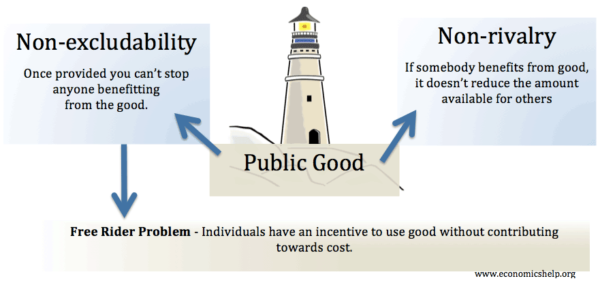
If everyone thinks this way, no one will pay, and the private firm will have no revenue to cover its costs. As a result, the private market will fail to produce the good, even if the total benefit to society (the sum of what everyone would be willing to pay) is far greater than the cost. This is a classic market failure.
The following video segment explains this dynamic and shows its impact on the market using a supply and demand graph.
Micro 6.3 Public Goods (Rival vs Non-rival and Excludable vs Non-excludable goods)
Let's return to the ReviewEcon video to see a clear explanation of the free-rider problem and how it leads to the underproduction of goods.
Please watch from 02:30 to 06:09. This segment will cover: The definition of a free-rider. How free-riding causes market demand to be artificially low, leading to underproduction and deadweight loss. The formal definition of a public good as being both non-rival and non-excludable, with national defense and tsunami sirens as key examples.
Because of the free-rider problem, public goods are typically provided or funded by the government through taxation. By requiring everyone to contribute via taxes, the government overcomes the free-rider incentive and can fund goods that are socially beneficial but not privately profitable.
4. Practice: Let's Classify
To make sure these concepts are clear, let's apply them. For each of the goods listed below, decide whether it is rival or non-rival, and excludable or non-excludable. Then, classify it into one of the four categories (Private, Public, Club, Common).
- A slice of pizza
- Public radio
- A congested public highway (during rush hour)
- An uncongested toll road
Think about your answers before revealing the solutions below.
Click to see the solutions
-
A slice of pizza:
- Rival: Yes. If I eat it, you can't.
- Excludable: Yes. You have to pay for it to get it.
- Classification: Private Good.
-
Public radio:
- Non-rival: Yes. My listening to the broadcast doesn't stop you from listening.
- Non-excludable: Yes. Anyone with a radio can tune in without paying.
- Classification: Public Good. (This is why they rely on donations and government funding, to fight the free-rider problem).
-
A congested public highway (during rush hour):
- Rival: Yes. Because it's congested, another car on the road slows everyone else down, diminishing the "good" (a quick commute).
- Non-excludable: Yes. You typically don't have to pay to enter a public highway.
- Classification: Common Resource. (This is why we see the "tragedy" of traffic jams).
-
An uncongested toll road:
- Non-rival: Yes. Because it's uncongested, one more car does not impact anyone else's travel.
- Excludable: Yes. You have to pay a toll to use it.
- Classification: Club Good.
Conclusion
In this lesson, we established a systematic way to think about different types of goods and identified the unique characteristics of public goods that lead to market failure.
Key Takeaways:
- Goods can be classified based on two characteristics: rivalry in consumption and excludability.
- A public good is defined as being both non-rival and non-excludable.
- The non-excludable nature of public goods creates the free-rider problem, where individuals can benefit without paying.
- Because of the free-rider problem, private markets will under-provide or fail to provide public goods entirely, even when they are socially valuable. This market failure often justifies government provision funded by taxes.
In our next lesson, we will shift our focus to the other category of non-excludable goods: common resources. We will explore the "Tragedy of the Commons," another famous market failure that explains why shared resources like fisheries, forests, and clean air are often overused and depleted.