Recommended resources
The freely available resources this lesson will direct you to.
- Monetary policy tools | Financial sector | AP Macroeconomics | Khan Academywww.youtube.com
- The Money Market - How Monetary Policy Works (OMOs, Reserve Requirements, Discount Rate)www.youtube.com
- Monetary Policy: Stabilizing Prices and Outputwww.imf.org
- Reading: Tools of Monetary Policy | Macroeconomicscourses.lumenlearning.com
Introduction
Welcome to your next lesson in our journey through money, banking, and monetary policy. In our last session, we mastered the mechanics of the simple money multiplier, calculating how an initial change in bank reserves can lead to a much larger change in the total money supply. We saw that the formula is the key to quantifying this potential expansion.
Today, we will build directly on that knowledge. Now that you understand the leverage the multiplier provides, we will explore how a country's central bank deliberately manipulates those initial reserves to steer the economy. Our learning outcome is to explain the role of a central bank and its primary monetary policy tools (open market operations, policy rates, and reserve requirements).
We will first examine the fundamental purpose of a central bank—its objectives and why it operates independently. Then, we will dissect the three main instruments it uses to conduct monetary policy, linking each one back to the money multiplier process you've just learned.
1. The Role and Objectives of a Central Bank
Before we look at the "how," let's understand the "why." What is a central bank's purpose? In most modern economies, the central bank is tasked with managing the nation's money supply and credit conditions to achieve broad economic goals. These often include maintaining stable prices (controlling inflation) and supporting maximum employment and economic growth.
An important feature of most modern central banks, like the U.S. Federal Reserve (the Fed) or the European Central Bank (ECB), is their political independence. To understand the reasoning behind this, please read the following brief article from the International Monetary Fund (IMF).
Monetary Policy: Stabilizing Prices and Output - IMF
This article, 'Monetary Policy: Stabilizing Prices and Output,' explains the core objectives of a central bank and the rationale for its independence.
Please read the sections titled 'Twin objectives' and 'Independent policy'. Focus on understanding the dual mandate (balancing price stability and output/employment) and the concept of 'time inconsistency' that motivates central bank independence.
As the article explains, central banks often walk a tightrope. Policies that boost short-term growth and employment can risk higher inflation, and vice versa. An independent central bank is better positioned to make the politically difficult decisions needed to maintain long-term price stability, free from the pressures of short-term electoral cycles.
2. The Primary Tools of Monetary Policy
To achieve its objectives, a central bank must be able to influence the amount of money and credit in the economy. It does this by changing the quantity of reserves in the banking system, which, as you know from our last lesson, triggers the money multiplier effect.
There are three primary tools a central bank uses to conduct monetary policy:
- Open Market Operations
- The Reserve Requirement
- The Discount Rate (and other policy rates)

We will now examine each of these in detail. The following video provides a comprehensive overview of how these tools work within the money market framework. We will watch it in segments as we discuss each tool.
Monetary policy tools | Financial sector | AP Macroeconomics | Khan Academy
The Khan Academy video 'Monetary policy tools' will be our main guide for this section. It clearly explains how each tool shifts the money supply and affects interest rates.
We will watch this video in three parts, corresponding to each of the monetary policy tools. For now, just be aware that this video will be our reference.
2.1. Open Market Operations (OMOs)
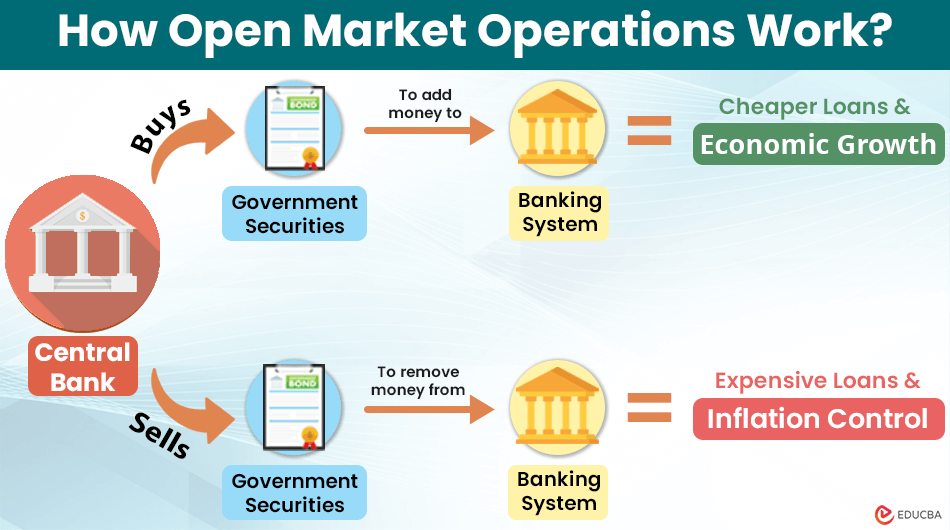
Open Market Operations are the most important and frequently used tool of monetary policy. OMOs involve the central bank buying or selling government securities (like government bonds) in the "open market" with commercial banks.
- To increase the money supply (Expansionary Policy): The central bank buys government securities from commercial banks. It pays for these securities by crediting the banks' reserve accounts. This injects new reserves into the banking system, which can then be loaned out, increasing the money supply via the money multiplier.
- To decrease the money supply (Contractionary Policy): The central bank sells government securities to commercial banks. Banks pay for these securities using their reserves, which are debited from their accounts at the central bank. This drains reserves from the system, reducing banks' ability to lend and causing the money supply to shrink.
Now, let's watch the segment of the Khan Academy video that explains this process.
Monetary policy tools | Financial sector | AP Macroeconomics | Khan Academy
This first segment focuses on Open Market Operations.
Watch the video from 02:02 to 06:22. Pay close attention to how buying bonds injects money into the system, lowering interest rates, and how selling bonds does the opposite. Notice the direct reference to the money multiplier, which you studied previously.
The diagram below provides a clear visual summary of this process.
Given your technical background, you might appreciate seeing how these transactions are reflected on a bank's balance sheet. The reading LINK, "Reading: Tools of Monetary Policy," provides excellent examples using T-accounts in the section titled "Open Market Operations." This is optional but recommended if you're curious about the accounting mechanics.
2.2. The Reserve Requirement
The reserve requirement is the percentage of deposits that banks are legally required to hold in reserve and cannot lend out. As you know, this variable (rrr) is the denominator in the money multiplier formula.
- To increase the money supply (Expansionary): The central bank could lower the reserve requirement. This does two things: it increases the value of the money multiplier (e.g., lowering
rrrfrom 20% to 10% changes the multiplier from 5 to 10) and it instantly transforms some required reserves into excess reserves, which banks can then lend out. - To decrease the money supply (Contractionary): The central bank could raise the reserve requirement. This reduces the money multiplier and forces banks to hold more reserves, possibly by reducing their lending to meet the new, higher requirement.
Let's watch the next segment of the video, which explains this tool.
Monetary policy tools | Financial sector | AP Macroeconomics | Khan Academy
This short segment explains the reserve requirement as a policy tool.
Watch the video from 06:22 to 07:11. Note how changing the reserve requirement directly changes the money multiplier.
In practice, central banks rarely change the reserve requirement. It is considered a blunt and disruptive tool, as even a small change can force banks to make sudden and significant adjustments to their lending operations. OMOs allow for much more precise and gradual adjustments.
2.3. The Discount Rate and Other Policy Rates
The third tool relates to the interest rate at which the central bank lends money directly to commercial banks.
-
The Discount Rate: This is the interest rate that commercial banks pay on short-term loans they take from the central bank's "discount window." Lowering the discount rate makes it cheaper for banks to borrow reserves, encouraging more lending and expanding the money supply. Raising it has the opposite effect. In the U.S., borrowing from the discount window is often seen as a last resort.
-
Policy Target Rate (e.g., the Federal Funds Rate): More importantly, the central bank usually sets a target for the interest rate at which commercial banks lend reserves to each other overnight. In the U.S., this is the Federal Funds Rate. The central bank doesn't directly set this rate, but it uses its primary tool—Open Market Operations—to adjust the supply of reserves in the banking system until the actual Federal Funds Rate moves to the target. Annoucements about the central bank "changing interest rates" are typically announcements about a change in this target rate.
This final segment of the video clarifies the distinction between these rates.
Monetary policy tools | Financial sector | AP Macroeconomics | Khan Academy
This final segment discusses the discount rate and clarifies its relationship with the more widely cited federal funds rate.
Watch from 07:11 to 08:37. Focus on the difference between the discount rate (loans from the Fed) and the federal funds rate (loans between banks), and understand that OMOs are the tool used to hit the federal funds rate target.
Conclusion
In this lesson, we have demystified the role and actions of a central bank. You now have a solid framework for understanding how monetary policy is conducted.
Key Takeaways:
- Role of a Central Bank: The primary role is to conduct monetary policy to achieve a dual mandate of stable prices and maximum employment. Its political independence helps it to make credible long-term decisions.
- Expansionary vs. Contractionary Policy: To expand the money supply and lower interest rates (expansionary), the central bank buys bonds, lowers the reserve requirement, or lowers the discount rate. To contract the money supply and raise interest rates (contractionary), it does the opposite.
- The Three Primary Tools:
- Open Market Operations: The buying and selling of government securities. This is the most common and precise tool.
- Reserve Requirement: Changing the percentage of deposits banks must hold. A powerful but rarely used tool.
- Discount Rate / Policy Rate: The discount rate is the rate for borrowing from the central bank. More importantly, the central bank sets a target for the interbank lending rate (like the Fed Funds Rate) and uses OMOs to achieve it.
Preview of the Next Lesson:
We have now established what the central bank's tools are and how they influence the money supply and interest rates. The next logical question is: so what? How do these changes in interest rates and the money supply actually affect the broader economy—things like GDP, unemployment, and inflation? In our next lesson, we will answer this by exploring the transmission mechanism of monetary policy, using the Aggregate Demand-Aggregate Supply (AD-AS) model to trace the effects of these policy actions on the entire economy.