Recommended resources
The freely available resources this lesson will direct you to.
Hello! Welcome to your third lesson in our exploration of Jonathan Swift.
In our last session, we examined the Glorious Revolution of 1688, a pivotal event that established a constitutional monarchy and fundamentally realigned the political landscape. We saw how the Whigs, once the opposition, became defenders of the new establishment, while the Tories, champions of hereditary monarchy, found themselves in the awkward position of being the opposition party, their loyalty often questioned.
Today, we will build directly on that foundation. Our learning outcome is to describe the core tenets and political conflicts between the Whig and Tory parties in Augustan England. We will move from the parties' origins to the substance of what they stood for and fought over during the reign of Queen Anne (1702-1714), the era of Swift's most intense political activity.
For you, with your deep background in political philosophy and economics, this is an opportunity to see how abstract principles manifest as concrete political and social divisions. We will explore a fundamental clash between two visions of society: one rooted in land, tradition, and hierarchy, and another based on commerce, finance, and a new concept of parliamentary power. Understanding this clash is the key to decoding Swift's powerful political pamphlets and satires.
This lesson should take you approximately 45 minutes to complete.
1. The Core Ideological Divide: Sovereignty and Succession
As we saw, the Glorious Revolution settled the immediate crisis of 1688, but it did not erase the fundamental philosophical differences between Whigs and Tories. These differences continued to define them throughout the Augustan age.
Whigs: Champions of the "Revolution Settlement"
The Whigs were the intellectual heirs of John Locke. They championed a constitutional monarchy where the monarch's power was limited by law and derived from a contract with the people, represented by Parliament. They were the staunchest defenders of the 1688 settlement and the subsequent Act of Settlement (1701), which secured the Protestant Hanoverian succession. For the Whigs, loyalty was not to a person (the monarch) but to a system of government that protected liberty and property.
Tories: Guardians of Monarchy and Tradition
While most Tories pragmatically accepted the outcome of 1688, they remained ideologically closer to the principles of hereditary right and a strong monarchy. They viewed the monarch as God's anointed ruler, not a parliamentary appointee, and were deeply uncomfortable with the Lockean idea of a right to resistance. This led to a critical weakness: their party was perpetually shadowed by Jacobitism—the sympathy for the exiled Catholic Stuart dynasty. Their Whig opponents never missed an opportunity to accuse them of treasonous loyalty to the "King over the water."
To deepen your understanding of this core philosophical split, please read the following brief excerpts.
Reading (8-10 minutes):
Whig and Tory--Historical Outline
- Author: Alok Yadav, George Mason University
- Focus on: Paragraphs [¶10], [¶11], and the quote from Swift in [¶27].
- What to look for: Note the explicit contrast between the Whig view of Parliament's right to determine succession ("the people" choosing their rulers) and the Tory adherence to "passive obedience and non-resistance." This directly echoes the philosophical debates you've studied between Locke and proponents of divine right. Pay special attention to Swift's own complex self-identification: "rank Tories in Government, & worse than Whigs in Church, whereas I was the first Man who taught & practised the direct contrary Principle." This reveals the nuance behind the party labels.
2. The Economic and Social Battleground: Land vs. Money
The ideological conflict between the parties was mapped directly onto a fierce social and economic rivalry. This was, in essence, a struggle between old and new forms of wealth and power.
Tories: The "Landed Interest"
The Tory party was the party of the landed gentry and aristocracy. Their wealth was tangible, rooted in vast agricultural estates that had defined English power for centuries. They were socially conservative, deeply tied to the rhythms of country life and the hierarchy of the Anglican parish. They were profoundly suspicious of the new world of finance, viewing it as an unstable, corrupting force. Crucially, they bore the primary burden of the land tax, which was levied to fund the state's expenditures—most notably, war.
Whigs: The "Moneyed Interest"
The Whigs, by contrast, represented the ascendant "moneyed interest." This was a new class of financiers, merchants, and bankers whose power grew exponentially after the creation of the Bank of England (1694) and the national debt. Their wealth was not in soil but in stocks, credit, and global trade. They were concentrated in cities, especially London, and were often allied with Protestant Dissenters (non-Anglicans), who were a dynamic part of the urban commercial class.
This division between "land" and "money" was perhaps the most significant conflict of the age. Tories saw the Whig financial system as a scheme that enriched a small urban elite at the expense of the landed backbone of the nation. Whigs saw the Tories as backward-looking agrarians who failed to grasp the new realities of commercial power.
The following resources provide a clear summary of this socio-economic divide.
Reading 1 (5 minutes):
Whig and Tory | Definition, Difference, History, & Facts
- Author: The Editors of Encyclopaedia Britannica
- Focus on: The section "Post-Glorious Revolution Doctrines and Constituencies."
- What to look for: This concisely identifies Toryism with "the squirearchy" and Whiggism with "the financial interests of the wealthy middle classes."
Reading 2 (5 minutes):
Whig and Tory--Historical Outline
- Author: Alok Yadav
- Focus on: Paragraphs [¶3] and [¶12].
- What to look for: This source explicitly lays out the associations: Whigs with "'new' wealth...the moneyed interest (financiers and merchants)," and Tories with the "'old' landowning gentry class (the country squires)."
3. Key Conflicts in the Arena of Politics
These ideological and economic tensions erupted into specific, high-stakes political battles during Queen Anne's reign.
-
The War of the Spanish Succession (1701-1714): The Whigs were the "war party," seeing the conflict against Louis XIV's France as essential for England's security and commercial advantage. The war was financed through the national debt and serviced by taxes, enriching their "moneyed interest" allies. The Tories became the "peace party," arguing the war was being prolonged unnecessarily to the benefit of financiers and the ruin of the landed gentry who paid the land tax. Swift's pamphlet The Conduct of the Allies (1711) was the devastating propaganda piece that helped turn public opinion and bring the Tories to power to end the war.
-
Religion: "The Church in Danger!": The Tories were the unwavering party of the established Anglican Church. Their great fear was that the Whigs' alliance with Dissenters would undermine the Church's privileged position. A key flashpoint was "Occasional Conformity," a loophole allowing Dissenters to qualify for public office by taking Anglican communion just once. The Tories repeatedly tried to pass bills to outlaw this, while the Whigs defended it, leading to the popular Tory rallying cry, "The Church in danger!"
-
The Succession: As Queen Anne's health failed, the question of who would succeed her became paramount. The Whigs were united and ferocious in their support for the designated Protestant Hanoverian line. The Tories were fatally divided. Some, like Swift's patron Robert Harley, were committed Hanoverians, but a significant faction of the party were Jacobites. This division and suspicion of disloyalty led to their complete political collapse when the Hanoverian King George I took the throne in 1714, ushering in decades of Whig dominance.
This political cartoon vividly captures the constant struggle for control that defined the era.
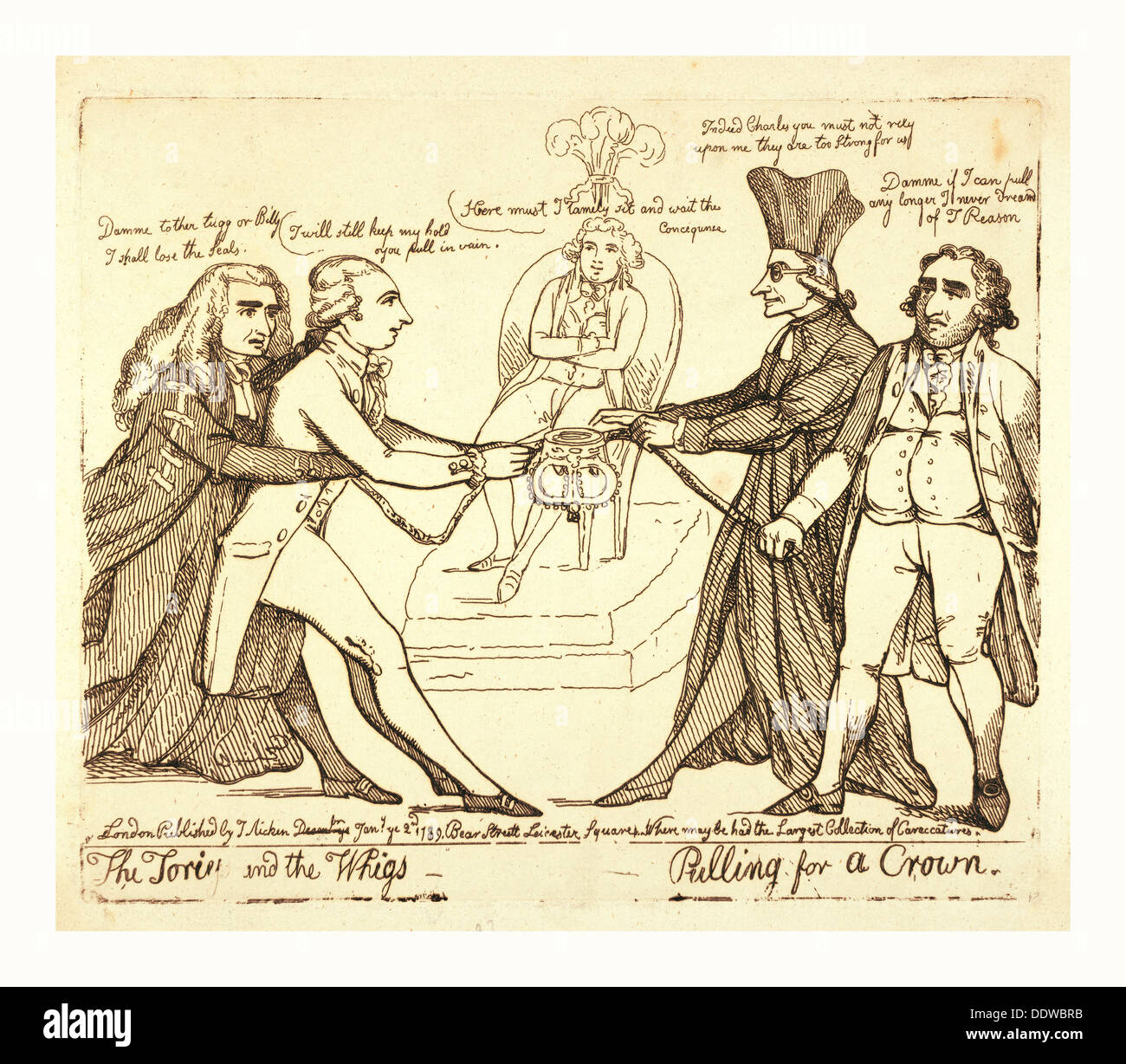 This 1789 cartoon, though from a later period, perfectly illustrates the central dynamic of Augustan politics: a relentless tug-of-war between the Whig and Tory parties for control of the state, symbolized by the crown.
This second cartoon illustrates the philosophical difference, with the Whigs toasting "The Majesty of the People" as their sovereign.
 This 1790 cartoon contrasts the Whig ideal of popular sovereignty with the Tory emphasis on a more traditional, hierarchical relationship between ruler and subject.
Conclusion
Today we have mapped the ideological, economic, and political divisions between the Whigs and Tories in the age of Swift.
Key Takeaways:
- Ideological Core: The Whigs championed a Lockean constitutional monarchy based on parliamentary supremacy and the "Revolution Settlement." The Tories clung to a vision of a stronger, hereditary monarchy and were haunted by accusations of Jacobitism.
- Socio-Economic Base: The conflict was a proxy war between two forms of capital: the Tory "landed interest" (old gentry) and the Whig "moneyed interest" (new finance and commerce).
- Key Battlegrounds: These tensions played out in fierce debates over the War of the Spanish Succession, the status of the Anglican Church versus Dissenters, and the ultimate prize—the Hanoverian Succession.
You can now see the political world not just as Swift saw it, but as he lived it. He was a combatant in a struggle between two competing visions for Britain's future. The Tory vision, which he came to champion, was of a stable, hierarchical society grounded in the land and the authority of the Church and Crown. The Whig vision was of a more dynamic, commercial, and globally ambitious nation, underpinned by a new financial system and parliamentary government. Swift’s satires are his weapons in this fight.
Up Next:
In our next lesson, we will focus on the specific case of Ireland. We will examine the political and economic relationship between England and Ireland in the early 18th century. You will see how the principles of the dominant Whig party—particularly their focus on commercial advantage for England—created the conditions of exploitation that Swift would so savagely attack in his Irish tracts.