Recommended resources
The freely available resources this lesson will direct you to.
Hello again. The previous lesson explained why rapid social change made society itself an object of systematic inquiry. Now we can ask a more precise question: what makes an inquiry sociological when historians, economists, political scientists, psychologists, and anthropologists may study the same people and events?
For Sociology Optional, the useful distinction is not that each discipline owns a separate piece of reality. It is the question each tends to foreground and the kind of explanation it seeks. This lesson takes about 40 minutes, including the selected readings.
One social world, several lines of inquiry
Imagine a graduate who moves from a small town to a city to prepare for the civil services examination. Her move has a history, costs money, involves the state, affects her thoughts and emotions, and places her in a community of fellow aspirants. Any of the five disciplines could study it. Sociology becomes distinctive when it asks, for example: How do family expectations, class resources, gender norms, social networks, and the prestige of public employment shape who can make this move and what it means to them?
Sociology studies social relationships, groups, institutions, and patterned social life. It examines both how people act toward one another and how arrangements such as family, education, work, caste, and the state shape opportunities and constraints. An individual decision can therefore be sociological subject matter; the question is whether we investigate its social meaning and patterned conditions, rather than treating it as an isolated personal choice.
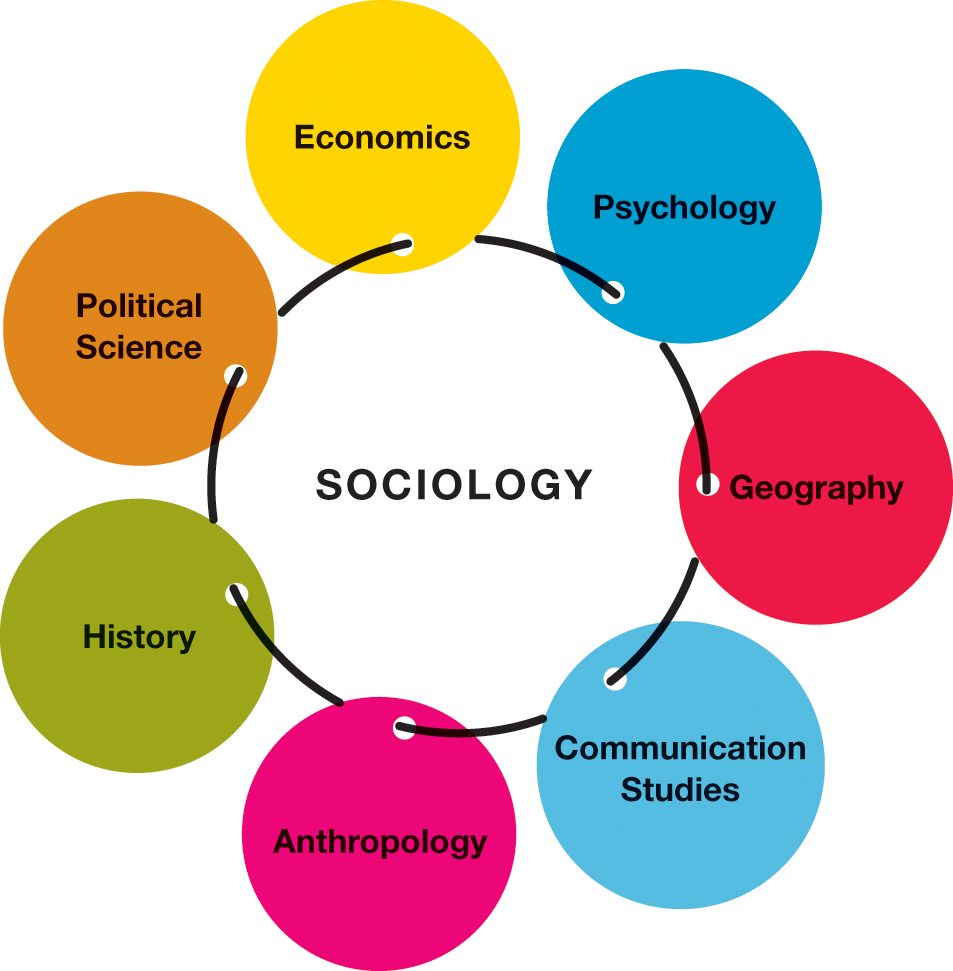
Keep the diagram’s central idea, but resist reading it as a claim that sociology absorbs every other field. Its breadth is useful because social relationships run through economic, political, and cultural life. Breadth does not remove the need for a specifically sociological question.
History: a past sequence or a social pattern?
A historian studying our graduate’s move might trace how public recruitment, higher education, and coaching centres developed in particular places and periods. What happened, in what sequence, and under what historical conditions? are central questions. The historian may use records and accounts to reconstruct that development, attending closely to what was distinctive about its time and place.
A sociologist might use the same historical evidence but foreground a different problem: how the growth of educational credentials altered relationships among families, occupations, status groups, and the state. Which groups gained access, and what recurring inequalities accompanied that change? Sociology often seeks concepts or patterns that can illuminate more than one case, while remaining attentive to historical context.
Read the paired IGNOU passages for both the distinction and the connection. The text sometimes states disciplinary differences too sharply; treat them as differences of emphasis, not rules about what researchers are permitted to study.
IGNOU’s discussion of sociology and history gives you language for distinguishing their questions without separating the disciplines completely.
In subsection 4.2.2, “Relationship of Sociology with History” (pp. 48–49), begin with the paragraph opening “Sociology and history are interrelated to each other.” Read their relationship through E. H. Carr’s observation about traffic across the frontier. Then go to subsection 4.2.3, “Difference between Sociology and History” (p. 52). Near the end of its main discussion, just before the boxed summary headed “Sociology and History: Differences,” begin at “Furthermore, sociology differ from history…” and read the comparison through the sentence about theoretically grounded generalisation. Focus on the contrast between explaining a particular past and developing concepts about social processes—not on the claim that either discipline uses only one kind of evidence.
The boundary cannot be “history studies the past; sociology studies the present.” Historical sociology studies past societies, and historians may investigate social patterns. Nor is it “historians use documents; sociologists use surveys”: researchers in both fields can work with varied evidence. The stronger distinction is analytical purpose—although even here there is overlap. As the reading’s account of E. H. Carr suggests, each field can improve the other.
Economics and political science: focused institutions within social life
Return to the graduate preparing in the city. An economist could investigate household spending on coaching, the cost of moving, expected earnings, or how limited seats affect competition. Economics centres on the production, distribution, exchange, and consumption of resources, though it also examines institutions and behaviour that influence them. A sociologist may ask instead how a family decides whose education deserves that expenditure, how information travels through networks, or why a secure government job carries prestige beyond its salary. Money is present in both accounts; social relationships are the sociologist’s explanatory focus.
A political scientist could examine recruitment rules, public authority, representation in state institutions, or debates about reservation. Political science foregrounds power, government, political institutions, and collective decision-making. Sociology also studies power, but may follow it through family authority, caste relations, workplace hierarchies, and other settings that are not confined to government. Conversely, political science is not confined to formal state offices: political behaviour and social movements also fall within its scope.
The next IGNOU unit is written primarily about social anthropology and its allied disciplines, rather than sociology. Read it as a useful comparison of economic and political focal questions; our sociological applications are developed here in the lesson.
IGNOU’s Unit 3 contrasts broad inquiry into social life with the more focused subject matter of economics and political science.
In the unit “Relationship of Social Anthropology with Allied Disciplines,” find the paragraph on economics on p. 35. Starting “As we know economics focuses on a particular institution…,” read the economic comparison through the sentence about understanding a particular production and distribution system. Continue to the following paragraph on political science. Begin where it says that “political science focuses on the political system and power,” and read the political comparison through the reference to political anthropology. Notice both the focused subject matter and the explicit warning that other disciplines study power too.
One distinction worth retaining for an optional answer is this: economics and political science specify prominent domains of social life; sociology asks how such domains are organised through social relationships and connected to other institutions. This is a contrast of emphases, not a hierarchy in which one field is automatically “broader” and therefore better.
Psychology and anthropology: the person, the group, and culture
Psychology may investigate the graduate’s motivation, learning, anxiety, memory, or response to stress. Its central subject matter includes mental processes and behaviour, often examined at the level of the person. A sociologist could study the same anxiety by asking whether particular groups of aspirants face similar pressures because of financial insecurity, family obligations, or expectations attached to success and failure.
That does not mean psychology ignores society or sociology ignores the individual. Social psychology, for instance, investigates how other people influence a person’s thoughts and behaviour. Sociologists also study individual action: what makes their question sociological is the attention to action in relation to others and to the social setting in which it acquires meaning. Psychology and sociology may explain different aspects of the same experience, and those explanations can be combined.
Social anthropology offers an especially close comparison. An anthropologist might spend extended time with aspirants, learning their everyday categories, routines, and ways of interpreting success. Culture, meanings, and ways of life are central concerns. Sociology shares an interest in meanings and social relationships, but often frames an inquiry around patterns across groups and institutions—for example, comparing access to preparation across regions, classes, and genders.
Historically, anthropologists often studied smaller-scale communities unfamiliar to them, while sociologists often studied industrial societies in which they lived. That history shaped research traditions; it is not a reliable boundary today. Anthropologists study cities and contemporary institutions, while sociologists conduct close fieldwork in villages and small communities. Neither discipline owns a method or a type of society.
Return to IGNOU’s Unit 3 for its account of the particularly close relationship between sociology and social anthropology, followed by its comparison with psychology.
In the discussion immediately before subsection 3.2.2 (pp. 31–32), read the historical contrast, beginning with the older descriptions of anthropological and sociological fieldwork and ending where the author notes exceptions. Next, starting “The first major difference…,” read the subject matter through the discussion of beliefs as objects of study. Farther down, begin “The distinction is by no means…” and read the qualification about small-scale systems. In subsection 3.2.2, “Social Anthropology and Psychology” (p. 33), read from “The study of mind and human behaviour is called Psychology” through its examples of psychological inquiry. Later in the same subsection, find “The only line of difference…” and read the group-person contrast. Use that final contrast as a starting point, not as an absolute division.
The anthropology reading’s older contrast between “other cultures” and “one’s own society” is particularly important to qualify in an Indian context. Sociology of an Indian village need not become anthropology because it studies a village; anthropology of an urban institution need not become sociology because it studies a city. Subject matter and analytical question provide better guidance than a location label.
A comparison you can carry into an answer
The five distinctions can be compressed without turning them into rigid exclusions:
| Neighbouring discipline | Typical foreground question | Sociological emphasis on the same case |
|---|---|---|
| History | How did this situation develop in a particular time and place? | What social relationships and patterns developed, persisted, or changed? |
| Economics | How are resources allocated, exchanged, and used? | How do social ties, norms, and inequalities shape those economic activities? |
| Political science | How is political power organised and exercised? | How is power embedded in social groups and institutions, including beyond the state? |
| Psychology | How do mental processes and behaviour vary among people? | How are actions and experiences patterned by social relations and settings? |
| Anthropology | How do people organise and interpret ways of life and culture? | How do social relations and institutions connect across groups and settings? |
The table is an answer-planning aid, not a set of definitions that exclude shared work. Notice what it avoids: no discipline is identified solely by its method; no claim says that sociology studies “society as a whole” while everyone else studies mere fragments. Sociologists may conduct a narrowly focused study. Its distinctive contribution lies in explaining that focus through social interaction, structure, institutions, and change.
For the coaching-city example, a strong sociological account could draw on a historian’s chronology, an economist’s cost analysis, a political scientist’s account of recruitment rules, a psychologist’s work on stress, and an anthropologist’s close account of aspirant culture. It would still need to establish its own argument: how access to the opportunity and the experience of pursuing it are socially organised. Overlap is a resource for explanation, not evidence that the disciplines are indistinguishable.
Takeaways
Sociology is distinguished less by which event it studies than by what it asks about social relationships, patterned inequalities, institutions, meanings, and change. History foregrounds particular developments over time; economics, resource allocation; political science, political power; psychology, mental processes and behaviour; and anthropology, culture and ways of life. Each boundary is porous, so an accurate comparison names both a characteristic emphasis and an area of overlap.
Next, we will use this grasp of sociology’s subject matter to organise the Sociology Optional syllabus into Paper I and Paper II topics—and to place past questions where they belong.