Recommended resources
The freely available resources this lesson will direct you to.
- Learn to hear Harmonics!! (Intros to Just Intonation)www.youtube.com
- EASIEST Access to your Vocal HARMONICS - Overtone Singing for Beginners - Tutorial Part 3/5www.youtube.com
- Harmonic Awareness Training (HAT) - Hearing Test – I love overtone singing - Wolfgang Sauswww.oberton.org
- Overtone Series (aka Harmonic Series) in Musicmuted.io
Introduction
In our last lesson, we explored the fascinating Jain concept of shabda (sound) as a tangible form of matter, or pudgal. We learned that the universe is permeated with "speech molecules" (Bhasha Vargana) that a living being grasps and transforms into audible sound through intention. This provided the metaphysical "what" of sound.
Today, we shift our focus from metaphysics to perception. This lesson is a practical session designed to train your ears. We'll bridge the physics of sound—specifically, the properties of frequency and harmonics we first discussed—with the subjective experience of listening. You will learn to conduct a listening exercise to distinguish a sound's fundamental tone from its overtones. This skill is not merely academic; it is the very foundation of developing a refined awareness of the vibrational qualities of music and, ultimately, mantra. By the end of this lesson, you will have taken the first step in learning to hear the rich, internal architecture of sound itself.
The Hidden Architecture of Sound
When you hear a note played on a guitar or a sung by a voice, you perceive it as a single sound with a specific pitch. However, that single sound is actually a composite, a complex mixture of a primary frequency and a series of fainter, higher-pitched frequencies.
- The Fundamental Tone is the lowest frequency in the sound. It is the strongest and determines the note's pitch that we name (e.g., C, G, etc.).
- The Overtones (or harmonics) are a series of higher frequencies that vibrate at integer multiples of the fundamental frequency.
The unique character, or timbre, of any sound—what makes a flute sound different from a violin playing the same note—is determined by the number and relative loudness of its overtones.
Physically, these overtones arise naturally from a vibrating object. The image below illustrates how a string vibrates not only as a whole (producing the fundamental) but also in halves, thirds, fourths, and so on, simultaneously. Each of these smaller vibrating segments produces an overtone.

When this complex wave reaches our ears, the brain typically performs a remarkable act of "fusion," merging the fundamental and all its overtones into the perception of a single, unified sound. Our goal today is to learn to consciously "un-fuse" them. The image below is a spectrum analysis of a sung vowel, visually representing the fundamental (the first and largest peak on the left) and its series of overtones (the subsequent, smaller peaks). This is what you will be training your ear to hear.
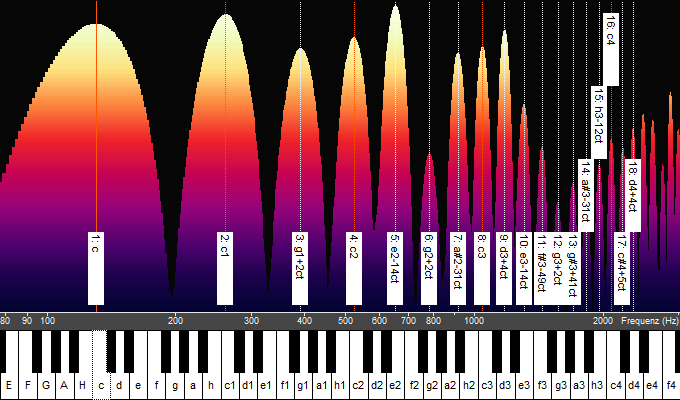
Let's begin the practical exercises to develop this "harmonic awareness."
Part 1: Building a Sound from Scratch
Before we try to dissect an existing sound, let's build one from its core components. This will give you a clear, analytical understanding of how the fundamental and overtones combine. We will use an interactive online tool for this.
Overtone Series (aka Harmonic Series) in Music
This interactive tool allows you to isolate the fundamental tone and then add each overtone one by one, controlling their volume. This is an excellent way to understand their relationship constructively.
First, scroll down past the initial text to the interactive panel labeled "First 12 Harmonics". Start by clicking the play button next to the "Fundamental". You will hear a pure, flute-like tone. This is a sine wave with no overtones. Now, add the "1st Overtone: Octave" by clicking its play button. Notice how the sound becomes richer. Adjust its volume slider to hear its effect. Continue adding the "2nd Overtone: Perfect Fifth", the "3rd Overtone: Octave", and so on. Experiment with turning different overtones on and off and changing their volumes. Listen to how the overall character (timbre) of the sound changes. After experimenting, read the short explanation in the section About the Harmonic Series to solidify your understanding.
This exercise demonstrates intellectually how a complex sound is built. Now, let's train your ears to perceive these components when they are already mixed together.
Part 2: Guided Listening - Deconstructing a Sound
In this next exercise, we'll listen to a complex instrument sound and be guided to identify the overtones hidden within. The video presenter uses a bass clarinet, which has a rich harmonic profile, and cleverly boosts the volume of specific overtones to make them temporarily "pop out" from the mix.
Learn to hear Harmonics!! (Intros to Just Intonation)
This video, from the channel mannfishh, provides an excellent guided ear-training session. It will help you overcome the brain's natural tendency to "fuse" harmonics into a single sound.
Please watch the first part of the video, from the beginning up to about the 4-minute mark. Listen to the introduction where the presenter explains the goal. Pay close attention to the first exercise with the 3rd harmonic (an overtone a perfect fifth above the fundamental). He will play a reference tone first, then amplify it within the clarinet sound. The presenter then explains the psychoacoustic phenomenon of 'fusion', which is the very reason this training is necessary. Continue with the exercises for the 5th, 7th, and 9th harmonics. Try to hold the sound of the overtone in your mind after its volume is reduced, and see if you can still faintly perceive it in the original sound.
Don't worry if you can't hear them all clearly at first. This is a skill that develops with practice. The key is knowing what to listen for.
Part 3: Advanced Perception - The Melody in the Voice
Now for a more subtle and fascinating challenge. The human voice is incredibly rich in overtones. So much so, that by manipulating the shape of the mouth, a singer can amplify specific overtones to create a clear, whistle-like melody that seems to float above the fundamental note. This is the basis of overtone singing. The following test, developed by vocal researcher Wolfgang Saus, is designed to train your brain to perceive this hidden melody.
Harmonic Awareness Training (HAT) - Hearing Test – I love overtone singing - Wolfgang Saus
This is a step-by-step audio test that progressively changes a sung phrase to make the overtone melody easier to hear. It's a powerful demonstration of the richness of the human voice.
Navigate to the section "Saus’ hearing test". Follow the instructions on the page and listen to the audio samples in order. Listen to Sound sample 1. You will hear a series of syllables sung on one note. Most people only hear the syllables. Listen to Audio sample 2. Here, some vocal information is removed, making the hidden melody slightly clearer. The text reveals the hidden melody is from Beethoven's 9th Symphony. Listen to Audio example 3, which whistles the melody, to prime your brain. Then listen to sample 2 again. Listen to Audio example 4, where consonants are removed. The melody should become even more apparent. Listen to Audio example 5. This is true overtone singing, where the overtones are strongly amplified. You should clearly hear a flute-like melody over the fundamental drone. Finally, listen to Audio example 6 several times. It transitions from the clear overtone melody back to the original syllables. Try to keep your focus on the melody as it becomes "hidden" again within the vocal sound.
This exercise powerfully demonstrates that these higher frequencies aren't just theoretical; they are a tangible, perceptible part of sound that can even carry melodic information.
Part 4: Personal Experience - Finding Your Own Overtones
The final step is to connect this perception to your own body. You can produce and hear overtones with your own voice. This exercise makes the concept fully tangible and personal, connecting back to the idea of the jiva shaping Bhasha Vargana.
EASIEST Access to your Vocal HARMONICS - Overtone Singing for Beginners - Tutorial Part 3/5
In this video, overtone singer Miroslav Grosser provides a simple and effective method for beginners to perceive the harmonics in their own voice.
Follow along with these two short exercises from the video: Watch the section on the word "music" from this part. The trick is to sing the word in "slow motion." Start with a closed-lip hum "mmmm" and very slowly transition to the "ooo" vowel sound. As you do, listen for the shifting, higher-pitched tones. Next, try the exercise with the word "sound", explained from this section. As you slowly move from the "ah" to the "ooo" to the "nn" sound, listen for the "steps" of changing overtones. Relax, don't force it, and allow yourself to sink into the sound. The goal is simply to notice the rich inner dimensions of the sounds you yourself produce.
Conclusion
Today's lesson was a deep dive into the practice of listening. We have moved from a theoretical understanding of harmonics to the direct, personal perception of them.
Key Takeaways:
- Most sounds are complex, composed of a fundamental tone (which sets the pitch) and a series of overtones (which create the timbre).
- Our brain naturally fuses these components into a single perceived sound.
- Through focused listening exercises, we can train our auditory perception to "un-fuse" these components and hear the rich internal structure of sound.
- This "harmonic awareness" can be developed by deconstructing sounds, using guided listening, and even by exploring the overtones present in our own voices.
You have now acquired a fundamental skill for the journey ahead. This ability to hear beyond the primary note and perceive the subtle, vibrational architecture of sound is precisely what is needed to appreciate the depth of a raga and the profound power of a mantra.
In our next lesson, we will begin Module 2, "The Power of Syllable: Mantra in Jain Tradition." We will leave the physics of sound for a while and enter the world of sadhana, exploring the role of mantra in Jain practice and its connection to the discipline of mind, speech, and body. Your newly trained ears will be an invaluable asset.