Recommended resources
The freely available resources this lesson will direct you to.
Hei! Last time, you practised turning spoken directions into a sequence of actions and checking a turn or landmark before setting off. At a transport stop, the same habit helps when something goes wrong: say what happened, explain what you need, then check the action staff recommend.
This lesson focuses on short exchanges about delays, missed connections, services that are not running, and lost belongings. Allow about 40 minutes, including a short listening segment and time to say the sample exchanges aloud.
Give staff the information they need
You do not need a long explanation to get useful help. Start with Unnskyld (“Excuse me”), state the problem, and say what you are trying to do. Then ask an open question.
Unnskyld, bussen er forsinket, og jeg må rekke et tog. Hva kan jeg gjøre?
“Excuse me, the bus is delayed, and I need to catch a train. What can I do?”
Two details make this more useful than simply saying Bussen er forsinket: staff know that you have a connection, and they know you are asking for a solution. If the connection has already been missed, change the sentence:
Jeg rakk ikke toget fordi bussen var forsinket. Finnes det et annet tog?
“I missed the train because the bus was delayed. Is there another train?”
Jeg må rekke toget means you need to catch the train; jeg rakk ikke toget means you did not catch it. That difference tells staff whether there is still time to prevent the problem or whether they need to help you recover from it.
For a service that has stopped, you might say T-banen går ikke videre (“The metro isn’t going any farther”). Add Jeg skal til sentrum (“I’m going to the city centre”) so the person can suggest a route that serves your destination.
Separate the delay from the estimate
Listen to this short train-delay segment from NTN SKOLE’s Norskkurs 4: Å Ta Offentlig Transport i Norge. The announcement is more important here than the passengers’ comments afterward.
Norskkurs 4: Å Ta Offentlig Transport i Norge | Norske Samtaler
Watch NTN SKOLE’s “Norskkurs 4: Å Ta Offentlig Transport i Norge” for an example of how a disruption and an estimated wait are announced.
In the “Problemer og forsinkelser” segment, watch the delay segment. Listen especially for “toget er forsinket,” the reason introduced by “på grunn av,” and the estimate “om omtrent 20 minutter.” The final lines are passengers reacting to the announcement, not staff offering a new route.
The announcement says that the train is delayed på grunn av tekniske vanskeligheter—because of technical difficulties—and that they regner med being under way again om omtrent 20 minutter. For your immediate decision, the most useful distinction is this: the train is delayed is the current situation; approximately 20 minutes is an estimate, not a guaranteed departure time.
If that wait may make you miss a connection, move from listening to asking: Jeg må rekke et tog. Finnes det et annet alternativ? (“I need to catch a train. Is there another option?”) You can explain the consequence without needing to repeat the technical reason.
Hear a proposed solution as a usable plan
A staff member’s answer may contain more than one piece of information. Suppose you hear:
Ta erstatningsbussen fra holdeplass B. Den går om ti minutter.
“Take the replacement bus from stop B. It leaves in ten minutes.”
The usable plan has three parts: what to take (erstatningsbussen, the replacement bus), where to board (holdeplass B), and when it leaves (om ti minutter, in ten minutes). Listen for these details rather than trying to remember every word.
Here is a complete illustrative exchange; it is a language example, not advice about an actual service:
Du: Unnskyld, T-banen går ikke videre. Jeg skal til sentrum. Hva bør jeg gjøre?
Ansatt: Du kan ta erstatningsbussen. Den går fra holdeplass B om ti minutter.
Du: Fra holdeplass B om ti minutter?
Ansatt: Ja, det stemmer.
Du kan ta … presents an option; Ta … gives a direct instruction. Det går et nytt tog om 20 minutter tells you when another train leaves, while Du må bytte means you need to change services. If staff mention a different bus or train, do not assume your existing ticket is valid on it. Ask Gjelder billetten min der? (“Is my ticket valid there?”).
A display can also tell you whether a vehicle is an option at all:
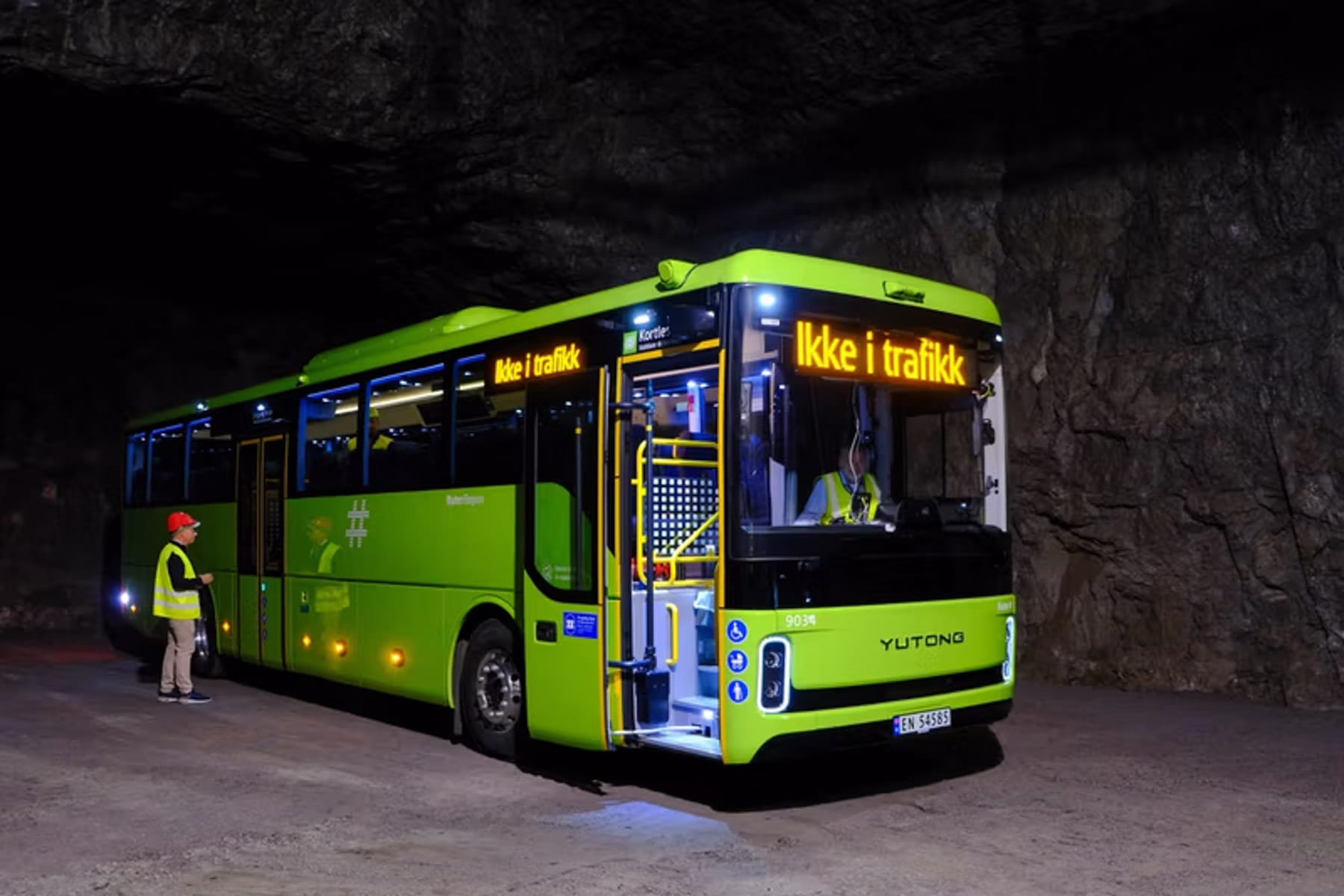
If the vehicle you expected says Ikke i trafikk, a useful question is Hvilken buss kan jeg ta i stedet? (“Which bus can I take instead?”). I stedet—“instead”—makes clear that you need an alternative, not just an explanation.
Check the part of the answer that could change your journey
The confirmation you used for walking directions works here too. Repeat a stop, time, or platform as a question: Fra holdeplass B? (“From stop B?”) or Går det fra spor tre? (“Does it leave from platform three?”). If the entire answer was too fast, ask Kan du si det litt saktere? (“Could you say that a little more slowly?”)
A check can also uncover a missing condition:
Du: Jeg rakk ikke toget fordi bussen var forsinket. Hva kan jeg gjøre?
Ansatt: Det går et nytt tog om 20 minutter, fra spor tre.
Du: Om 20 minutter fra spor tre. Kan jeg bruke den samme billetten?
Ansatt: La meg sjekke billetten din.
The staff member has proposed another departure, but has not yet confirmed that the same ticket is valid. The reply La meg sjekke (“Let me check”) means you should wait for that answer rather than treat it as permission. This is a good pattern whenever a solution sounds workable but one practical detail remains uncertain.
When the problem is a lost belonging
A delay is not the only reason to approach transport staff. In the illustration below, the passenger says Jeg har mistet vesken min! (“I’ve lost my bag!”), and the staff member asks Når oppdaget du det? (“When did you notice it?”).

Give the most useful facts you know: Jeg glemte vesken min på bussen (“I left my bag on the bus”), followed by the bus and approximate time if you remember them. If staff direct you to hittegods (lost property), check how to act on that advice: Hvor kontakter jeg hittegods? (“Where do I contact lost property?”) A proposed next step is only helpful once you know where to go or whom to contact.
Key takeaways
To explain a transport problem, state what happened and what you need: Bussen er forsinket, og jeg må rekke et tog. When staff answer, listen for the alternative, its boarding place, and its time. Repeat the detail you are least sure of, and ask separately about ticket validity or any other condition that has not been confirmed.
In the next lesson, you will work with dates and clock times more precisely—useful whenever a proposed departure or a change of plans depends on the exact time.