Recommended resources
The freely available resources this lesson will direct you to.
Hei! This first lesson in the Getting Around Oslo and Managing Plans module gives you the words to make sense of a stop sign, choose a ticket, follow a route, and recognize when a service is disrupted. We’ll use Bokmål as it appears on transport information, then turn the most useful terms into things you can say.
The aim is not to memorize the whole network. It is to recognize what kind of information you are looking at—and have the vocabulary to act on it. Allow about 40 minutes, including the short readings.
Finding your way through the network
The main transport words are buss (bus), trikk (tram), T-bane (metro), tog (train), and båt (boat or ferry). They name different vehicles, but much of the language around them is shared: each has a linje (line), an avgang (departure), and a retning (direction).
A holdeplass is usually a bus or tram stop; a stasjon is a station, often for a train or the T-bane. You may also see stopp for a stop on a route and plattform for a platform. At the stop, look for the linjenummer (line number) and the destination shown after mot (“towards”). These matter more than the vehicle type alone: two buses at the same stop may travel in opposite directions.

On the sign, 20 Skøyen and 28 Fornebu identify different services. A natural way to describe one is buss 20 mot Skøyen—bus 20 towards Skøyen. The word til means “to,” while mot identifies the direction displayed on a vehicle or sign. A service marked mot a place may have other stops along the way, so check whether it stops where you need to get off.
Here are four route expressions worth learning as complete phrases:
| Norwegian | Meaning |
|---|---|
| fra A til B | from A to B |
| mot B | towards B |
| stopper ved B | stops at B |
| bytte på B | change at B |
For example, Jeg skal fra Majorstuen til Fornebu means “I’m going from Majorstuen to Fornebu.” To check a vehicle before boarding, you can ask: Går denne bussen til Fornebu? (“Does this bus go to Fornebu?”). If the journey involves a change, Må jeg bytte? asks “Do I need to change?”
Tickets: type, zone, and validity
A ticket is en billett. The important distinction is between en enkeltbillett, a single ticket, and en periodebillett, a ticket valid for a period. Ruter’s ticket page introduces both in the terms you will encounter when buying one.
Read Ruter’s “Billettpriser” page to see how ticket types and passenger categories are named in Norwegian.
Under “Billettpriser,” read the opening paragraph, then look at the “Se hva billetten koster” table immediately below it. Notice voksen, barn, and honnør as passenger categories; you do not need to memorize the listed prices. Stop before “Se hvem som får rabatt.”
A voksenbillett is an adult ticket, and a barnebillett is a child ticket. Periodebillett is the broader term for tickets valid for a day, week, month, or year. If you need to buy one, you can say Jeg trenger en enkeltbillett (“I need a single ticket”) or ask Hvor kjøper jeg billett? (“Where do I buy a ticket?”).
The next decision is geographical. A sone is a fare zone, and your ticket must cover the zones required for your journey. This map makes the basic idea visible: central Oslo is marked sone 1, while surrounding areas have other zone labels.
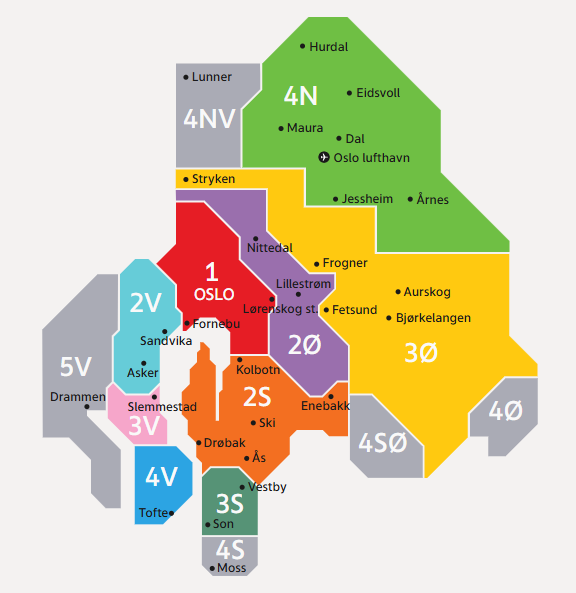
A destination’s zone label is not the number of zones you should buy. For an actual journey, enter your starting point and destination in the current journey planner and check the ticket it recommends. Useful questions are Hvilken sone er dette? (“Which zone is this?”) and Gjelder billetten i denne sonen? (“Is the ticket valid in this zone?”).
Ruter’s practical ticket guidance adds another word you will need: gyldig, meaning “valid.” A ticket can be valid for a specified time and set of zones. Å bytte means to change vehicles; en overgang is a transfer.
Return to Ruter’s ticket page for the vocabulary of buying, activating, and transferring with a ticket.
In “Slik kjøper du en billett,” read the three purchase options, beginning with the purchase list. Then, in “Slik fungerer billetten,” read from single-ticket validity through transfers and transport modes. Focus on aktiverer, gyldig, bytte, and overgang rather than trying to retain every fare rule.
Notice the practical difference between buying and using a ticket. Å kjøpe is to buy; å aktivere is to activate. Ruter says a single ticket for one zone is valid for 60 minutes from activation, with additional validity time for extra zones. A transfer is possible while the ticket is still valid for the relevant zones. Its page also lists the transport modes on which Ruter tickets can be used, including specified Vy train services in Oslo and Akershus. For a particular trip—especially one using a train—check the journey and ticket details rather than assuming every service accepts the same ticket.
A compact question that covers both issues is: Er denne billetten gyldig til [sted]? (“Is this ticket valid to [place]?”)
Reading a route and spotting a disruption
When planning, distinguish the timetable from what is happening now. Rutetider are scheduled times; sanntid is real-time information. Trafikkstatus describes the current state of the network. Ruter places these terms together on its journey-planning page.
Read Ruter’s short “Planlegg reise” introduction to learn the labels used for journey suggestions and service changes.
Under “Planlegg reise,” read the introductory sentence and the two linked descriptions, “Reiseplanlegger” and “Trafikkstatus,” from planning to traffic status. Then glance at “Mer om reise” for rutetabeller (timetables) and linjekart (line maps).
A reiseplanlegger proposes a journey. An avgang is a departure and an ankomst an arrival. If a proposed journey has more than one vehicle, look for where to bytte. You can ask Når går neste avgang? (“When is the next departure?”) or Hvor må jeg bytte? (“Where do I have to change?”)
Disruption vocabulary tells you whether the proposed journey still works:
- en forsinkelse / forsinket — a delay / delayed
- innstilt — cancelled, said of a departure or service
- en endring / endret — a change / changed
- buss for bane — replacement bus service for the T-bane
- i rute — on schedule
These words are not interchangeable. If a tram is forsinket, expect it later than scheduled. If its departure is innstilt, do not wait for that departure. If a notice says buss for bane, look for information about the replacement bus rather than the usual metro platform. Ruter is the transport provider’s name; i rute describes a service running on schedule.
Consider this illustrative notice, not a live service update:
Trikken er innstilt. Det går buss for trikk fra neste holdeplass.
The tram is cancelled. A replacement bus for the tram runs from the next stop.
The first sentence tells you the original plan will not work. The second tells you what to look for and where. To check that you have understood, ask Er trikken innstilt? (“Is the tram cancelled?”) or Hvor går bussen fra? (“Where does the bus leave from?”). For a broader check, Er det forsinkelser på denne linjen? means “Are there delays on this line?”
Bringing the words together
Imagine you need to travel beyond central Oslo. First, you search fra your starting stop til your destination and check the linje and retning of each vehicle. Next, you check which soner the journey requires and choose an enkeltbillett or periodebillett accordingly. Before leaving, you check sanntid or trafikkstatus: a forsinket departure may change your timing, while an innstilt one requires another plan.
You now have vocabulary for all four parts of that decision: the vehicle and route, the ticket, its zones and validity, and disruptions. You also have short questions to use when the screen or stop sign does not settle the matter. In the next lesson, we’ll build on these words to pick out departures, destinations, platforms, and delays from spoken transport announcements.