Recommended resources
The freely available resources this lesson will direct you to.
- Why you procrastinate even when it feels badwww.youtube.com
- How to become 37.78 times better at anything | Atomic Habits summary (by James Clear)www.youtube.com
- Building a Better You: James Clear's Four Laws of Behavior Change ...confidecoaching.com
- [PDF] 20 Tips to Reduce Academic Procrastinationwww.mcgill.ca
Hello again! Welcome back to your capstone module.
In the last lesson, you performed a critical audit of your Learning Experience Journey Map, analyzing it through the lens of effective retention. You identified the strengths and weaknesses in your process concerning retrieval practice, spacing, and elaboration.
Today, we will analyze that very same map, but with a different set of diagnostic tools. This time, our focus is on behavior. Your goal for this lesson is to analyze your learning process against the principles of habit formation and procrastination avoidance. This directly addresses the pain points of starting, consistency, and application that you've set out to solve. By the end of this lesson, you'll have uncovered the behavioral "bugs" that hinder your consistency and identified clear strategies to fix them.
1. The Audit Toolkit: Principles of Behavior Change
To effectively debug the behavioral side of your learning process, we need to understand two key concepts: how habits are formed and why we procrastinate.
The Mechanics of Habits
Consistency in learning isn't about willpower; it's about building an effective system of habits. A habit is simply a behavior that has been repeated enough times to become automatic. Understanding its structure is the first step to controlling it.
To get a concise overview of a powerful framework for habit design, let's watch a summary of James Clear's Atomic Habits.
How to become 37.78 times better at anything | Atomic Habits summary (by James Clear)
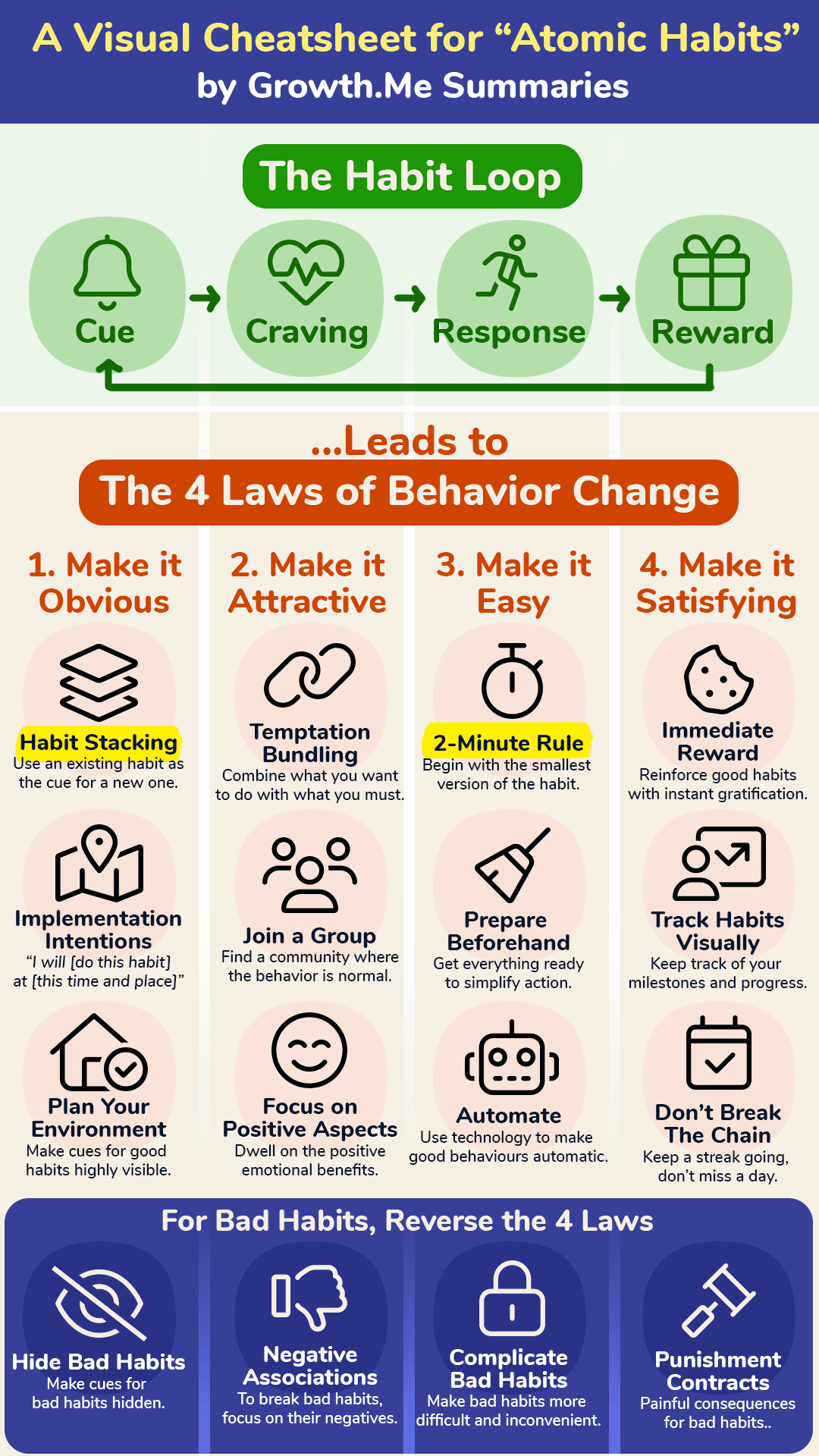
This video provides an excellent summary of the core concepts you'll need for your audit. It explains the habit loop and the 'Four Laws of Behavior Change,' which give us a blueprint for building good habits and dismantling bad ones.
Please watch the following segments: The Habit Loop & Identity (04:43 - 07:09): Focus on the Cue -> Craving -> Response -> Reward loop. This is the fundamental structure of any habit. Law 1: Make it Obvious (07:09 - 09:12): Pay attention to strategies like 'Implementation Intentions' and 'Habit Stacking'. Law 3: Make it Easy (15:33 - 18:13): The 'Two-Minute Rule' and the concept of 'Reducing Friction' are especially relevant for overcoming procrastination. Law 4: Make it Satisfying (18:13 - 20:38): Understand why immediate rewards are crucial for making a habit stick.
For your reference, here is a visual cheatsheet that summarizes these laws. You might find this useful during your audit, much like a designer would use a component library or style guide for quick reference.
The Psychology of Procrastination
While habits are the mechanical "how," procrastination is often about the emotional "why." It's rarely about laziness. More often, it's an emotional regulation strategy: we avoid tasks that make us feel bad (e.g., bored, anxious, insecure) in favor of something that provides immediate relief.
Why you procrastinate even when it feels bad
This short TED-Ed video explains the psychological roots of procrastination, framing it as a threat response rather than a character flaw.
Please watch these key parts: The Threat Response (01:15 - 02:11): Understand how your brain can perceive a challenging task as a threat. The Role of Negative Feelings (02:11 - 03:14): This explains why we procrastinate on certain tasks and not others. How to Break the Cycle (04:13 - 05:17): Focus on the actionable strategies offered, particularly self-compassion and breaking tasks down.
A powerful strategy to counter this emotional avoidance and proactively build habits is the implementation intention, or "if-then" plan. It involves deciding in advance how you'll handle a trigger or obstacle. This offloads the decision-making from your future, stressed self to your present, calm self.
To solidify this concept, let's look at a quick, practical guide.
20 Tips to Reduce Academic Procrastination
This document offers a wealth of practical tips. We'll focus on the section that formally introduces implementation intentions.
Please read tip #9, 'Make use of well-formed ‘implementation intentions’'. This provides a clear definition and the 'if...then...' format.
Test your understanding!
You want to build a habit of practicing a new coding concept for 30 minutes after work, but you often find yourself scrolling through social media instead. How could you apply the Four Laws and an implementation intention to redesign this?
Show answer
Here's one possible approach:
- Make it Obvious (Cue): Set a calendar reminder for 5:30 PM that says "Open VS Code for 30 min practice." Or, use Habit Stacking: "After I close my work laptop, I will immediately open my coding project."
- Make it Attractive (Craving): Use Temptation Bundling: "I can listen to my favorite new album only while I am doing my coding practice."
- Make it Easy (Friction): Leave the coding application and the specific file you're working on open before you finish work. Use the Two-Minute Rule: "My only goal is to write one line of code."
- Make it Satisfying (Reward): After the 30 minutes, give yourself a small, immediate reward, like watching one comedy skit on YouTube or making a cup of your favorite tea.
- Implementation Intention (Obstacle): "If I feel the urge to open social media, then I will close my eyes, take three deep breaths, and open my code editor for just two minutes."
2. The Activity: Auditing Your Journey Map for Behavior
Take out your Learning Experience Journey Map from the previous lesson. We're going to conduct our second round of analysis. Just as before, you can add annotations in Figma or write notes separately.
For each phase on your map, ask yourself these questions:
Audit Checklist:
1. Analyzing for Habit Loops (The Four Laws):
- Cues (Make it Obvious/Invisible): What triggered your learning activities? Was it a time of day, a location, a previous action (habit stacking)? What were the cues that triggered your distractions? Was your phone visible? Were social media tabs open?
- Friction (Make it Easy/Difficult): Look at your 'Actions' and 'Emotions' rows. Where did you feel resistance? What made starting the task difficult? (e.g., "I had to find the right video," "I didn't know where to start"). Conversely, what made distractions easy? (e.g., "My phone was right there").
- Reward (Make it Satisfying/Unsatisfying): Did you get any sense of immediate accomplishment from your learning activities? Or was the only "reward" the temporary relief of a distraction? Did you track your progress in any way?
2. Analyzing for Procrastination (Emotional Triggers):
- Task Aversion: Look at your 'Emotions' and 'Pain Points' rows. Which tasks were associated with negative feelings like boredom, confusion, frustration, or insecurity? How did you respond to those feelings? Did you push through, or did you switch to a more pleasant activity?
- "Giving in to Feel Good": Identify a specific moment where you delayed a task. What was the intended task, and what did you do instead? What was the immediate emotional payoff of the switch? (e.g., "I avoided the frustration of debugging code by watching a funny video, which felt good for a few minutes.")
3. Synthesizing Your Audit Findings
Now, let's consolidate your analysis into a behavioral "audit report." Answering these questions will give you a clear diagnosis of the behavioral bugs in your learning system.
- Primary Procrastination Trigger: Based on your map, what is the most common reason you delay or get distracted? Is it task aversion (the task is boring/hard), fear of failure, or something else?
- Weakest Link in the Habit Loop: Which of the Four Laws is most frequently violated in your current process? (e.g., "My cues are inconsistent," "There's too much friction to get started," or "The process is unsatisfying.")
- Design Two 'If-Then' Plans: Identify two critical failure points from your map. For each one, create a specific implementation intention to address it. Use the template below.
The "INTENTIONS: BEAT PROCRASTINATION" worksheet is a great tool for this.
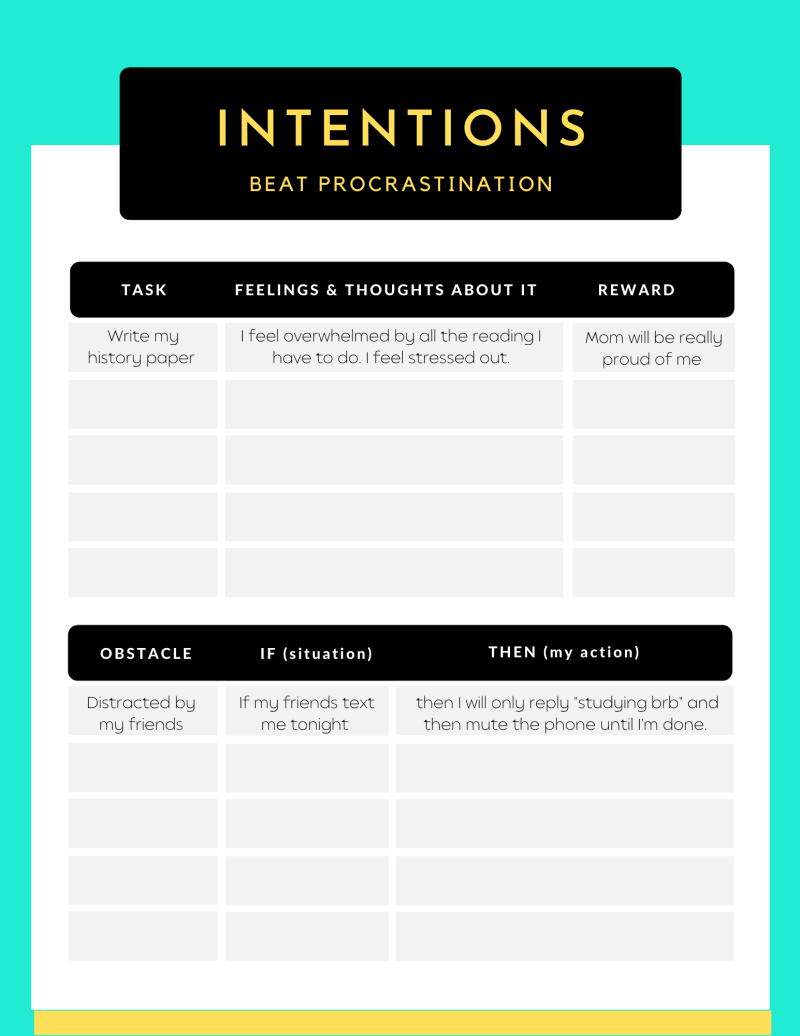
Example:
- Obstacle: Feeling stuck on a difficult coding problem and wanting to browse design forums instead.
- If-Then Plan: If I get stuck on a problem for more than 10 minutes, then I will write down exactly what I'm stuck on in a comment, and then take a 5-minute walk away from my desk.
Conclusion
Fantastic work today. You have now analyzed your learning process from two critical angles: cognitive (retention) and behavioral (habits and procrastination). By examining the cues, friction, rewards, and emotional triggers in your journey map, you've uncovered the hidden forces that shape your ability to be a consistent learner.
Key Takeaways:
- Learning consistency is not a matter of willpower but a result of a well-designed system of habits.
- Procrastination is often an emotional response to a task, not a sign of laziness. We can design strategies to manage these emotions.
- Using tools like the Four Laws of Behavior Change and implementation intentions allows us to proactively "debug" our behavior, just as we would debug a user flow or a piece of code.
Preview of the Next Lesson:
You now have a comprehensive audit of your "as-is" learning process, complete with findings on both retention and behavior. In our next lesson, we will move from analysis to synthesis and design. You will create a reusable template for a weekly learning schedule that integrates all your findings, building a new, robust system for learning that works for you.