Recommended resources
The freely available resources this lesson will direct you to.
Hello! Welcome to the fifth and final lesson in our module on Scaling and Universality.
In our previous lesson, we verified the scaling relations for both mean-field theory and the 2D Ising model. This exercise revealed a crucial point: while each model's exponents form an internally consistent set, the sets themselves are distinct. For instance, the 2D Ising model requires a non-zero anomalous dimension , and hyperscaling holds, whereas for mean-field theory and hyperscaling fails for . This naturally leads to a fundamental question: why do different systems exhibit different sets of critical exponents, and what determines which set a given system will follow?
Today, we will answer this question by formalizing the concept of universality. You will learn to define a universality class and, most importantly, to identify the key physical properties that determine the critical behavior of a system, rendering many microscopic details irrelevant. This concept is one of the most profound and powerful ideas in modern statistical physics.
The Phenomenon of Universality
At its core, universality is the observation that the critical behavior of a vast range of different physical systems can be described by a small number of sets of critical exponents. Systems as seemingly different as a liquid-gas mixture at its critical point, a binary alloy undergoing phase separation, and a ferromagnet at its Curie temperature can all share the exact same critical exponents.
A universality class is a collection of all physical systems that share the same set of critical exponents.
[PDF] Phase Transitions and Collective Phenomena
To begin, let's read a short, high-level introduction to this idea from the lecture notes by the TCM Group at Cambridge.
Read the section titled 'Introduction' up to the paragraph before '1.3 Critical Behaviour' (the first five paragraphs of the document), and then the first paragraph of section '1.3 Critical Behaviour'. Focus on how the text contrasts the microscopic complexity of systems with the simplicity and shared nature of their critical properties.
The key insight is that near a critical point, the correlation length diverges. As fluctuations become correlated over macroscopic scales, the specific microscopic details of the interactions—such as the precise shape of the inter-particle potential, the lattice structure (square vs. triangular), or the exact value of the coupling constant —become unimportant. The system's behavior is instead governed by more fundamental, large-scale properties.
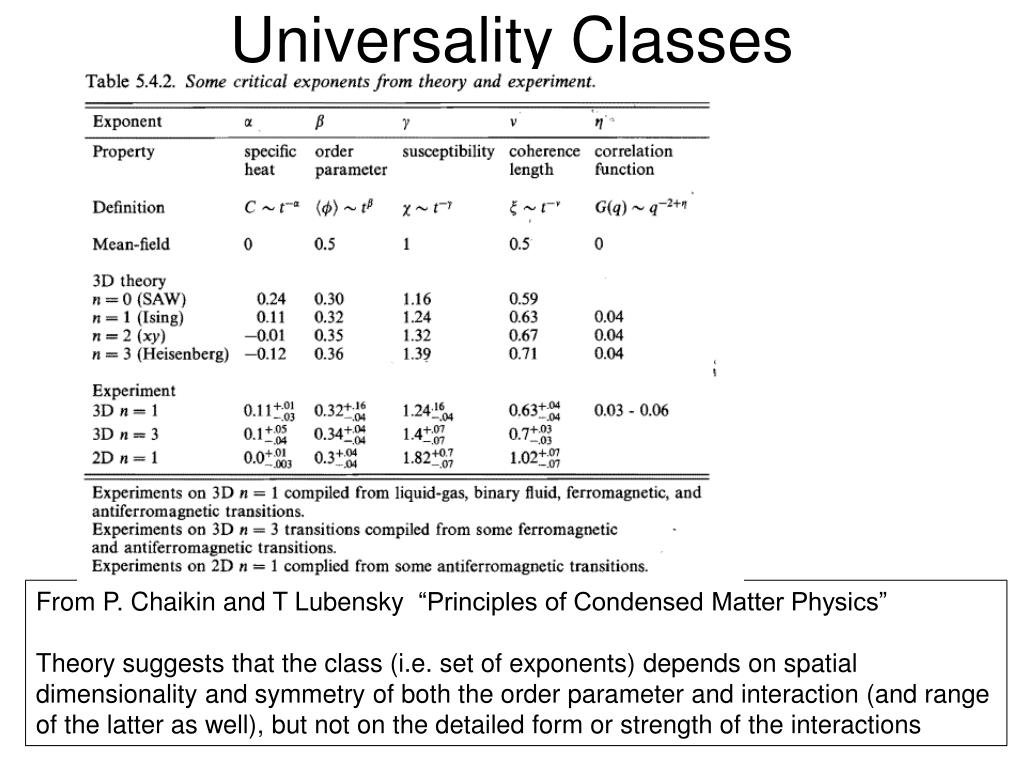
The image below shows a table of theoretical and experimental critical exponents. Notice how experimental values for different physical systems (e.g., ferromagnets, liquid-gas transitions) cluster around the theoretical predictions for a particular universality class.
The Determinants of Universality
So, what are these fundamental properties that determine a system's universality class? Decades of theoretical and experimental work have shown that there are primarily two:
- The spatial dimensionality of the system (
d). - The symmetry of the order parameter, often characterized by its number of components (
n).
Let's explore these two determinants.
Universality Class - an overview | ScienceDirect Topics
The following text from ScienceDirect provides a concise statement on this and sets the stage for a more detailed discussion.
Read the sections titled 'Universality Classes' (under section 5.2.3 from the book 'Two-Dimensional Crystals') and 'Universality classes' (section 13.3.2 from the 'Handbook of Surface Science'). Both sections clearly state the role of dimensionality and order parameter symmetry.
1. Spatial Dimension,
We've already seen hints of the importance of dimensionality. In the last lesson, we found that the hyperscaling relation for mean-field theory only holds at the upper critical dimension . This is because the number of nearest neighbors increases with , which tends to average out and suppress local fluctuations. Therefore, a 3D Ising model will have different exponents from the 2D Ising model we've studied. They belong to different universality classes because their spatial dimensions differ.
2. Symmetry of the Order Parameter,
This is arguably the more subtle and interesting determinant. The symmetries of the Hamiltonian dictate the nature of the order parameter. We can classify systems by the number of independent components the order parameter has. This is best understood through the canonical examples that give their names to the most common universality classes.
[PDF] Phase Transitions and Collective Phenomena
To understand the link between order parameter symmetry and universality, let's revisit the Ginzburg-Landau framework, which constructs a free energy based on these very symmetries. This text also introduces the key examples.
Please read the beginning of Chapter 2, 'Ginzburg-Landau Theory', up to (but not including) the numbered list of symmetries. Focus on how it introduces a generalized n-component order parameter field m(x) and lists the physical systems corresponding to n=1, 2, and 3.
Let's look at the main classes:
-
The Ising Class ():
- The order parameter is a single real number (a scalar).
- Examples: Magnetization in a uniaxial ferromagnet (spins can only point up or down), density deviation from critical in a liquid-gas transition, or concentration difference in a binary mixture.
- Symmetry: The Hamiltonian is invariant under a discrete transformation, such as . This is the symmetry group. The Landau free energy, , reflects this as it only contains even powers of .
-
The XY Class ():
- The order parameter is a two-component vector.
- Examples: Magnetization in a planar ferromagnet (spins are confined to a plane), or the complex order parameter in a superfluid or superconductor (where the two components can be viewed as the real and imaginary parts of ).
- Symmetry: The Hamiltonian is invariant under continuous rotations in a 2D plane. This is O(2) or U(1) symmetry.
-
The Heisenberg Class ():
- The order parameter is a three-component vector.
- Example: Magnetization in an isotropic ferromagnet, where the spins can point in any direction in 3D space.
- Symmetry: The Hamiltonian is invariant under continuous rotations in 3D space, which corresponds to O(3) symmetry.
Each of these classes (Ising, XY, Heisenberg), for a given dimension d, has a unique set of critical exponents.
Test your understanding!
A physicist is studying a novel phase transition in a 2D material. The order parameter is found to be a complex field . To which universality class (Ising, XY, or Heisenberg) would you expect this system to belong, and why? How would your answer change if the material were a 3D bulk crystal?
Show answer
The order parameter is a complex number, which can be represented by two real numbers (its real and imaginary parts, or its amplitude and phase). Therefore, it is a two-component order parameter ().
- In the 2D material, the system has and . It would belong to the 2D XY universality class.
- In the 3D bulk crystal, the system has and . It would belong to the 3D XY universality class. The exponents would be different from the 2D case because the spatial dimension
dhas changed.
The Renormalization Group Explanation of Universality
Why do dimension and symmetry play this starring role, while other details are irrelevant? The most powerful and complete answer comes from the Renormalization Group (RG), which we will begin studying in detail in the next module. Here is a conceptual preview.
The RG provides a mathematical framework for how a system's description changes as we look at it on different length scales (a process called "coarse-graining"). We can imagine a vast, abstract "parameter space" where every point represents a possible Hamiltonian for a system.
-
RG Flow: The coarse-graining procedure creates a "flow" in this space. Starting from a Hamiltonian with specific microscopic details, the RG transformation generates a new effective Hamiltonian describing the system at a larger scale.
-
Fixed Points: Certain points in this parameter space are fixed points of the RG transformation—they don't change upon coarse-graining. These special points represent scale-invariant systems. A fixed point with an infinite correlation length corresponds to a critical point.
-
Relevant and Irrelevant Parameters: Near a fixed point, we can classify parameters (or "operators" in the Hamiltonian) based on how they behave under the RG flow:
- Irrelevant parameters shrink and vanish as we flow towards the fixed point. These correspond to the microscopic details like lattice structure or non-universal coupling constants. Their irrelevance under RG is the mathematical reason they don't affect critical exponents.
- Relevant parameters grow under the RG flow and drive the system away from the fixed point. For a standard critical point, there are typically two relevant parameters: one related to temperature () and one to the external field () that breaks the order parameter's symmetry. The properties of these relevant operators are determined by
dandn.
-
Basins of Attraction: The set of all Hamiltonians that flow to the same critical fixed point is called the basin of attraction of that fixed point. All systems within this basin, despite their different microscopic starting points, will exhibit the same critical behavior, governed by the properties of that single fixed point. This basin of attraction is the universality class.
[PDF] Phase Transitions and Collective Phenomena
This is a deep concept. The following text provides an excellent conceptual summary of the RG approach to universality, introducing the ideas of fixed points, relevant/irrelevant operators, and basins of attraction.
Please read section 4.2, 'Formal Approach'. Don't worry about the mathematical details for now. Focus on the conceptual steps (numbered 1-5) and the accompanying diagram (Figure 4.2). Pay close attention to the definitions of fixed points, relevant/irrelevant operators, and the final paragraph that ties it all together to explain universality.
This RG picture provides a beautiful and profound explanation for universality: the bewildering variety of microscopic Hamiltonians is organized by the RG flow into a small number of basins of attraction, each corresponding to a distinct universality class.
Conclusion
Key Takeaways:
- Universality is the principle that diverse physical systems exhibit identical behavior near a critical point.
- A universality class is the set of systems sharing the same critical exponents.
- The class is determined by two fundamental properties: the spatial dimension
dand the symmetry of the order parametern. - Microscopic details like lattice structure or coupling strengths are irrelevant for determining critical exponents.
- The Renormalization Group (RG) provides the theoretical foundation for universality, explaining it in terms of flows in a parameter space, fixed points, and the distinction between relevant and irrelevant operators.
Preview of the Next Module:
We have just had a conceptual introduction to the powerful ideas of the Renormalization Group. In the next module, we will move from this high-level picture to concrete calculations. Our first lesson will be to apply the RG method in its simplest form—a real-space decimation—to solve the 1D Ising model and see explicitly why it does not have a finite-temperature phase transition. This will be our first step in building the full machinery of RG.