Recommended resources
The freely available resources this lesson will direct you to.
Hello. In the last lesson, you looked at how a CEO, CFO, and CRO can ask different questions about the same revenue-operations signal. You also established that the facts and uncertainties must remain consistent across those conversations. Now you can make a more practical choice: which details should you say or show immediately, and which should you keep ready for follow-up?
This lesson will help you make that choice based on the communication goal, the audience, and the evidence available. The aim is not to make every update as short as possible. It is to give executives enough to make the right next move without making them work through the entire analysis first.
Start with the decision, not the size of the spreadsheet
Return to the scenario from the previous lesson. Qualified pipeline for the coming quarter fell from $75 million to $60 million against an unchanged $20 million bookings target. The $15 million decline appears entirely in enterprise. You know where the change appears, but you have not yet established why it happened or what it means for bookings.
Imagine you have reconciled the two dashboard snapshots and have fifteen opportunity-level fields available in a spreadsheet. How many belong in the opening? That cannot be answered by counting fields or setting a universal slide limit. It depends first on what you need the audience to do.
If your goal is alignment that the signal needs investigation, the opening needs the size and location of the change, the uncertainty, and the proposed next step. An opportunity-by-opportunity history would obscure that message.
If your goal is approval to investigate, add the decision-critical specifics: what review you propose, who would own it, when it would report back, and what you need approved. The full opportunity list can remain available for questions.
If your goal is a change to the bookings forecast or a resource decision, the standard of evidence rises. Executives would need to see how opportunity movements affect the forecast, the assumptions behind that assessment, and the material risks of acting or waiting. The two pipeline snapshots alone are not enough. In that case, the appropriate communication may be: We can confirm the pipeline movement, but we cannot yet support a forecast change; here is the review needed to make that decision.
The distinction is important: a higher-stakes decision may require more detail up front—or a narrower decision today. Brevity does not give you permission to make a weakly supported recommendation sound certain.
Duarte’s How to Present to Senior Executives: 5 Practical Tips offers a useful way to separate the opening from the material you hold in reserve.
How to Present to Senior Executives: 5 Practical Tips | Duarte
Read Duarte’s guidance for putting findings and recommendations first while retaining access to deeper material.
In “Summarize up front,” read the priority test, beginning with the sentence about compressing the opening of a 30-minute presentation into five minutes. Then read the discussion setup in “Set expectations.” In “Create summary slides,” read the appendix approach; finish with the direct-request example in “Give them what they asked for.” Focus on the separation between what must land before discussion and what can be retrieved during it.
Duarte’s suggested ratio of summary slides to appendix slides is a planning heuristic, not a quota. A five-slide opening is not automatically better than one slide, and an appendix should not become a place to hide a limitation that changes the decision.
Give each detail a job
A useful way to edit an executive update is to give every detail one of three jobs.
| Place for the detail | Its job | In the pipeline scenario |
|---|---|---|
| Opening | Enable the audience to understand the issue and take the requested next step | The $15 million decline is concentrated in enterprise; its cause and bookings impact are not yet established; you propose a defined review |
| Supporting discussion | Answer the most likely questions that bear on that next step | Which types of opportunity movement might explain the change; whether the pipeline definition was consistent |
| Reference material | Permit verification or a deeper investigation without slowing the main discussion | Opportunity-level records, calculation checks, and detailed movement tables |
The Pyramid Principle image below depicts a conclusion supported by arguments, which in turn rest on evidence. Use it here as a detail hierarchy: the underlying evidence should support the opening, but it does not all need to appear in the opening. The three supporting boxes in the picture are illustrative, not a requirement to manufacture exactly three points.
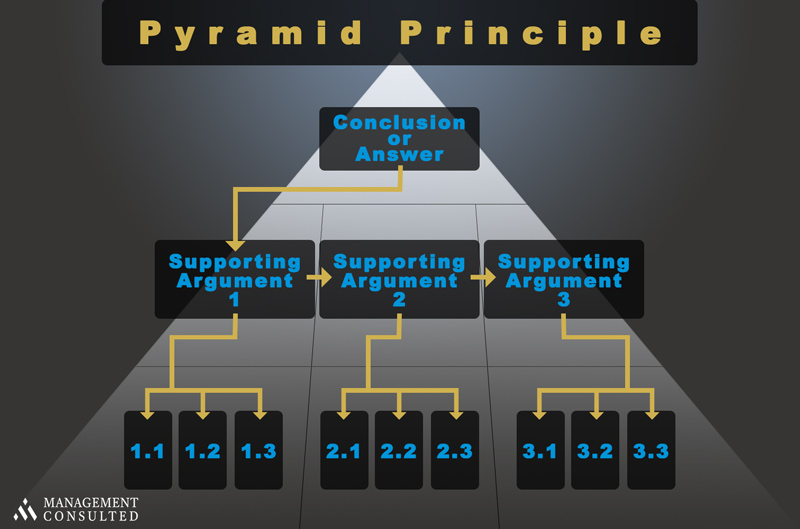
The hard part is deciding whether something belongs in the first row rather than the second. Ask: If I leave this out of the opening, could the audience misunderstand the issue or make the wrong next move? If yes, bring it forward. If no, but a reasonable executive may ask for it, prepare it as support.
That test protects two details that often get cut by mistake: a material qualification and a decision-relevant exception. In our example, saying “enterprise pipeline is down $15 million” without adding that the bookings impact is unverified could invite an unsupported conclusion. Conversely, listing every unaffected segment is unnecessary unless an apparent exception changes how the audience interprets the concentration in enterprise.
An analyst’s work may begin with rows of data, definition checks, and reconciliations. The executive’s discussion usually begins with the result those checks can support. This segment of Data Presentation Tutorial | Effectively Communicate Insights to Stakeholders, from Value Driven Analytics, examines that difference.
Data Presentation Tutorial | Effectively Communicate Insights to Stakeholders
Watch how the presenter distinguishes the work behind an analysis from the findings and proposed action that need meeting time.
Watch summary first for the case for delivering key findings and actions even when meeting time shrinks. Then watch method versus findings: notice the warning against spending the available time narrating how the analysis was performed before reaching what it found. Finally, watch prepared depth for the distinction between anticipating questions and answering every possible question unprompted.
The video’s advice to avoid a long methodology walkthrough is sound when the method is not itself the decision point. If a forecast change depends on a disputed qualification rule, that rule belongs in the discussion early. “Keep methods in reserve” is a default, not a reason to conceal a fragile assumption.
Adjust depth to the audience and the medium
Executive audience does not mean uniformly shallow detail. From the previous lesson, you know that the CEO may first need the company-level consequence, the CRO the commercial movement, and the CFO the reliability of a financial interpretation. Let those likely questions influence which supporting detail you prepare. But do not assume a job title tells you exactly how deep someone wants to go: the question they ask and the decision in front of them are stronger guides.
The medium also changes what must be explicit. In a live meeting, you can state the essential point, observe where confusion arises, and retrieve a movement table or definition note when needed. In a written update read without you present, you need enough context for a reader to understand the measure, the comparison, the uncertainty, and the requested action without asking an immediate clarifying question.
Storytelling with Data’s The Right Amount of Detail makes this live-versus-written distinction and adds another consideration: how much support an audience needs to trust a selective view.
Read Storytelling with Data’s discussion of why the same finding may need different amounts of visible explanation in a live presentation and a written communication.
Under “The method of communication,” read live versus written, from the opening sentence through the paragraph’s conclusion about written communication. Under “The level of trust your audience has in you,” read the trust consideration. Then read the question test in the next paragraph, stopping after the distinction between questions to answer directly and those to address on the fly. Consider which first-order question a written note cannot leave unanswered.
Trust does not mean asking an audience to take an unsupported claim on faith. It affects how much supporting work you may need to show, not whether you must do that work. If the numbers conflict with a figure leaders recently saw, for instance, even a short verbal update should acknowledge the discrepancy and say whether it has been resolved.
A practical distinction for your usual materials is:
- Verbal update: state the issue, its decision relevance, and the immediate ask; keep the detailed breakdown ready.
- Executive slide: display only the evidence needed to understand the point being discussed; make definitions or qualifications visible when they affect interpretation.
- Written note or pre-read: include enough context and sourcing that the message stands on its own, with detailed tables available separately.
- Spreadsheet or dashboard: retain the depth needed to check and explore the analysis, but do not make the audience navigate it to discover your main point.
These are choices about presentation depth, not about doing less rigorous analysis.
What an appropriate level looks like in practice
Suppose the immediate goal is approval for a short investigation, not a forecast change. Your opening could contain this much:
“Qualified pipeline for next quarter has fallen by $15 million, from $75 million to $60 million, with the decline entirely in enterprise. We have not yet established which opportunity movements caused it or whether it changes the bookings outlook. I’m asking for approval to reconcile those movements with sales and finance and return with a forecast assessment.”
That opening omits stage-by-stage counts and individual deals because neither is required to understand the requested investigation. It does not omit the uncertainty about bookings, because that uncertainty determines what should—and should not—be decided today. The proposed review would still need an owner and return date before it became a complete action request.
Now suppose the meeting invitation instead asks whether leaders should revise the forecast. Reusing the same opening and proceeding straight to “yes” or “no” would not provide enough evidence. You would need a forecast assessment and its material assumptions, or you would need to say plainly that the information is not yet sufficient for that decision. The communication goal changes the threshold for detail.
You can apply the same test when an executive requests a deep dive. Do not rigidly defend a short script: give the requested breakdown and connect it to the question under discussion. Conversely, do not treat having prepared a detailed appendix as an obligation to present every page. Preparation gives you the ability to go deeper selectively.
Key takeaway
Choose detail by asking what the audience must know to take the intended next step. Put the signal, its significance, the requested action, and any qualification that could change the decision up front. Keep explanatory breakdowns and verification material accessible, and bring them into view when the question or stakes require them. A short message is effective only if it remains accurate.
In the next lesson, you will concentrate that opening further: writing a one-sentence bottom line that states the main point and why it matters to the business.