Recommended resources
The freely available resources this lesson will direct you to.
Good to see you again. You have just established the PT side of a yield market: buying PT below its maturity redemption value can lock in a return in the relevant redemption unit, provided the position is held to maturity. A YT is the complementary exposure. It gives up that fixed-return certainty in exchange for the future yield actually generated by the underlying position.
This lesson makes that trade measurable. By the end, you will be able to translate a YT’s all-in purchase cost and its expected incentive cash flows into the minimum realized underlying yield required to break even. That is the central calculation for evaluating whether a quoted YT entry is an attractive yield view or simply an expensive one.
The economic claim a YT represents
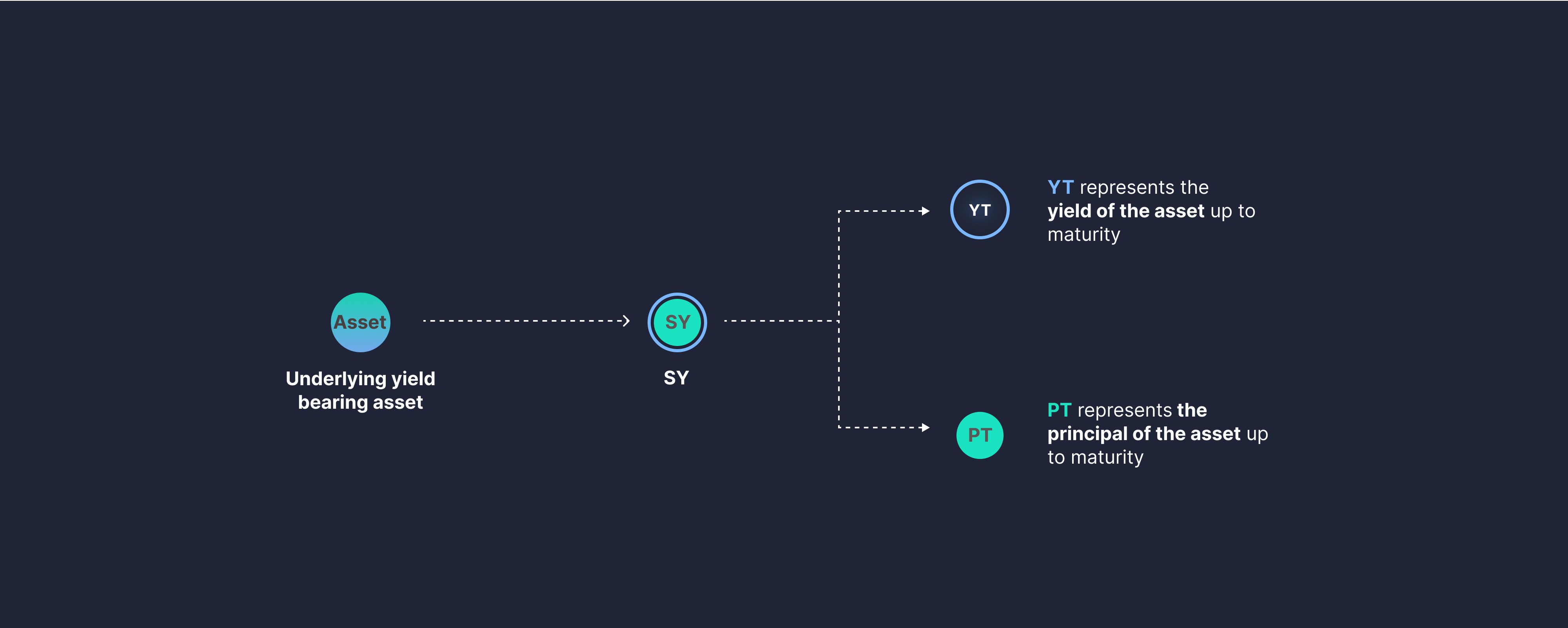
A YT is a claim on the future yield produced by a specified yield-bearing position during a defined remaining term. It is not a claim on the principal itself. At maturity, the remaining future-yield period is zero, so the YT’s standalone value tends toward zero after the final yield entitlement has been settled.
This means a YT investment is best analyzed as a finite cash-flow position:
- You pay an acquisition cost today.
- You receive the underlying position’s realized yield through maturity.
- You may receive protocol incentives or emissions, if the market terms allocate them to YT holders.
- At maturity, the YT itself has no remaining future yield to sell.
The key question is therefore not “will the YT price rise?” That matters for a pre-maturity trading exit, but for a maturity-held position the basic question is:
Will the total yield and incentive cash flows received exceed the all-in cost paid for the YT?
Exponent’s documentation frames YT risk in exactly these terms: YT holders are exposed to realized yield relative to the cost implied at entry, while the token itself loses time value as maturity approaches.
Read Exponent’s official “Yield Markets” documentation to anchor the calculation in the platform’s treatment of YT returns and directional risk.
In the “Understanding Risks and Returns” section, read all of the risk bullets and then the “YT Returns” subsection. Focus on YT directional risk, then continue through the statement that a YT is profitable only when total yield received exceeds acquisition cost. Treat “Implied APY” as an entry-pricing reference, not as a guaranteed realized outcome.
The maturity break-even equation
For a position held until maturity, express every cash flow in the same unit of account. A USDC-denominated yield source is the cleanest case because the YT cost, yield, and incentives can all be measured in USDC. For a SOL- or ETH-related market, the same calculation can be made in units of the underlying asset, but a USDC PnL introduces an additional asset-price exposure.
Define:
| Symbol | Meaning |
|---|---|
| Price paid for the YT position | |
| Trading, routing, conversion, and other entry costs | |
| Expected claim, settlement, or exit costs needed to collect the yield | |
| Total all-in cost | |
| Realized base yield from the underlying asset through maturity | |
| Incentives or emissions received by the YT holder, valued in the same unit | |
| Profit or loss if the YT is held through maturity |
Your all-in cost is:
Your maturity PnL is:
At break-even, PnL equals zero:
So the required base yield is:
This is the fundamental result. The break-even base yield equals your all-in cost less any incentives you actually receive.
Two practical qualifications matter:
- Treat uncertain incentives as scenario inputs, not guaranteed offsets. If an incentive depends on holding conditions, governance decisions, a future token price, or a campaign that can change, calculate separate conservative and upside cases.
- Do not double-count unclaimed yield and YT market value. Before maturity, total PnL includes yield already claimed plus the mark-to-market value of the remaining YT. At maturity, the remaining YT value is normally zero, leaving only the cash flows received.
Converting a cash-flow hurdle into a realized-yield rate
Institutions generally need the answer expressed not only as a dollar or token amount, but also as an annualized yield hurdle.
Suppose the YT represents the yield on units of underlying principal for remaining days. Using the same Actual/365 fixed convention used in the previous PT lesson:
If you model the realized underlying yield using a simple annualized rate, then:
Substituting the break-even base-yield amount gives:
This is a reporting convention rather than a claim that the underlying yield arrives smoothly every day. Staking rewards, lending interest, trading fees, and emissions can accrue differently. The important discipline is to use a cash-flow model that reflects the asset’s actual reward mechanics.
If an investment committee instead uses an effective annual yield convention, the equivalent break-even rate is:
The economic threshold has not changed. Only the annualization convention has changed.
Worked example: a 90-day stablecoin YT
Assume an institution buys a YT representing the yield on USDC of a lending position for the next 90 days.
| Input | Value |
|---|---|
| Underlying principal represented by YT | USDC |
| Remaining term | 90 days |
| YT purchase price | USDC |
| Trading and collection costs | USDC |
| Expected YT-holder incentive | USDC |
| Day-count basis | Actual/365 fixed |
First, calculate the all-in acquisition cost:
Next, subtract the incentive assumed in this scenario:
The underlying lending position must therefore generate at least USDC of base yield during the 90-day period.
The cumulative break-even yield is:
Now annualize it on a simple basis:
The position therefore needs approximately:
over the remaining period, assuming the USDC incentive is received.
Scenario interpretation
| Realized base yield, simple annualized | Base yield over 90 days | Total benefits, including incentive | Maturity PnL |
|---|---|---|---|
| USDC | USDC | USDC | |
| about USDC | about USDC | approximately zero | |
| USDC | USDC | USDC |
Notice what drove the result:
- A higher YT purchase price raises the break-even realized yield.
- Higher fees raise the break-even realized yield.
- More remaining days lower the required annualized rate for a given cash-flow hurdle.
- Incentives lower the required base yield, but only to the extent they are actually earned and can be valued credibly.
If the USDC incentive were not received, the required base yield would be USDC rather than USDC. The simple annualized break-even hurdle would rise from roughly to approximately .
That difference illustrates why it is dangerous to present an incentivized YT return as though it were purely organic underlying yield.
A compact token-unit example
Spectra’s documentation offers a useful one-year YT illustration in ETH terms. Its example has a buyer pay approximately ETH for one YT claim and then compares realized annual yield outcomes of , , and .
Principal & Yield Token | Spectra
Read Spectra’s concise tokenized-yield example. It provides a helpful cash-flow view of why YT buyers profit only when the future yield they receive exceeds what they paid.
In the “Yield Token” section, find the “YT-Example” immediately after the PT example. Read the one-year scenarios. Focus on the subtraction of purchase cost from the ETH yield received; that is the maturity-held PnL logic used in the calculation above.
Using a simplified one-year case with no fees or incentives:
| Item | Amount |
|---|---|
| YT cost | ETH |
| Yield claim received at maturity | Variable |
| Incentives | ETH |
The break-even condition is simply:
If the YT corresponds to the yield on one ETH of principal for exactly one year, that equates to a realized yield threshold under a simple-return convention. A realized yield below produces a loss; a yield above produces a gain.
The point is not that every YT can be analyzed with this shortcut. Actual markets can have shorter terms, changing reward rates, non-ETH-denominated incentives, transaction costs, and standardized-yield conversion mechanics. The point is that a YT purchase is fundamentally a price paid today for a finite, uncertain future-income stream.
The quote-basis discipline
A break-even result is only meaningful if numerator and denominator are in compatible units.
For a USDC lending YT, a USDC calculation is usually straightforward. But consider a YT referencing a SOL-related staking asset:
- The YT may cost a quantity of SOL, SY, or another normalized receipt asset.
- The realized staking yield may accrue as additional SOL-equivalent value.
- Incentives might be paid in a different token.
- A USDC reporting return also depends on SOL and incentive-token prices.
You must choose the question before calculating the answer.
| Question | Appropriate unit |
|---|---|
| “How much staking yield must this YT earn?” | Underlying asset or normalized SY unit |
| “What annualized on-chain yield must be realized?” | Yield relative to represented principal, in underlying units |
| “Will the position make money in USDC?” | USDC, including underlying-asset and incentive-token price changes |
| “Does this beat the treasury’s funding hurdle?” | A base-currency return, adjusted for hedging and financing costs where relevant |
A statement such as “the YT breaks even at 7%” is incomplete unless it specifies:
- the asset unit;
- the represented principal amount;
- the remaining maturity;
- the day-count and compounding convention;
- whether fees are included;
- whether emissions are included, and on what valuation basis.
For a sales or client-facing memo, a reproducible statement would look like this:
“For a 90-day YT claim on 1.0 million USDC of represented principal, purchased at an all-in cost of 13,800 USDC, the break-even base yield is 11,300 USDC after assuming 2,500 USDC of incentives. This equals a 1.13% cumulative yield, or approximately 4.58% simple annualized using Actual/365 fixed.”
That wording separates observed trade inputs from scenario assumptions and makes clear that the threshold is not a promise of future yield.
Break-even realized yield is not the same as a screen APY
The entry implied APY is the market’s pricing of future yield at the moment the YT is bought. Your break-even realized yield is the yield outcome required to recover your own all-in cost.
They can diverge because of:
- execution price versus displayed mid-price;
- slippage on a large order;
- transaction and conversion fees;
- incentives included or excluded from the screen convention;
- a different day-count or compounding convention;
- a different principal amount after SY normalization;
- changes in the value of non-base-asset rewards.
In a frictionless and simplified market, a YT’s entry implied yield can be a useful first approximation for its break-even realized yield. For an institutional ticket, it is not enough. Use the actual expected fill, all costs, and a transparent treatment of each expected cash flow.
Also keep the holding-period distinction clear:
A trader who exits before maturity can profit or lose even if final realized yield later turns out to have been below or above the original break-even threshold. That is a mark-to-market trading result. This lesson’s break-even calculation concerns the cleaner case: holding the YT claim through maturity and collecting its yield.
Key takeaways
A YT is a finite claim on future yield, not on principal. For a maturity-held position:
The base yield needed to break even is:
When the YT represents yield on units of principal for years, the simple annualized break-even rate is:
The operational disciplines are just as important as the formula: calculate from all-in execution cost, normalize all cash flows into one unit, state your time and compounding conventions, and present incentives as explicit assumptions rather than guaranteed organic yield.
Next, you will separate a yield market’s implied forward rate from the underlying asset’s current APY—a distinction that prevents a common but consequential error in institutional yield discussions.