Recommended resources
The freely available resources this lesson will direct you to.
Hello! In the previous lesson, you estimated calculations and checked whether an answer was plausible. Now the first challenge happens before calculation: deciding what a verbal statement says mathematically. In CAT Quantitative Aptitude, a sound equation can make a word problem manageable; an equation with the comparison reversed can make even flawless arithmetic useless.
This lesson focuses on choosing variables, translating comparisons into expressions or equations, and checking that the result still means what the words meant. The aim is to model a problem accurately before spending time solving it.
1. Give each quantity a clear meaning
An expression represents a quantity, such as . An equation states that two quantities are equal, such as . Before writing either one, decide what your variable measures. “Let be the number of basic tickets sold” is useful; “let be a number” leaves you more work to do later.
Consider: “The number of premium tickets is three more than twice the number of basic tickets.” If is the number of basic tickets and the number of premium tickets, then “twice the basic tickets” is . Three more gives
Notice the difference between the expression , which represents the premium-ticket count, and the equation , which states its relationship to the basic-ticket count.
Watch the selected examples in Translating Words To Algebraic Expressions Explained! by The Organic Chemistry Tutor. Concentrate on how the speaker identifies the quantity being described before placing an equals sign.
Translating Words To Algebraic Expressions Explained!
The Organic Chemistry Tutor works from short verbal statements to equations, including subtraction, division, and grouped quantities.
Watch the first translation for “more than” and “is.” Then watch less than for the order of subtraction, the quotient for division, and the grouped sum for the role of parentheses. Focus on which entire quantity each operation acts on.
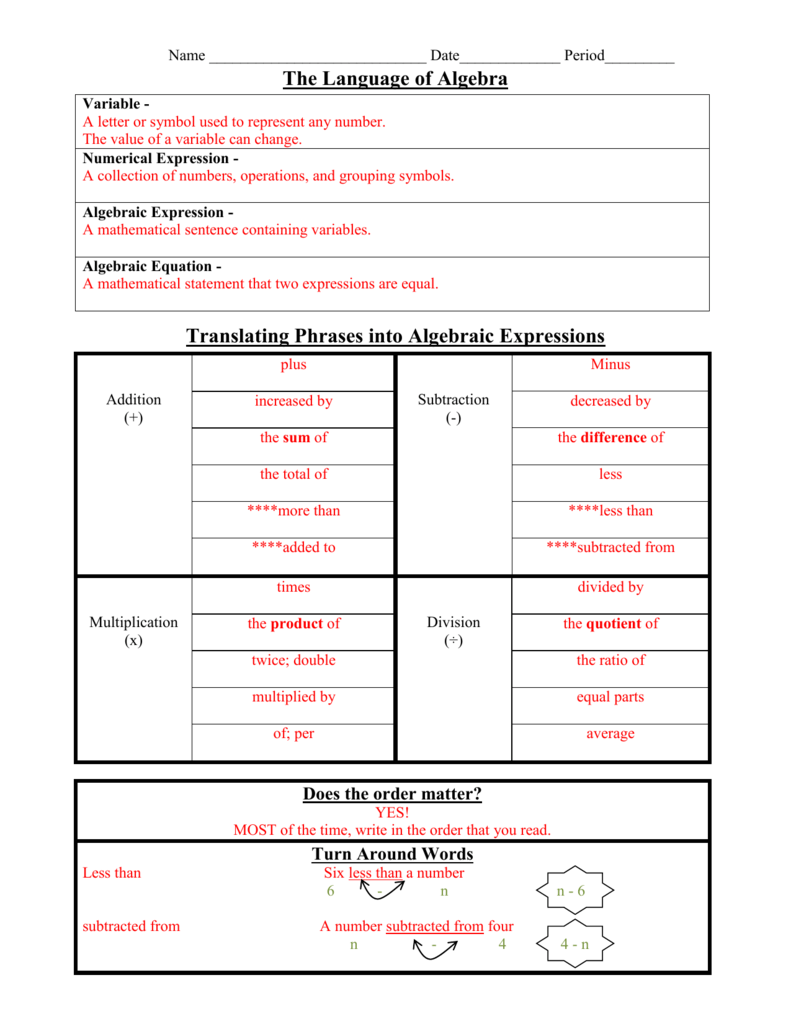
The worksheet below is a quick reference for operation words. Its “turn around words” are especially worth noticing—but treat the chart as a prompt to interpret the sentence, not as a rule to write symbols in the order you hear them.
2. Order and grouping determine the meaning
Addition can conceal an order mistake because and have the same value. Subtraction cannot. “Six less than a number” means start with the number and take away six: . By contrast, “a number less six” means the same thing here, while “the difference of six and a number” means .
It helps to replace a variable temporarily with a familiar value. If the number is , “six less than the number” must be . That confirms , not . The same check works for “six subtracted from ,” which is . For “ subtracted from six,” the result is .
Read the “Translate Words to Algebraic Expressions” section of Prealgebra 2e from OpenStax. Its operation table is useful, but give particular attention to Example 2.25: identifying the right operations is not enough if they act on the wrong-sized quantity.
2.2 Evaluate, Simplify, and Translate Expressions
Read the operation vocabulary and the contrasting grouped expressions to see how short phrases determine mathematical structure.
In “Translate Words to Algebraic Expressions,” start at the paragraph introducing Table 2.7 and read through Example 2.25. Use Table 2.7 as a reference, then compare the two parts of Example 2.25: ask whether “times” applies to a whole sum or just one term.
For example, these phrases use the same numbers and operations but describe different quantities:
- “Three times the sum of a number and four”: .
- “The sum of three times a number and four”: .
With , the first is and the second is . Parentheses are not decoration; they identify what is being tripled. Likewise, “the quotient of seven and the difference of a number and two” is
not . The entire difference is the divisor.
A reliable translation habit is to find the two complete quantities being compared or combined. In “five less than three times the sum of a number and four,” first form the sum , then triple that sum, then subtract five. The resulting expression is . Read it back in words before moving on.
3. Turn comparisons into equations
Many word problems give more than one statement about the same quantities. Rather than assign a separate independent variable to everything, use one comparison to describe one quantity in terms of another.
OpenStax’s Use a Problem-Solving Strategy provides a useful framework: identify what is sought, name a quantity, translate the relationship, and check the result against the original wording. Read the strategy and its two-number example for the modeling steps; solving techniques are not the focus of this lesson.
3.1 Use a Problem-Solving Strategy - Elementary Algebra 2e | OpenStax
Read the strategy and Example 3.5 to see how a comparison and a total become one equation.
Under “Use a Problem-Solving Strategy for Word Problems,” read the strategy. Then, under “Solve Number Problems,” go to Example 3.5, beginning “One number is five more than another,” and read the worked example. Focus on how both numbers are named before their sum is written.
Here is the same modeling move in a CAT-style setting:
A shop sold 12 fewer basic packages than three times its premium packages. It sold 148 packages in total.
Let be the number of premium packages. The basic-package count is : the phrase says 12 fewer than three times the premium count. Because the two counts total 148, the equation is
That is the translation. Solving it gives , so the basic count is . The check is verbal as well as numerical: is 12 fewer than three times , and .
Comparisons can also express multiplication rather than an added difference. If and are two counts, “ is three times ” means , whereas “ is three more than ” means . If “ exceeds by eight,” then , or equivalently . Both forms express the same comparison; choose whichever makes the remaining information easier to use.
A useful test is to ask what happens when the reference quantity changes. In “three more than ,” the gap stays at three. In “three times ,” the ratio stays at three. That distinction will matter throughout arithmetic word problems.
4. Check the model before calculating
Under CAT time pressure, translation should be deliberate but brief. For a short stem, try to establish the variable meanings and central relationship before doing any arithmetic. Three checks catch many modeling errors:
- Direction: If is five less than , your equation should make smaller. Test with if the order is uncertain.
- Scope: In “twice the difference,” does the multiply the whole difference? Write , not .
- Units: A count must equal a count; a total count must add its component counts. If a statement concerns money, ensure you have not equated an amount of money with a number of items.
Do not turn every occurrence of “is” into an equals sign without reading the rest of the claim. “ is six less than ” gives ; “ is less than ” says only . Likewise, if a question uses the conversational phrase “two times more than,” look for context that makes the intended comparison unambiguous rather than assuming it always means one particular formula.
The final check is to read your mathematics back into the original sentence. For , you should be able to say, “Premium packages plus basic packages, where basic is 12 fewer than three times premium, total 148.” If that sounds unlike the question, revise the model before solving it.
Key takeaways
Define variables as specific quantities, build expressions from complete verbal phrases, and use equations when a statement relates those quantities. Pay particular attention to subtraction order and to whether multiplication or division applies to a whole grouped expression. A quick numerical example and a read-back check can expose a mistranslation before it costs time.
Next, you will apply this modeling discipline to percentage changes, including successive and reverse changes, where identifying the quantity a percentage is of is often the decisive step.