Recommended resources
The freely available resources this lesson will direct you to.
Hello! Welcome back to our study of many-body formalism.
In the previous lesson, we established the concept of dielectric screening. We saw how the collective response of the electron gas weakens an external potential, and we quantified this effect using the dielectric function, . We found that in the Random Phase Approximation (RPA), the dielectric function is given by a simple and powerful expression:
Here, is the bare Coulomb interaction, and is the non-interacting density-density response function, which we identified with the "irreducible polarization bubble" diagram.
Today, we will build directly on this result. Our goal is to determine the effective interaction, , between two electrons within the interacting medium. This is the "dressed" interaction that one electron feels from another, and it replaces the bare Coulomb force in many-body calculations. We will achieve this by formally summing the infinite series of bubble diagrams that we glimpsed in the last lesson.
1. From Dielectric Screening to the Effective Interaction
In the previous lesson, we defined the dielectric function by considering how an external potential, , is screened to produce a total potential, :
Now, let's shift our perspective. Instead of an external apparatus creating a potential, consider the potential created by one of the electrons in the system, say at position . In a vacuum, another electron at would feel the bare Coulomb potential from it. But inside the solid, the electron at induces a screening cloud, and the electron at interacts with both the electron at and its associated screening cloud.
The total potential created by the electron at is the effective potential we are looking for. We can find it by treating the bare potential from this single electron, , as the "external" potential in our screening formula. Therefore, the effective interaction, , is simply this total potential:
Substituting our RPA expression for , we arrive at the central result:
This equation defines the effective interaction within the Random Phase Approximation. It tells us that the complex many-body screening effect can be captured (in this approximation) entirely by the bare interaction and the much simpler non-interacting response function .
2. Summing the Bubble Diagrams: The Geometric Series
The form of is highly suggestive. If we think of the product as a variable , the expression is . You'll recognize this as the sum of a geometric series: . Applying this expansion to our effective interaction gives:
This expansion has a beautiful and intuitive interpretation in the language of Feynman diagrams.
Let's establish the diagrammatic dictionary:
- The bare Coulomb interaction, GAUGE_SYMMETRIES_GAUGE_GROUPS, is represented by a wavy line.
- The non-interacting polarization bubble, GAUGE_SYMMETRIES_GAUGE_GROUPS, is a simple loop of two solid lines (electron propagators).
- The full effective interaction, GAUGE_SYMMETRIES_GAUGE_GROUPS, is often drawn as a shaded or double wavy line.
With these rules, we can translate the series for term by term:
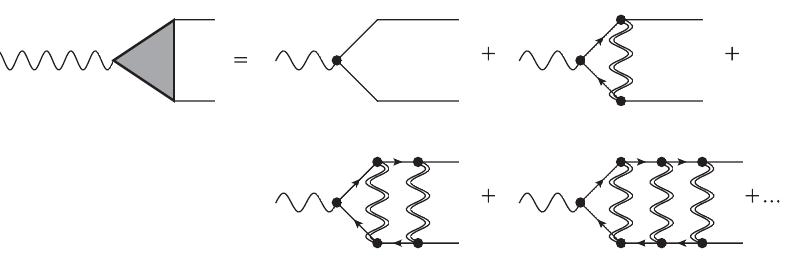
- The first term, GAUGE_SYMMETRIES_GAUGE_GROUPS, is just the bare interaction: two electrons interacting directly.
- The second term, GAUGE_SYMMETRIES_GAUGE_GROUPS, represents a process where two electrons interact, but the interaction is mediated by the creation and subsequent annihilation of a single electron-hole pair ().
- The third term, GAUGE_SYMMETRIES_GAUGE_GROUPS, is a more complex process mediated by two sequential electron-hole pairs.
And so on. The Random Phase Approximation gets its name from an early derivation by Bohm and Pines, but its modern meaning is precisely this: the effective interaction is approximated by summing the infinite series of all diagrams containing only non-interacting polarization bubbles. All more complex intermediate processes (like interactions between the electron and hole in the bubble itself) are neglected.
The following resource provides a formal derivation that connects the self-consistent screening argument to this diagrammatic expansion.
A Perspective on Screened Coulomb Interactions...
The paper 'A Perspective on Screened Coulomb Interactions...' by Jan Tomczak gives a clear derivation of the RPA interaction and its diagrammatic representation. Please note that this paper uses a sign convention where W_RPA = V / (1 + Vχ₀) because their χ₀ is defined to be positive. The physics is identical, but the diagrammatic expansion is the key focus here.
Please read section 2.1 'Derivation of the RPA in the context of screening' and section 2.2 'Diagrammatic representation'. In 2.1, focus on equations (11) and (13) which show the algebraic form of W_RPA and its expansion as a geometric series. In 2.2, focus on equation (24) and the associated diagrams, which visualize this exact series expansion.
3. A Dyson Equation for the Interaction
The infinite geometric series can be expressed more compactly in a self-consistent form. If we factor out the leading term from the second term onwards in the series for , we get:
Recognizing that the expression in the parentheses is just itself, we can write:
This is a Dyson-like equation for the effective interaction. Diagrammatically, it looks like this:
(Shaded wavy line) = (Bare wavy line) + (Bare wavy line)---(Bubble)---(Shaded wavy line)
This equation states that the full effective interaction is equal to the bare interaction plus a term representing the bare interaction followed by a polarization process that involves the full effective interaction . Solving this integral equation for is equivalent to summing the infinite series. This type of equation, which describes the interaction between a particle and a hole, is an example of a Bethe-Salpeter Equation.
Test your understanding!
The RPA sums an infinite series of diagrams. Why is this considered an *approximation*? What kind of diagrams are being left out? (Hint: Think about what could happen *inside* the bubble).Show answer
RPA is an approximation because it only includes a specific subset of all possible diagrams. It assumes the electron-hole pair that forms the polarization bubble propagates freely, without interacting. We are neglecting diagrams where, for example: 1. An interaction line (another wavy line) connects the electron and hole lines *within* the bubble. These are called **vertex corrections**. 2. The electron or hole propagators in the bubble are themselves "dressed" with self-energy corrections.Including these more complex diagrams goes beyond RPA and is necessary for describing phenomena in strongly correlated systems where interactions inside the screening cloud are important.
Conclusion
Today, we have formalized the concept of the screened interaction in an electron gas. We have moved from a qualitative picture to a quantitative and diagrammatic understanding. The RPA provides the first and most fundamental step in understanding how charged particles truly interact inside a material.
Key Takeaways:
- The effective interaction is related to the bare interaction by the dielectric function: .
- Within the RPA, this leads to the expression .
- This expression is equivalent to the sum of an infinite geometric series of Feynman diagrams: . This is the process of "summing the bubble diagrams."
- This infinite series can be written compactly as a Dyson-like equation for the interaction: .
- RPA is an approximation because it neglects all diagrams beyond this simple bubble chain, such as vertex corrections.
Preview of the Next Lesson
We have now derived the formal expression for the effective interaction . The final piece of the puzzle is to understand its physical consequences. The poles (divergences) of correspond to real, collective excitations of the system. In the next lesson, we will analyze the structure of and show how it predicts the existence of a new excitation, the plasmon, which is a quantum of collective charge density oscillation. This will complete our initial tour of screening and set the stage for using to calculate the electron self-energy.