Recommended resources
The freely available resources this lesson will direct you to.
Hello! Welcome to the third lesson in our module on Maxwell's equations.
In the previous lesson, we examined the two "static" laws: Gauss's law for electricity and Gauss's law for magnetism. We learned that electric fields originate from charges, while magnetic fields form continuous loops with no start or end point (no magnetic monopoles). These laws describe the sources of fields.
Today, we will explore the two dynamic laws, which are arguably the most profound parts of the theory. Our learning outcome is to explain the physical meaning of Faraday's law (changing B-field creates E-field) and the Ampère-Maxwell law (currents and changing E-fields create B-fields). These two laws reveal a deep, symmetrical relationship between electric and magnetic fields and are the key to understanding how electromagnetic phenomena like induction and radio waves are possible.
Faraday's Law: A Changing Magnetic Field Creates an Electric Field
In our last lesson, we saw that the electric field from static charges is conservative. This means the work done moving a charge around any closed loop is zero. Mathematically, . This is why you need a battery (a source of chemical energy) to sustain a current in a simple DC circuit; the electric field itself can't do net work over a complete loop.
However, in the 1830s, Michael Faraday discovered something remarkable: a changing magnetic field can generate a current in a wire loop, even without a battery. This implies the existence of a new kind of electric field—one that is non-conservative and can do work on charges around a closed loop.
To build an intuition for this, let's watch a video that explains Faraday's discovery and its physical meaning.
I never understood Faraday's law intuitively...until now! (Maxwell's equations Part 2)
The video 'I never understood Faraday's law intuitively...until now!' from the FloatHeadPhysics channel offers a superb physical explanation of this law. It starts by reviewing why static E-fields don't do work in a closed loop and then masterfully builds up to the core idea behind induction.
Please watch from 00:43 to 19:20. Focus on these key points: The argument for why the line integral of a static E-field around a closed loop is zero. Faraday's experimental discovery that a moving magnet (i.e., a changing magnetic field) induces a current. The core intuitive idea: 'Nature hates flux changes' and induces a current to create a magnetic field that opposes this change. How this leads to the mathematical form of Faraday's Law, connecting the induced EMF (work done per charge) to the rate of change of magnetic flux.
As the video explained, the central idea is that nature resists a change in magnetic flux.
- Magnetic Flux (): A measure of how much magnetic field passes through a given area, like the area enclosed by a wire loop.
- Change in Flux: You can change the flux by changing the magnetic field strength, changing the area of the loop, or changing the orientation of the loop relative to the field.
- The Response: When the flux changes, an electric field is created that circulates around the loop. This field exerts a force on the charges in the wire, driving a current. This induced current generates its own magnetic field that opposes the original change in flux. This opposition is known as Lenz's Law.
This gives us the third of Maxwell's equations, Faraday's Law of Induction, in its integral form:
Let's break this down:
- The left side, , is the electromotive force (EMF), symbolized by . It's the line integral of the electric field around the closed loop, representing the work per unit charge done by the induced electric field. Given your math background, you'll recognize this as a statement that this induced field is non-conservative (its curl is non-zero).
- The right side, , is the negative rate of change of magnetic flux through the surface bounded by the loop. The minus sign is the mathematical representation of Lenz's Law—the induced EMF opposes the change in flux.
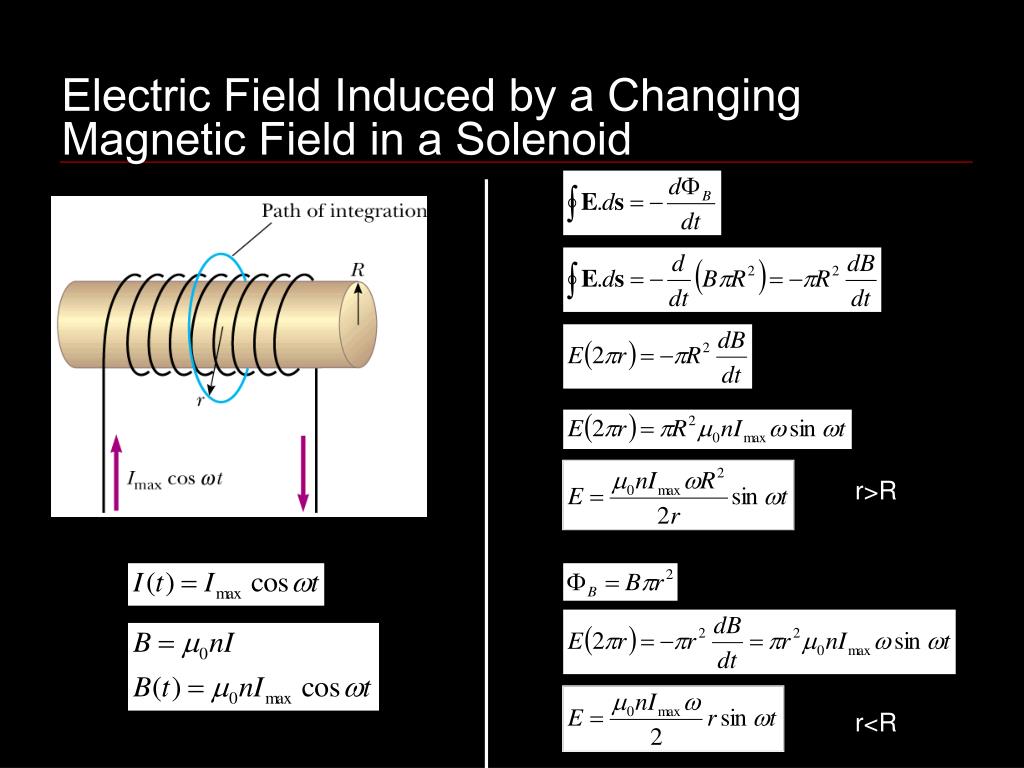
To formalize this, it's useful to distinguish the two ways an EMF can be generated, as they have different physical origins.
The Wikipedia article on Faraday's Law of Induction provides a clear distinction between the two mechanisms that can generate an EMF. We will focus on the one directly related to a changing magnetic field.
Please read the introduction, then the section on 'Transformer emf', and finally the section on the 'Maxwell-Faraday equation'. Focus on understanding that a time-varying magnetic field itself (even in empty space) is always accompanied by a spatially varying, circulating electric field. This is the core physical meaning we are after.
The key takeaway is that the phenomenon Faraday discovered is fundamentally about the fields themselves: a changing magnetic field creates an electric field. The presence of a wire loop simply allows us to observe this induced electric field by the current it drives.
The Ampère-Maxwell Law: Currents and Changing Electric Fields Create Magnetic Fields
Now we turn to the fourth and final equation. The story begins with Ampère's Circuital Law, which you may have encountered before. In its original form, it stated that an electric current produces a circulating magnetic field around it: .
This law worked perfectly for steady currents. However, James Clerk Maxwell noticed a critical flaw. Consider a charging capacitor. Current flows to the capacitor plates, but no charge physically crosses the gap between them. If you draw a loop around the wire, Ampère's law correctly predicts a magnetic field. But if you imagine a surface that passes through the gap of the capacitor, no current penetrates it, so Ampère's law would incorrectly predict a zero magnetic field around the gap. Yet, experiments showed a magnetic field was present.
This is where Maxwell made his most brilliant contribution. He proposed that there must be another source of magnetic fields.
Displacement current & Ampere Maxwell's law | Electromagnetic waves | Physics | Khan Academy
This Khan Academy video does an excellent job explaining the problem with the original Ampere's Law and how Maxwell fixed it.
Please watch from the beginning to 09:45. Pay close attention to: The capacitor example and why it breaks the original Ampere's law. Maxwell's reasoning by analogy to Faraday's Law: if a changing \vec{B} creates an \vec{E}, perhaps a changing \vec{E} creates a \vec{B}. The introduction of the 'displacement current' term and the complete Ampère-Maxwell law.
As the video explained, Maxwell postulated that a changing electric field must also create a circulating magnetic field, just as a real current does. He called this effective current the "displacement current".
This insight completes the fourth equation, now known as the Ampère-Maxwell Law:
Here's the breakdown:
- The left side is the line integral of the magnetic field around a closed loop.
- On the right side, we now have two sources for this circulating magnetic field:
- : The familiar conduction current of moving charges passing through the surface .
- : The displacement current. This term is proportional to the rate of change of the electric flux through the surface. It is this term that creates the magnetic field in the gap of the charging capacitor, where the electric field is changing.

So, the full physical meaning is: a circulating magnetic field is produced by both the flow of electric charge (current) and by a changing electric field.
Test your understanding!
Consider a single, static point charge in empty space.
- Does it produce an electric field?
- Does it produce a magnetic field?
Now, imagine the charge starts to accelerate from rest. - As its velocity changes, what happens to the electric field at a distance from the charge?
- According to the Ampère-Maxwell law, what is the consequence of this change?
- According to Faraday's law, what is the consequence of the result from step 4?
Show answer
- Yes, a static charge produces a static, radial electric field (Gauss's Law for ).
- No, a static charge has no current associated with it and its E-field is not changing, so it produces no magnetic field (Ampère-Maxwell Law).
- The electric field at any point in space will change over time as the source charge moves and accelerates. This means there is a non-zero .
- The changing electric field (a non-zero displacement current) will create a circulating magnetic field around it.
- This newly created magnetic field is itself changing, so by Faraday's law, it will induce a new circulating electric field, and so on. This is the beginning of a self-propagating electromagnetic wave.
The Grand Synthesis: A Dance of Fields
Individually, Faraday's Law and the Ampère-Maxwell Law are powerful. Together, they are revolutionary. They reveal a beautiful symmetry in nature:
- Faraday's Law: A changing -field creates a circulating -field.
- Ampère-Maxwell Law: A changing -field creates a circulating -field.
This creates a perpetual feedback loop. A changing magnetic field creates a changing electric field, which in turn creates a new changing magnetic field, and so on. This "leapfrogging" of electric and magnetic fields, sustaining each other as they travel, is an electromagnetic wave.
Maxwell's equations - Vacuum equations, electromagnetic waves and speed of light
The Wikipedia page on Maxwell's equations has an excellent section that describes how these two dynamic laws lead directly to the prediction of electromagnetic waves.
Please read the section titled 'Vacuum equations, electromagnetic waves and speed of light'. You don't need to follow every step of the curl derivations, but focus on the conceptual conclusion: how the interplay between Faraday's law and the Ampère-Maxwell law in a vacuum (no charges or currents) leads to a self-perpetuating wave that travels at a specific speed, c.
This was Maxwell's ultimate triumph. By combining these equations, he was able to calculate the speed of these waves using the constants and from tabletop electricity and magnetism experiments. The value he calculated, , was astonishingly close to the known speed of light. He had not only unified electricity and magnetism but had also discovered the fundamental nature of light itself.
Conclusion
Today we've completed our tour of Maxwell's four equations by exploring the two dynamic laws that govern how fields interact and change.
Key Takeaways:
- Faraday's Law of Induction states that a time-varying magnetic flux creates a circulating, non-conservative electric field. This is the principle behind electric generators and transformers. ()
- The Ampère-Maxwell Law states that a circulating magnetic field is created by both conduction currents (moving charges) and by a time-varying electric flux (the "displacement current"). ()
- Symmetry and Waves: Together, these two laws reveal a deep symmetry where changing electric and magnetic fields generate one another. This mechanism allows for the existence of self-propagating electromagnetic waves that travel at the speed of light.
Preview of the Next Lesson:
We have just seen that Maxwell's equations predict the existence of electromagnetic waves. In our next and final lesson of this module, we will explore this consequence in more detail. We will describe how this interplay between changing electric and magnetic fields leads to the propagation of these waves, unifying electromagnetism with optics.