Recommended resources
The freely available resources this lesson will direct you to.
- NVIDIA Triton Inference Server and its use in Netflix's Model Scoring Servicewww.youtube.com
- Mastering LLM Inference Optimization From Theory to Cost Effective Deployment: Mark Moyouwww.youtube.com
- NVIDIA Triton Inference Server - Emergent Mindwww.emergentmind.com
- Triton Inference Server vs vLLM: The Platform Trade-Off Behind AI ...sider.ai
Introduction
Welcome to the final lesson in our "Inference at Scale" module. In our previous lesson, we took a deep dive into the memory optimization of a single Large Language Model, focusing on how specialized libraries like vLLM use PagedAttention to overcome the KV cache bottleneck. We saw how applying concepts from operating systems—like virtual memory and paging—can yield massive throughput gains for a specific, demanding workload.
However, a real-world AI system is rarely about just one model running in isolation. Production environments are complex ecosystems with multiple models of different types (vision, language, classical ML), developed using various frameworks (PyTorch, TensorFlow, etc.), serving numerous concurrent users, and running on heterogeneous hardware. This creates a significant management and orchestration challenge.
This lesson zooms out from the single-model optimization to the system-level orchestration required for production deployment. Our goal is to address the learning outcome: Describe the role of a dedicated inference server (e.g., Triton) in managing models, requests, and hardware resources. We will use NVIDIA's Triton Inference Server as our primary example to understand how these systems provide a crucial abstraction layer that simplifies and scales AI inference.
The Problem: From a Model to a Production Service
Imagine you're tasked with deploying several machine learning models for your company. A computer vision team has a ResNet model in TensorFlow. A natural language processing team has a BERT model in PyTorch for classification. And a new team is experimenting with an LLM for a chatbot feature. How do you get from these model files to a robust, scalable, and manageable production service?
You would face several immediate challenges:
- Framework Heterogeneity: Each model requires its own environment and serving code. You might end up with separate Flask apps for each one, leading to duplicated effort and maintenance headaches.
- Hardware Utilization: A single model might not fully utilize a powerful GPU. How can you run multiple models concurrently on the same hardware to maximize your return on investment?
- Dynamic Management: What happens when a model is updated? Do you need to take the entire service down? How do you perform A/B tests on a new model version?
- Performance Optimization: How do you batch incoming requests from multiple users to improve throughput without writing complex, custom logic for each model?
This is precisely the problem space that a dedicated inference server is designed to solve.
NVIDIA Triton: A Unified Inference Server
An inference server acts as a standardized, high-performance "engine" for executing models. It sits between the client applications and the underlying hardware, providing a unified control plane for managing the entire inference lifecycle.
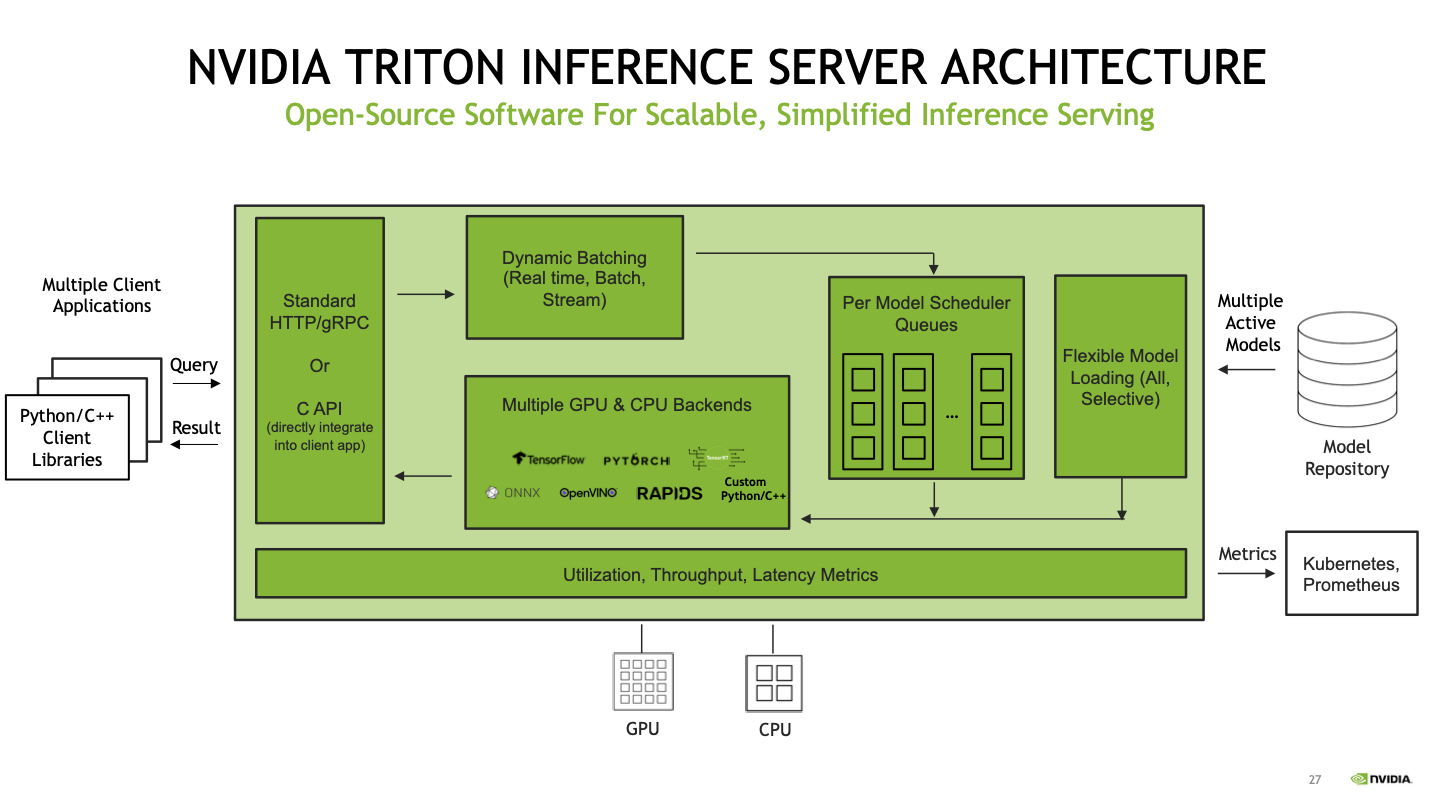
The core design philosophy of Triton is platform unification. Instead of building bespoke solutions for each model, Triton provides a single, consistent way to deploy, manage, and scale all of them.
To get a better sense of the problems Triton solves and where it fits in the full inference stack, please watch the following video.
NVIDIA Triton Inference Server and its use in Netflix's Model Scoring Service
This video from NVIDIA provides a great introduction to the common challenges in AI deployment and positions Triton within the broader inference platform. It clarifies the server's role in addressing issues like latency SLAs, interoperability, and integration.
Please watch from 01:10 to 10:53. Focus on the 'common challenges' discussed at the beginning (speed, interoperability, integration) and how the 'full stack' view positions Triton as the model server layer that handles scheduling and concurrency.
Core Capabilities: Managing Models, Requests, and Hardware
Let's break down Triton's role based on the three key areas it manages.
1. Model Management
Triton decouples model management from the application logic, providing a flexible and dynamic way to handle a diverse portfolio of models.
- Model Repository: Triton points to a simple directory structure (on local disk or cloud storage) that acts as a model repository. Each model has its own sub-directory containing the model file(s) and a configuration file. Triton can monitor this repository and automatically load, unload, or update models without any server restarts.
- Multi-Framework Support: Triton uses a "backend" system to support models from virtually any framework (TensorFlow, PyTorch, ONNX, TensorRT, and even custom Python code). This allows you to standardize your deployment process regardless of how the model was trained.
- Model Versioning: The model repository structure explicitly supports versioning. You can have
v1,v2, etc., of a model available simultaneously. Triton's configuration allows you to control which versions receive traffic, making it easy to implement canary rollouts or A/B tests. - Ensemble Models: Triton can chain multiple models together into a single "ensemble" model. This is extremely powerful for multi-stage pipelines (e.g., pre-processing -> inference -> post-processing). The data transfer between stages can happen entirely within GPU memory, avoiding costly roundtrips to the CPU.
2. Request Management
Triton provides a standard, efficient front-end for handling client requests.
- Standardized API: Clients communicate with Triton via gRPC or HTTP/REST protocols. This means a client application doesn't need to know if the underlying model is a PyTorch or a TensorFlow model; it just sends its data to a standard endpoint.
- Dynamic Batching: This is one of Triton's most critical performance features. Triton can automatically intercept individual requests as they arrive, wait for a configurable amount of time to collect a batch, and then send the entire batch to the GPU for execution. This dramatically increases throughput by better utilizing the GPU's parallel processing capabilities.
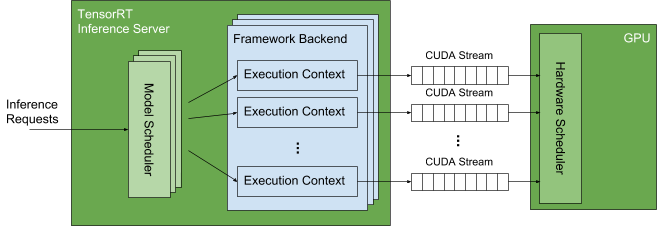
- Request Scheduling: As seen in the architecture diagram below, Triton has a sophisticated internal scheduler. It maintains queues for each model and can be configured with different scheduling strategies and priorities to meet varying service-level agreements (SLAs).
3. Hardware Resource Management
Triton's primary goal is to maximize the utilization and efficiency of your expensive hardware resources.
- Concurrent Model Execution: For many models that aren't as resource-intensive as large LLMs, a single model instance won't saturate a modern GPU. Triton can load multiple different models, or multiple instances of the same model, onto a single GPU and execute them concurrently. This spatial sharing is key to achieving high hardware utilization and lowering the total cost of ownership.
Mastering LLM Inference Optimization From Theory to Cost Effective Deployment: Mark Moyou
This short clip contrasts the deployment paradigm for general models with that of LLMs, perfectly illustrating the value of Triton's concurrent execution capability.
Watch from 16:25 to 17:30. The speaker highlights how, for non-LLM models, deploying multiple models on a single GPU is essential to avoid waste. This is a core function that Triton automates.
- CPU/GPU Placement: Triton can seamlessly manage models across both CPUs and GPUs. You can configure a model to run specifically on the CPU (e.g., a lightweight pre-processing script) or on a GPU.
- GPU Partitioning: On modern NVIDIA GPUs, Triton supports technologies like Multi-Instance GPU (MIG), allowing a single GPU to be physically partitioned into several smaller, independent GPU instances. Triton can manage these instances as separate resources, providing a strong isolation boundary for multi-tenant workloads.
The following reading provides a concise summary of these features and how they fit together.
NVIDIA Triton Inference Server - Emergent Mind
This article from Emergent Mind gives a clear, structured overview of Triton's design principles and capabilities, with a helpful summary table.
Please read Sections 1 ('Design Principles and Architecture'), 2 ('GPU Resource Management'), 5 ('Performance Bottlenecks...'), and the final 'Summary Table'. This will reinforce the key functions we've just discussed.
Case Study: Triton at Netflix
Theoretical features are best understood through real-world application. Netflix adopted Triton to build their centralized "Model Scoring Service," providing a clear example of why an inference server is so valuable at scale.
NVIDIA Triton Inference Server and its use in Netflix's Model Scoring Service
In this segment, engineers from Netflix explain their motivation for building a dedicated inference service and how they leveraged Triton as its core engine. They discuss serving a mix of models, including traditional ML models and, more recently, LLMs.
Watch from 18:24 to 32:27. Pay attention to: (1) Why they wanted to separate model inference into a dedicated service. (2) The benefits Triton provided (cost efficiency, model diversity, dynamic batching). (3) How they are extending this architecture to serve LLMs using the TensorRT-LLM backend, showing Triton's flexibility.
The Netflix case study demonstrates how Triton acts as a foundational platform piece, allowing application teams to offload complex, resource-intensive inference tasks to a standardized, optimized, and centrally managed service.
Design Trade-off: Generalist vs. Specialist Servers
In our last lesson, we focused on vLLM, a specialist server highly optimized for one thing: LLM inference. Triton, by contrast, is a generalist server designed for platform-wide leverage. This distinction represents a fundamental design trade-off in building AI systems.
- Choose Triton if your constraint is platform coherence. If you need to serve a diverse portfolio of models (vision, speech, ranking, LLMs) under a unified governance and MLOps framework, Triton's platform leverage is invaluable. It reduces operational complexity and total cost of ownership across the organization.
- Choose vLLM if your constraint is LLM throughput. If your product's success is existentially tied to the cost-per-token and latency of an LLM-powered chat or agent, a specialized server like vLLM that exploits the specific characteristics of that workload will likely provide the best performance.
Many large-scale systems end up using both: Triton for the broad portfolio of ML models, and a specialized server like vLLM for the most demanding generative endpoints, with a routing layer in front to direct traffic appropriately.
This article provides an excellent strategic analysis of this trade-off.
Triton Inference Server vs vLLM: The Platform Trade-Off Behind AI ...
This blog post frames the 'Triton vs. vLLM' debate not as a technical benchmark, but as a strategic choice based on your business constraints. It's a superb resource for thinking about system design trade-offs.
Please read the sections 'Background', 'Architecture Differences that Matter in Production', 'Choosing by Use Case', and the 'Appendix: Quick Comparison'. This will crystallize the different roles these two types of servers play.
Conclusion
In this lesson, we elevated our perspective from optimizing a single model to managing an entire fleet of models in a production environment. We established the critical role of a dedicated inference server like NVIDIA Triton in simplifying this complexity.
Key Takeaways:
- Centralized Management: An inference server provides a unified control plane for deploying, scaling, and managing diverse ML models, abstracting away framework-specific and hardware-specific details.
- Triton's Core Functions: Triton manages models (via a model repository, multi-framework backends, and versioning), requests (via a standard API, dynamic batching, and scheduling), and hardware (via concurrent execution, CPU/GPU placement, and partitioning).
- Performance and Efficiency: Key features like dynamic batching and concurrent model execution are designed to maximize hardware utilization and throughput, thereby lowering the total cost of ownership.
- Strategic Trade-Off: There is a crucial design choice between a generalist server like Triton, which offers platform leverage and coherence across many workloads, and a specialist server like vLLM, which offers peak performance for a specific workload. The right choice depends on your primary system constraints.
Preview of the Next Lesson:
This lesson concludes our module on "Inference at Scale." We've covered the full stack, from low-level memory optimizations with PagedAttention to high-level system orchestration with Triton.
In our next module, "Emerging Architectures and Future Trends," we will explore hardware architectures designed specifically for AI that differ from the general-purpose GPU. We will begin by examining systolic array-based accelerators, such as Google's TPUs, and analyze how their architectural design choices are tailored for the massive matrix multiplication workloads at the heart of deep learning.