Recommended resources
The freely available resources this lesson will direct you to.
Hello! Your project brief now defines what the first case must deliver. The company choice should make that brief finishable: an interesting business is not enough if its disclosures are hard to verify or its structure takes weeks to untangle.
In this lesson, you will shortlist a few publicly listed Indian companies, test them against three years of primary disclosures, and select one for your rapid company-research case. Allow about 45–55 minutes, or two sessions of roughly 30 minutes. You are choosing a subject for a consulting-oriented research brief—not making a stock recommendation or committing to use the same company for every later M&A, PE, and VC project.
Choose for an answerable question
Recruiter relevance does not mean choosing the largest or most famous company. For your first case, it means finding a business about which you can ask a bounded question and produce an evidence-based answer. A useful starting question might be: Has the company’s growth been accompanied by stronger operating performance, and what evidence complicates that interpretation? You will refine the wording after selection.
Apply three tests to each candidate:
- Recruiter relevance: Can the case demonstrate business judgment—growth drivers, competitive position, operating performance, or a strategic trade-off? Would its conclusion be meaningful to a consulting or business-research interviewer and understandable to an M&A interviewer?
- Business clarity: Can you explain what the company sells, who pays it, and how it earns revenue in three sentences? Can you identify at least one operating measure worth investigating? A diversified company is not automatically unsuitable, but complicated subsidiaries and shifting segment definitions can slow a first case.
- Disclosure availability: Can you locate annual reports for three distinct, completed financial years from the issuer or an exchange, with enough business discussion and financial statements to investigate the question?
For a rapid first release, a non-financial operating company is often easier than a bank or insurer: its revenue, costs, and operating margins generally fit the analysis planned in your project brief more directly. That is a time-management preference, not a claim that financial firms make poor subjects.
The following video helps you distinguish an understandable business description from a page of figures you cannot yet interpret.
How to Read Annual Report of any Company [+Worksheet] | Learn & Understand Annual Report Analysis
Watch the selected portions of Shankar Nath’s “How to Read Annual Report of any Company.” They show where a company describes its operations and where reported financial information lives.
Watch business description for products, footprint, and sector-specific operating measures. Then watch drivers and risks in management discussion. Finish with financial sections, focusing on the distinction between the statements and their explanatory notes. For now, use these sections to judge whether a case is workable; you do not need to analyse every number.
If a candidate’s appeal rests mainly on “the share price has risen” or “the company is in a popular sector,” keep looking for a question about the business. Price performance alone will not support the company brief you have promised.
Make three years of reports a firm gate
An investor presentation may display five years of charts, yet still leave you unable to check definitions, accounting notes, or audited figures. For this selection, three years of credible disclosures means that you can actually open annual reports covering three distinct completed financial years—not merely see three columns copied onto a finance website.
Start with the exact legal company name and an NSE symbol or BSE scrip code. Search the company’s investor-relations annual-report archive; use an exchange archive or annual-report announcement to cross-check when needed. Open each PDF and verify its cover year and issuer. For all three years, check that the report contains financial statements and an auditor’s report. For your eventual company-level analysis, check whether consolidated statements are available, particularly if subsidiaries matter.
Read the retrieval guidance below before searching. It gives you a way to find primary documents without treating a search-result snippet as the document itself.
Finding Company Reports, Filings, and Announcements | Grasp
Read Grasp’s “Finding Company Reports, Filings, and Announcements” for the primary-source routes and the checks that prevent a plausible-looking document from becoming a mistaken citation.
Begin with the opening primary-source guidance, from source priorities. In “Annual reports: the starting point for understanding a company” and “Three reliable routes to an annual report,” read the company-site, BSE-archive, and exchange-announcement routes; use PDF checks as your quick checklist. Under “Use the right identifier,” read identifier guidance. Finally, in “A repeatable retrieval routine,” read the routine; apply steps 1, 2, and 6 now, and leave the deeper announcement scan for later.
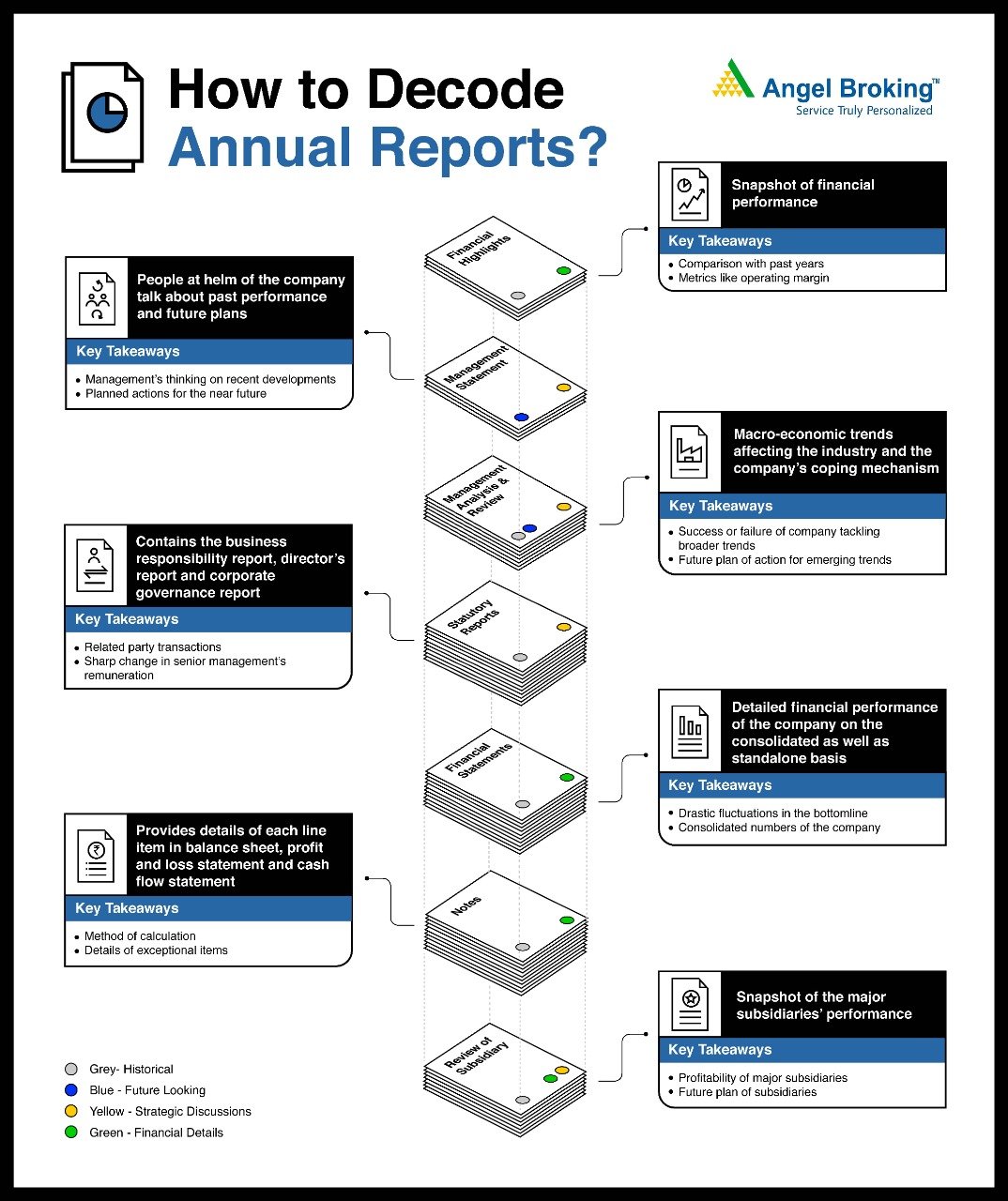
The annual-report map below is a navigation aid. For selection, look for the business discussion, financial statements, auditor’s report, and notes. You are checking that these materials exist and are usable, not yet performing a full financial audit.
A presentation can still help you spot a promising question. The sample below illustrates the distinction: multi-year segment and company-performance charts are useful leads, but they do not establish that the corresponding annual reports have been found or that every plotted measure uses the same definition.
Inspect this exchange-hosted Titan presentation only as an example of a candidate screen, not as a recommendation to choose Titan or as a replacement for annual reports.
Find the slides headed “Consolidated: Annual Segment Trends” (printed slide 48) and “Consolidated: Annual Performance Trends” (printed slide 49). Scan segment trends and company trends. Notice the reporting periods and the note that total income excludes bullion and digital-gold sales. Before using such a series in a case, you would verify its definition and underlying figures against the appropriate annual reports.
That last distinction matters in interviews. “The company reported total income” and “the presentation charts total income excluding specified sales” may be different statements. Record the definition before comparing figures across years or companies.
Run a short, reproducible selection screen
Do this in two passes rather than researching one attractive company indefinitely.
Pass 1: shortlist two or three candidates (about 15 minutes). Pick businesses you are willing to study, preferably with different reasons for being interesting. For each, use an official company or exchange document to jot down its main products or services, customers, and apparent growth or performance question. Do not spend time finding peers, calculating ratios, or reading entire reports yet.
Pass 2: verify feasibility (about 20–25 minutes). For each candidate, record three distinct annual-report years and a working issuer or exchange link for each. Open the PDFs, rather than counting links in search results. Note whether they include consolidated statements, an auditor’s report, and a business discussion that makes your proposed question investigable. A reporting year is not the upload year: for example, a report for a year ending 31 March may be published months later.
Keep this as a selection note, not a full source register; that comes in a later lesson. A compact record in COMPANY_SELECTION.md is enough:
# First company case: selection

## Candidate A: [legal company name]
NSE symbol or BSE scrip code:
Business in three sentences:
Possible decision-oriented question:

| Financial year | Annual-report link | Issuer/exchange | Opened and checked? |
|---|---|---|---|
| [year 1] | [link] | [source] | [yes/no; notes] |
| [year 2] | [link] | [source] | [yes/no; notes] |
| [year 3] | [link] | [source] | [yes/no; notes] |

Consolidated statements, auditor's report, and business discussion:
Definition or comparability concern:
Why this could make a useful first case:
Repeat that small section for each candidate. If a link fails, a document belongs to a similarly named entity, or only a presentation is available for a year, mark the check as not passed. Do not fill the gap with figures from an aggregator.
After the document gate, score the candidates quickly. Give each category 0, 1, or 2, where 2 means clear and workable, 1 means workable with a stated constraint, and 0 means a substantial obstacle.
| Category | What earns a strong score? |
|---|---|
| Decision relevance | A specific growth, performance, or strategy question could lead to a qualified conclusion. |
| Business clarity | You can explain how the company earns money and identify useful operating measures. |
| Analytical evidence | Disclosures offer figures and context for examining the question, not just promotional claims. |
| Speed to publish | Definitions and corporate structure look manageable within the two-page-brief scope. |
Do not score your way around a failed report gate. Among candidates that pass it, choose the one with the strongest combination of an answerable question and a short path to publication. A less glamorous company with clear disclosures may produce a better first portfolio piece than a fascinating company whose numbers require extensive reconstruction.
What does a good decision look like? It is specific and revisable: “I selected [company] because its three checked annual reports support a question about [growth or operating issue]; [reporting complication] is a limitation I can disclose or work around.” It is not “I selected it because its stock looks undervalued.” You have not done the valuation work required to defend that claim.
Update the company and provisional question fields in PROJECT_BRIEF.md once you choose. If none of the candidates passes, leave those fields open and run one more short screen. That is a better outcome than building a case on unverified data.
Takeaway
Your first company should pass a three-annual-report evidence gate and offer a clear, decision-oriented business question. Recruiter relevance, business clarity, and speed then help you choose among the companies that pass. Presentations and data websites can suggest questions; identifiable issuer or exchange disclosures must support the case.
Next, you will give the selected study its own organized place in the master repository so a reviewer can find its sources, analysis, and eventual report without searching through unrelated files.