Recommended resources
The freely available resources this lesson will direct you to.
- How To Pass Coding Interviews Like the Top 1%www.youtube.com
- How to Solve ANY LeetCode Problem (Step-by-Step)www.youtube.com
- Coding interview cheatsheet: Best practices before, during ...www.techinterviewhandbook.org
- How to Ask Clarifying Questions in a Coding Interview: Requirements, Edge Cases, and Examples | PracHub Knowledge Hubprachub.com
Hello! Last lesson, you compared STL operation costs under specific conditions: whether a vector is sorted, whether a list iterator is already available, and whether average-case hash performance is acceptable. In an interview, the prompt may not tell you those conditions. Before choosing a container or writing C++, you need to establish what problem you are actually solving.
This lesson is about turning a short prompt into a working contract: explicit inputs, outputs, constraints, and assumptions. We’ll use one small array problem throughout. The goal is not to solve it yet, but to reach the point where you and the interviewer would agree on what a correct solution must do.
A prompt is not yet a specification
Imagine hearing: “Given an array of integers and a target, return two numbers that add up to the target.”
Several reasonable implementations could disagree. Does “return two numbers” mean their values or their indices? May both numbers come from the same position? What if no pair exists—or several pairs exist? Is the array sorted? A solution can be efficient and still be wrong if it answers a different version of the question.
Watch the clarification segment of Tech With Tim’s How To Pass Coding Interviews Like the Top 1%. Notice how questions about input ranges and possible outputs can remove uncertainty before implementation.
How To Pass Coding Interviews Like the Top 1%
Tech With Tim uses a simple array prompt to show why its apparent simplicity is not enough to define a solution.
Watch clarifying the prompt. Focus on the questions about empty inputs, integer values, and whether a valid result is guaranteed. As you watch, distinguish information supplied by the prompt from information the candidate must ask for.
A useful first move is to restate the task without committing to an algorithm: “I receive a sequence of integers and a target. I need to return a pair whose values sum to that target. I’d like to confirm what the returned pair represents and what happens if it doesn’t exist.” That restatement exposes uncertainty rather than concealing it.
The How to Ask Clarifying Questions in a Coding Interview guide by PracHub offers a compact process: restate, resolve consequential ambiguities, confirm with an example, and proceed. Read the specified portions for a way to select questions rather than reciting an exhaustive checklist.
Read PracHub’s guide for its short opening process, its categories of high-value questions, and its advice for proceeding when an interviewer leaves a choice to you.
In “The quick answer: use a four-step opening,” read the four steps, from the introductory sentence through the “Proceed” row of the table. In “Ask only questions that can change the solution” and “The requirements taxonomy: what to clarify before coding,” read the decision guidance and continue through the final “Invalid and boundary data” row of the table. Finally, in “What if the interviewer says, ‘Make a reasonable assumption’?” read assumptions and pitfalls, continuing through “Common mistakes when clarifying a coding prompt.” Focus on which questions could change code, complexity, or expected output.
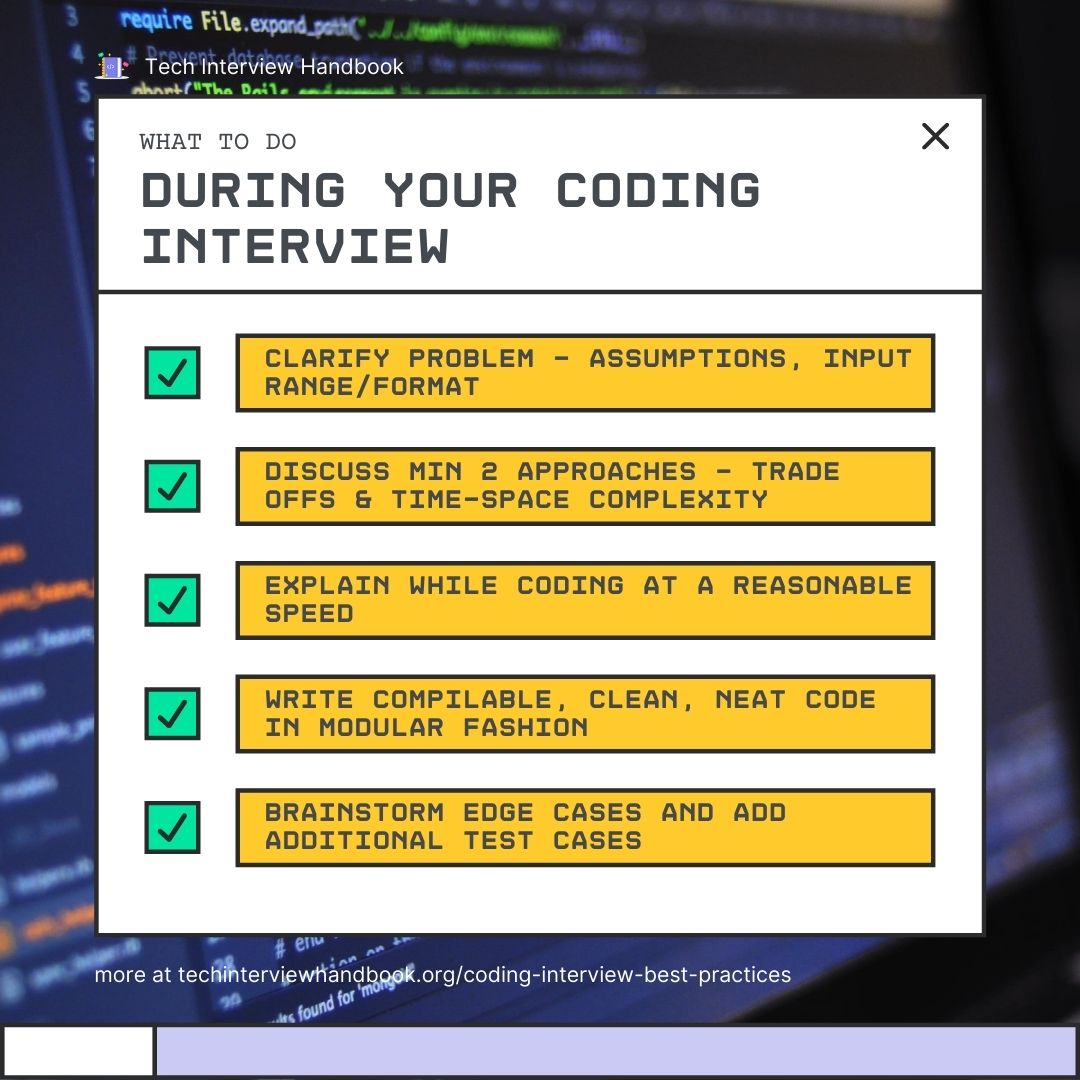
The checklist below puts “clarify problem” first. Its later items—approaches, coding, and tests—depend on knowing what has been agreed.
Write the contract in four parts
You do not need a formal requirements document in an interview. A few precise notes are enough, provided they separate four kinds of information.
Inputs describe what the function receives and in what representation. For the array prompt, that might be a std::vector<int> and an int target. Representation matters: an array supplied as a vector is different from a stream you can read only once. Even “array” does not tell you whether its elements are sorted.
Outputs describe exactly what a successful call returns, including its format. “A pair” is incomplete if the interviewer expects zero-based indices but you return values. The output contract also covers multiple valid answers, their ordering, and the no-solution result.
Constraints limit the accepted inputs or available resources. They include the maximum sequence length, allowed value range, structural guarantees such as sorted order, and restrictions such as “do not modify the input.” A guarantee that a solution always exists is also part of the contract: it changes which outcomes your function must represent.
Assumptions are choices you make where the prompt and interviewer leave a detail open. They must be stated, not silently promoted into guarantees. If you decide to return any valid pair when several exist, that is an assumption until the interviewer accepts it. If the interviewer explicitly says the array is unsorted, that is no longer an assumption; it is a known input condition.
In C++, these details can affect the function interface. If the vector must remain unchanged, a possible parameter is const std::vector<int>&: the reference avoids copying it, and const prevents your function from modifying it through that parameter. But you should not choose an output type such as std::pair<int, int> until you know whether those integers should be indices, values, or something else.
A question earns its place when either answer could change correctness, code, complexity, or validation. “Is the input sorted?” matters because it changes which approaches are available. “Should I use a hash map?” asks the interviewer to design the solution for you; it does not clarify the task. Likewise, do not ask whether duplicates are allowed if the prompt already answers that question.
Resolve the consequential ambiguities
Return to the two-sum prompt. The most useful questions expose forks in the contract:
| Ambiguity | Focused question | Why the answer matters |
|---|---|---|
| Result | “Should I return the values or their zero-based indices?” | Changes the output and how it is checked. |
| Reuse | “Must the pair use two distinct positions?” | Determines whether one element may serve twice. |
| Missing result | “Can there be no valid pair? If so, what should I return?” | Determines whether a failure result is needed. |
| Multiple results | “If several pairs work, may I return any one?” | Determines whether a particular pair must be selected. |
| Input properties | “Is sorted order guaranteed? Can values repeat?” | Changes which reasoning is valid. |
| Scale | “How many elements and how large can their values be?” | Affects performance planning and numeric safety. |
| Mutation | “May I reorder or otherwise modify the input?” | Rules approaches in or out. |
You rarely need to say every row aloud. Prioritize unresolved questions that could make your proposed result wrong. Then establish the limits needed to plan an implementation.
Two small examples make the output questions concrete. For [4, 4] with target 8, using two distinct positions gives indices (0, 1); the equal values do not mean the same element was used twice. For [3, 5, 5] with target 8, both (0, 1) and (0, 2) work. If either is acceptable, you need not build special tie-breaking into the result. If the interviewer requires the lexicographically smallest index pair, you do.
Input ranges can matter even before you select an algorithm. If individual integers can have magnitude near two billion, adding two of them in a 32-bit int may overflow, even if the target itself fits in an int. You would need a wider type, such as long long, for the sum. If the vector can contain 100,000 elements, a quadratic-time approach deserves scrutiny; if it contains at most ten, the same performance concern may be irrelevant. Neither limit should be invented and presented as a fact about an unspecified prompt.
Turn answers into an agreed specification
Suppose the interviewer now confirms the following for our running example. These are hypothetical answers, not facts supplied by the original prompt:
The input is an unsorted vector of up to 100,000 integers, with values of magnitude at most two billion, and an integer target. Return zero-based indices of two different elements whose values sum to the target. Values may repeat. Return any valid pair, written with the smaller index first. If none exists, return
(-1, -1). Do not modify the input.
You can translate that into a concise contract:
- Inputs:
const std::vector<int>& numsandint target; order is arbitrary and duplicate values are permitted. - Output: a pair of distinct indices
(i, j)withi < jandnums[i] + nums[j]equal totarget, or(-1, -1)if no pair exists. If several pairs qualify, any one is acceptable. - Constraints: at most 100,000 elements; values have magnitude at most two billion; the original vector must remain unchanged. Evaluate sums in a type wide enough for the stated range.
- Assumptions still open: none that affect the agreed behavior. If a required detail had not been answered, record the interpretation you intend to use and confirm it briefly.
Notice what this contract does not contain: a prescribed STL container or algorithm. Those are decisions to make after understanding the task. It also does not confuse “unsorted” with “randomly ordered”; the contract simply promises no sorted-order property.
Before moving on, confirm one example aloud: “For [4, 4] and target 8, I would return (0, 1). For [1, 2] and target 8, I would return (-1, -1). Is that consistent with what you want?” An example is useful here because it checks the meaning of the contract, not because it proves an implementation works.
If the interviewer instead says, “Make a reasonable assumption,” choose and state one: “I’ll return any valid pair of distinct indices, and use (-1, -1) when there isn’t one.” Mention the consequence if it matters, then continue. Clarification should get you to a stable contract, not prevent progress while you investigate every imaginable edge case.
Takeaways
Before coding, restate the requested transformation and make its inputs, outputs, constraints, and assumptions explicit. Ask focused questions where different answers would change the solution or its expected behavior. Treat interviewer-confirmed facts differently from assumptions you have chosen, and use a small example to check that you share the same interpretation.
The next lesson turns this agreed contract into boundary, minimal, and representative test cases. Today’s example confirmed what a result means; those tests will help check whether an implementation actually satisfies it.