Recommended resources
The freely available resources this lesson will direct you to.
- UNCOVERED: Hidden Secrets of Pompeii (Full Episode) | Lost Treasures of Romewww.youtube.com
- Exploring the Archaeological Site of Pompeii | with forensic expert Dr Estelle Lazerwww.youtube.com
- DNA evidence rewrites Pompeii Eruption story | Max-Planck-Gesellschaftwww.mpg.de
- Ancient Rome Live | Cities | Dating Pompeii The Material Evidenceancientromelive.org
Hello. Last lesson, you distinguished the kinds of evidence found at Pompeii: a cast, an animal bone, an inscription, and a built feature are not interchangeable. This lesson asks a different question: what can each piece of evidence justify saying? A find can be described accurately while the story told about it remains uncertain.
You will learn to separate archaeological observation from inference when assessing claims about Pompeii. We will use casts, an excavated animal skull, and genetic research to see how interpretations are built, tested, and sometimes revised. Allow about 35–40 minutes, including the selected viewing and reading.
What is observed, and what is inferred?
An observation records a feature of the evidence: a skull was found in a particular area; two casts appear close together; a scan shows bones within a cast. An inference proposes what that feature means: the animal was sacrificed; the people were relatives; a person held a particular social role. Archaeologists need inferences. Without them, excavation would produce descriptions but little understanding. The discipline lies in making the reasoning between evidence and claim visible.
The distinction is not quite “certain fact versus mere guess.” Identifying a skull as belonging to a bull, for example, relies on anatomical knowledge. Reading an inscription also requires expertise. These are interpretations of observed material, but they can be checked against identifiable features. A claim about why the bull died requires further evidence of a different kind.
A useful way to assess a Pompeian claim is to ask:
- What was recorded? Specify the object, feature, measurement, image, or analytical result.
- What conclusion is being drawn? Notice words such as therefore, must have, family, or ritual.
- What connects the two? State the assumption or comparison that makes the conclusion plausible.
- What else could explain the observation? Consider alternatives without pretending they are all equally likely.
- How strong is the conclusion? “Consistent with,” “likely,” and “established by” express different levels of support.
The most important move is often step three. An account can mention genuine evidence and still leap too quickly from that evidence to a vivid story.
A photograph can show proximity, not a relationship
Consider this photograph. Last lesson established that Pompeian casts are material poured into voids in volcanic deposits, not bodies turned to stone.
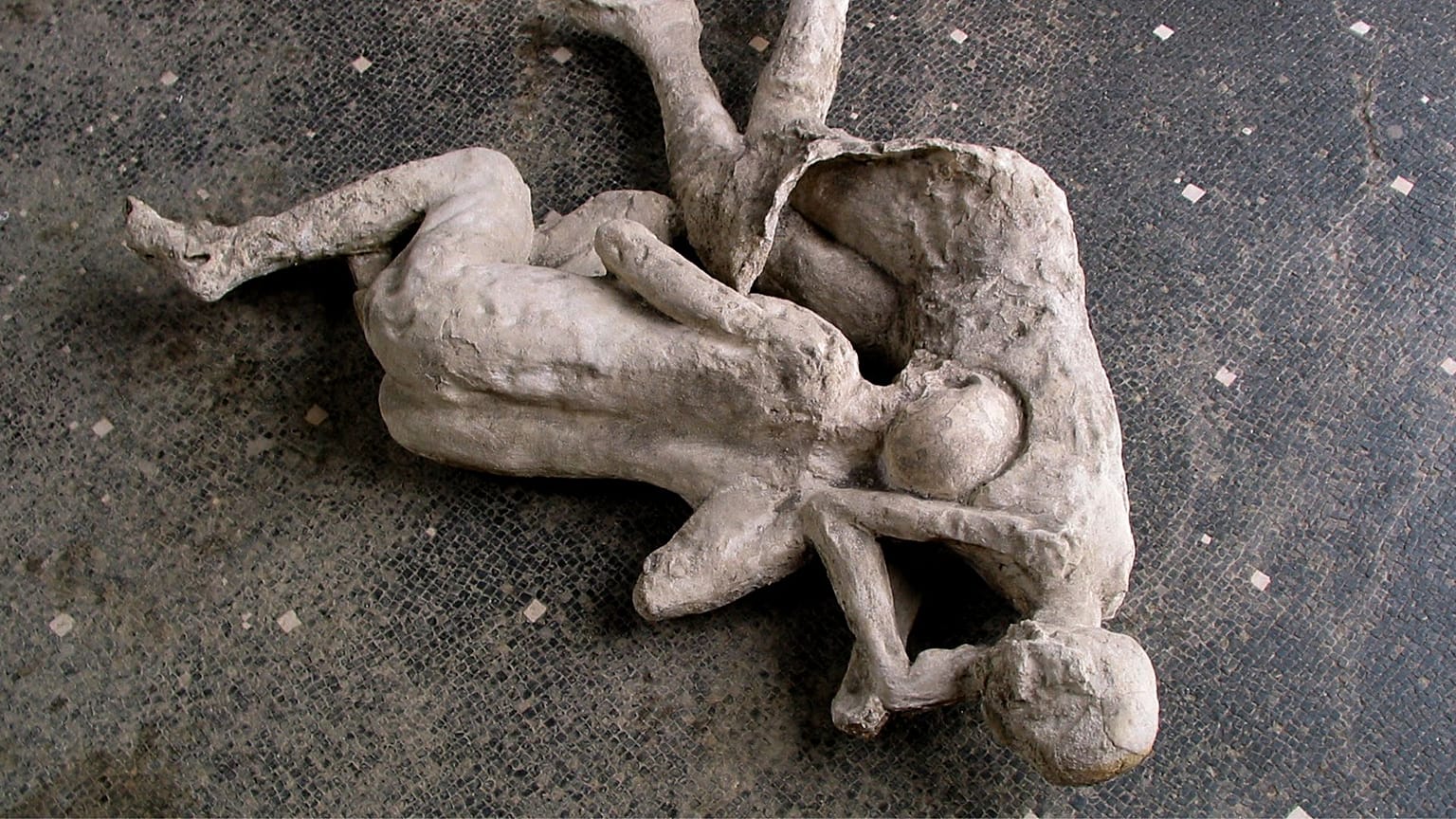
It is reasonable to observe that the figures’ forms lie close together. Describing them as being in a “final embrace”, however, already interprets their positions as an intentional human action. Calling them lovers or relatives would add another, unsupported step. Even a photograph that clearly showed contact would not identify who the people were or what they intended.
There is a second limit: a photograph shows the casts as photographed, not necessarily exactly as they were excavated. Casts may have been repaired, repositioned, or displayed after discovery. To make a claim about their original positions, you would need excavation records or other documentation. Next lesson will examine why such information about a find’s setting matters so much.
This does not mean the image is useless. It means the description should match the evidence available: two human-shaped casts are shown close together is defensible from the photograph; two family members sought comfort in their final moments is not.
An attractive explanation is still a hypothesis
The same discipline applies when a find suggests a known ancient practice. In this excerpt from UNCOVERED: Hidden Secrets of Pompeii, watch archaeologists investigate an animal skull. Pay particular attention to the difference between proposing ritual sacrifice and finding evidence that would support it.
UNCOVERED: Hidden Secrets of Pompeii (Full Episode) | Lost Treasures of Rome
Watch the selected passages from National Geographic’s UNCOVERED: Hidden Secrets of Pompeii to hear a possible explanation raised while excavation and analysis are still underway.
Watch the initial hypothesis: the team considers a ritual offering but looks for additional evidence rather than treating the idea as settled. Then watch the proposed test: notice what marks on the skull might help assess how the animal was killed, and listen to the cautious language used about a ritual at this location.
Here, the skull and its recorded location are evidence. Identifying the animal and examining any marks on its bones add expert analysis. “This animal was sacrificed here” is a more ambitious claim: it combines the find with knowledge of Roman ritual practice and an assumption that this particular deposit resulted from that practice.
The archaeologists’ search for associated vessels and their interest in possible strike marks show how to handle that claim responsibly. Further finds might strengthen it. Failure to find an expected object would prompt caution, though it would not automatically disprove every possible form of ritual activity. Another explanation for an animal skull in the area would have to be considered too. At the point shown, possible ritual activity is appropriately described as a hypothesis, not an observed event.
Notice also the difference between testing a hypothesis and proving an entire story. Marks consistent with a blow could help establish how an animal was killed. They would not, by themselves, establish the killer’s religious intention.
New evidence can overturn an old story
Claims about people can feel especially persuasive when casts seem to present a recognizable scene. Genetic research provides a case in which apparently intuitive readings of proximity and jewellery did not withstand further testing.
Read the brief section below. Keep the House of the Golden Bracelet example separate from the photograph earlier in this lesson: they are not presented as the same group of casts.
DNA evidence rewrites Pompeii Eruption story | Max-Planck-Gesellschaft
Read the Max Planck Society’s account of genetic research on Pompeian victims to see how new analytical evidence tests earlier interpretations of casts.
Under “Genetic relationships of victims revisited,” read the two researcher quotations beginning with the challenge to assumptions about jewellery and proximity and ending just before “Cosmopolitan nature of the Roman Empire.” Follow the examples, focusing on what people had inferred from appearance and what the genetic results could test.
In one example, an adult with a gold bracelet was found holding a child. The arrangement and bracelet were features people could document. The familiar interpretation—a mother holding her child—went further: it assigned a social identity, a family relationship, and a gender based largely on appearance. The reported genetic results instead identified an adult male and found that the adult and child were not genetically related.
Be precise about what the new evidence changes. It challenges a claim of biological kinship and the earlier identification of that adult. It does not show that the adult and child were strangers or that no one cared for the child. Genetic relatedness and a lived relationship are different questions. Likewise, jewellery can be observed without assuming that everyone who wore it belonged to a particular gender.
This is a good model of archaeological revision. An earlier inference was understandable as a proposed reading, but it should not have been presented as a fact. New evidence made parts of that reading untenable while leaving other questions open.
Even the cast itself needs careful reading
The outward shape of a cast can invite a detailed account of a person’s age, actions, or companions. Forensic researcher Estelle Lazer explains how earlier narratives about a group of Pompeian casts were tested against X-rays and skeletal evidence. Watch the selected portions rather than the full tour.
Exploring the Archaeological Site of Pompeii | with forensic expert Dr Estelle Lazer
In Exploring the Archaeological Site of Pompeii, Academy Travel’s forensic expert Dr Estelle Lazer contrasts an earlier account of the Garden of the Fugitives with later examination of the casts. Watch for the difference between a compelling description and a finding supported by examination.
Watch the earlier account to hear how family groups and individual roles were assigned to the figures. Then watch the display arrangement to see why the casts’ present positions require care. Finish with the forensic findings, focusing on where examination changes an age estimate, reveals an added feature, or leaves an identity uncertain.
The contrast is instructive. An earlier excavator described distinct families, their occupations, and poignant actions. Some of those claims reached well beyond what a cast’s shape could establish. Later examination found, for example, that a limb visible on one cast had been added during restoration, while bones and teeth could support more grounded estimates of some individuals’ ages.
Here, too, an analytical result is not unlimited access to a person’s life. Dental development can support an age range, with uncertainty. It cannot identify a child’s parents from proximity alone. X-rays can reveal bones inside plaster; they cannot show what someone was thinking. And a modern display arrangement cannot simply be read as the group’s original positions on the ground.
The lesson is not that early archaeologists observed nothing useful. They recovered and recorded remarkable evidence. It is that their descriptions sometimes combined observations with imaginative inferences without clearly marking the boundary. Modern techniques let researchers check some claims, reject others, and state more carefully what remains unknown.
Assess the wording of a claim
Compare these three ways of reporting essentially the same kind of find:
“Several casts were found near one another.”
This is chiefly an observation if the excavation record documents their find positions. “Near” should ideally be made more precise.
“The people may have been travelling together.”
This is an inference. Proximity makes it possible, but other explanations remain.
“A family fled together and died while protecting one another.”
This is a much stronger narrative. It asserts kinship, shared movement, and intention. None follows automatically from proximity. It would require several independent forms of supporting evidence, and some parts might remain impossible to establish.
Qualifying words alone do not rescue a weak argument. “Perhaps they were a family” correctly signals uncertainty, but you still need to explain why family is a plausible interpretation and whether the evidence can distinguish it from companions or unrelated people caught in the same area. Conversely, confidence is warranted when a claim has been tested by suitable evidence. The goal is not to make every sentence hesitant; it is to make its strength proportionate to its support.
One final habit helps: distinguish absence of evidence from evidence against a claim. If no relevant test has been carried out, a relationship may simply be unknown. If reliable genetic results show two people were not biologically related, that is evidence against a claim that they were biological parent and child. It still leaves other relationships possible.
What to carry forward
An archaeological observation describes evidence that can be located, recorded, or examined. An inference explains what that evidence may mean. The strongest Pompeian interpretations state both, make their connecting assumptions clear, consider alternatives, and change when better evidence appears. A striking image or a memorable story is a starting point for inquiry, not proof of every detail it suggests.
Next lesson turns to context and provenance: how knowing exactly where a find came from, and what was found with it, changes which inferences you can responsibly make.