Recommended resources
The freely available resources this lesson will direct you to.
In our previous lessons, you mastered Prim's and Kruskal's algorithms, two distinct yet powerful methods for constructing a Minimum Spanning Tree (MST). Both aim to connect all vertices in a graph with the minimum possible total edge weight. Now, we'll finalize our study of this module by contrasting MST algorithms with Dijkstra's algorithm, which you learned earlier. While they share structural similarities, they solve fundamentally different problems.
Today's lesson focuses on a crucial skill for coding interviews: distinguishing between problems that require Dijkstra's algorithm versus an MST algorithm. Misidentifying the problem is a common pitfall, and mastering this distinction will allow you to confidently select the right tool for the job. We'll explore the core difference in their objectives, see how their greedy strategies diverge, and establish a clear framework for problem recognition.
The Core Distinction: What Are We Optimizing?
At the heart of the distinction lies the question of what is being minimized. Although both algorithm types deal with finding "minimums" in a graph, their goals are entirely different.
- A Minimum Spanning Tree (MST) algorithm's goal is to find a subset of edges that connects all vertices together with the minimum possible total edge weight. The objective is to build the cheapest possible network infrastructure.
- Dijkstra's algorithm's goal is to find the shortest path from a single source vertex to every other vertex in the graph. The objective is to find the most efficient route from a specific origin.
To make this concrete, consider a real-world analogy.
- MST: Imagine you are a city planner tasked with laying down a water pipe network to connect all houses in a new development. Your goal is to use the least amount of pipe possible to ensure everyone is connected. This is an MST problem. The total length of pipe is the only thing that matters.
- Dijkstra's: Now, imagine you are living in one of those houses and want to find the fastest driving route to the grocery store, the library, and the train station. You would use a GPS, which calculates the shortest path from your specific location (the source) to each destination. You don't care about the total length of all roads in the city, only the length of your specific routes. This is a shortest path problem.
The following discussion from Stack Overflow clearly articulates this difference in purpose.
Difference between Prim's and Dijkstra's algorithms? - Stack Overflow
This highly-rated answer provides a clear, concise definition of the goals of each algorithm and offers useful application examples.
Please read the first main answer, which starts with this paragraph. It perfectly frames the distinction between building a network (MST) and finding routes (shortest path).
Why Isn't the MST Path the Shortest Path?
A common point of confusion is thinking that because an MST has the minimum total weight, the paths within it must also be the shortest. This is not true. An MST makes trade-offs to achieve a low global cost, sometimes sacrificing a direct, cheap path between two nodes in favor of edges that are more useful for connecting the graph as a whole.
Let's look at a simple example.
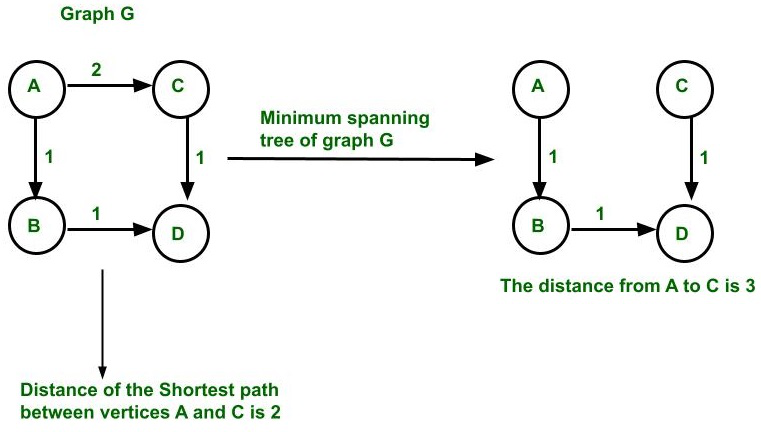
The MST algorithm discarded the A-C edge (weight 2) because including it while also needing to connect node B would lead to a higher total cost or a cycle. It prioritized cheaper edges like A-B, B-D, and D-C (all weight 1) to connect all four nodes with a minimal total cost of 3. Dijkstra's algorithm, starting from A, would have immediately identified the A-C path of length 2 as the optimal route to C.
This Stack Exchange thread provides several more excellent examples that hammer home this point.
Minimum spanning tree vs Shortest path
This thread contains several simple, clear graph examples that illustrate why an MST does not guarantee shortest paths.
Focus on two key answers. First, read Yuval Filmus's answer which uses a unit weight triangle to show that shortest paths can form cycles, which an MST cannot. Then, review Sauchin's answer which provides a clear numerical example under the heading this example.
The Algorithmic Difference: A Tale of Two Greedy Choices
The different goals of MST and Shortest Path algorithms are directly reflected in their greedy strategies. Both Prim's and Dijkstra's build a tree outward from a source, using a priority queue to decide which vertex to add next. The critical difference is in how they calculate the priority of a vertex.
Let's say we are processing vertex u and considering an edge (u, v).
- Prim's Algorithm asks: "What is the cost of this single edge
(u, v)?" It will greedily choose the edge with the minimum weight that connects a vertex inside the growing MST to a vertex outside of it. The priority ofvis simplyweight(u, v). - Dijkstra's Algorithm asks: "What is the total path cost from the original source to
vif we go throughu?" It will greedily choose the vertexvthat has the minimum total path distance from the source. The priority ofvisdistance_from_source(u) + weight(u, v).
This image summarizes the two distinct final products.
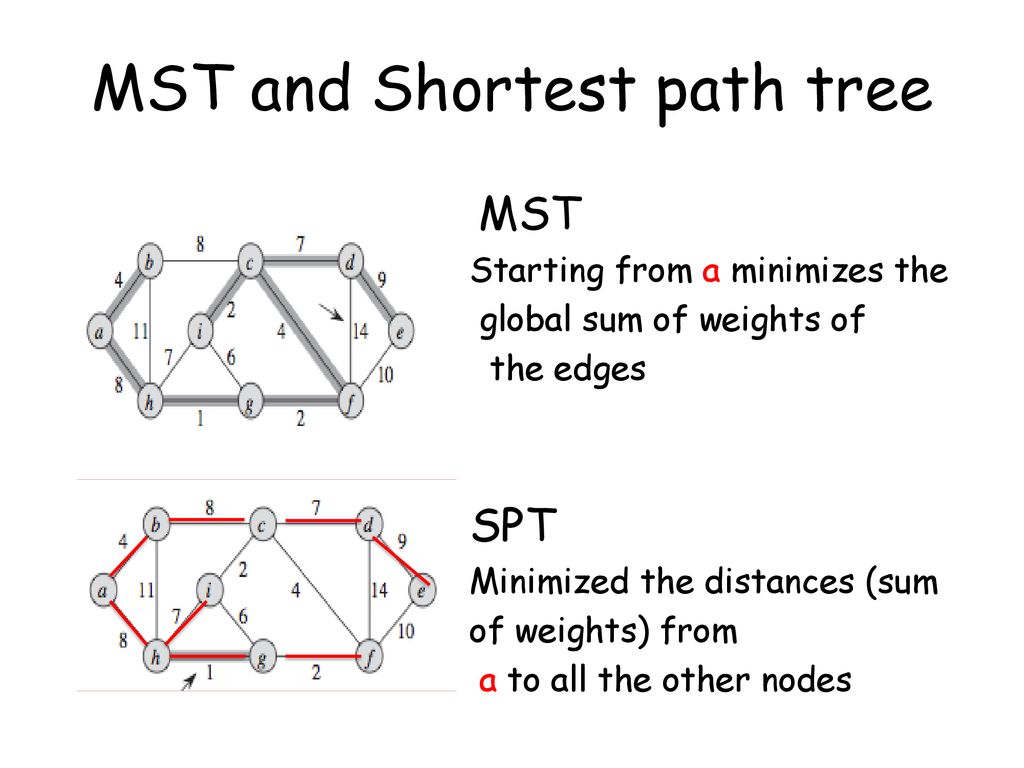
This seemingly small difference in the calculation leads to completely different outcomes. The following video provides a brilliant side-by-side walkthrough of both algorithms on the same graph, making their divergent decision-making processes crystal clear.
Dijkstra's Algorithm vs Prim's Algorithm
The video "Dijkstra's Algorithm vs Prim's Algorithm" from Back To Back SWE is perfect for visualizing the different greedy choices.
Watch the introduction from the beginning to understand the setup. Follow the detailed walkthrough of Dijkstra's algorithm from this section. Pay close attention to how it updates the distance table by always adding the total path cost from the source. Next, watch the walkthrough of Prim's algorithm from this section. Notice how it ignores the path cost from the source and only considers the weight of the next cheapest edge that expands the tree. The conclusion summarizes the core difference in their greedy choices perfectly.
A Practical Framework for Problem Recognition
In a coding interview, the problem statement won't say "Use Prim's algorithm." You need to deduce the correct approach from the problem's goal. Here is a simple framework to help you decide.
When to use an MST Algorithm (Prim's or Kruskal's):
Your problem is likely an MST problem if the goal is to...
- Connect all points/nodes in a network.
- Minimize the total cost of the connections.
- The path between any two specific nodes is not the primary concern.
Keywords to look for:
- "Connect all cities/computers/islands"
- "Minimum cost to build a network"
- "Cheapest way to lay cables/pipes"
- "Spanning" all nodes
Example Problem: You are given a list of cities and the cost to build a road between any two cities. What is the minimum cost to build a road network such that it is possible to travel between any two cities? (This is a classic MST problem, solvable with either Prim's or Kruskal's).
When to use Dijkstra's Algorithm:
Your problem is likely a shortest path problem if the goal is to...
- Find the best route from a single starting point to one or more destinations.
- Minimize the cost/time/distance of a specific journey.
- Connecting all nodes is not required.
Keywords to look for:
- "Shortest/cheapest/fastest path from A to B"
- "Minimum cost from a source node"
- "Find the most efficient route"
Example Problem (with your finance interest in mind): You are building a currency arbitrage bot. You are given a list of currency exchange rates, which can be modeled as a graph where currencies are nodes and the negative log of the exchange rate is the edge weight. What is the most profitable sequence of trades to convert USD to JPY? (This is a shortest path problem on a graph with potentially negative weights, a variant where Bellman-Ford would be used, but if all costs are positive, it's a Dijkstra problem).
Conclusion
You have now completed the graph module by developing a clear understanding of the fundamental differences between Minimum Spanning Tree and Single-Source Shortest Path problems. This is a high-yield topic for technical interviews, as it tests your ability to model a problem correctly before writing any code.
Key Takeaways:
- Different Goals: MSTs aim to connect all nodes with minimum total edge cost, while Dijkstra's finds the path with minimum cost from a single source to all other nodes.
- Different Greedy Choices: Prim's prioritizes the next cheapest edge to expand its tree. Dijkstra's prioritizes the node with the shortest known path distance from the source.
- Different Outputs: An MST is a single tree with minimum total weight. A Shortest Path Tree (SPT) contains the optimal routes from one specific node. The path between two nodes in an MST is often not the shortest possible path between them.
- Problem Recognition: Analyze the problem statement carefully. Does it ask for a complete, low-cost network (MST) or an optimal route from a starting point (Shortest Path)?
In our next lesson, we will venture into a new topic: Topological Sort. This algorithm applies to a specific type of graph—Directed Acyclic Graphs (DAGs)—and is used to find a linear ordering of its vertices based on their dependencies. This is fundamental to solving problems related to task scheduling, course prerequisites, and dependency resolution.