Recommended resources
The freely available resources this lesson will direct you to.

Hello! In our previous lesson, we focused on improving the user experience for interactive tasks by streaming LLM responses with Server-Sent Events. This is a crucial technique for making applications feel responsive. However, many powerful AI agent tasks aren't interactive—they are long-running processes that can take minutes or even hours to complete.
Today, we will address this challenge by designing an asynchronous architecture for these long-running agentic tasks. We'll explore how to move beyond the limitations of the standard request-response model to build robust, scalable, and resilient AI systems. This is a core competency for any AI engineer working on production systems and a frequent topic in system design interviews.
The Problem with Long-Running Tasks
Imagine asking an AI agent to "analyze the last quarter's 500 customer support tickets and generate a summary report." This task might involve multiple API calls, data processing, and several reasoning steps by an LLM. A synchronous HTTP request would simply time out, leaving the user with an error and the system in an unknown state.
This article provides an excellent overview of this fundamental challenge.
Async Agent Workflows: Designing for Long-Running Tasks
This article from TianPan.co clearly articulates why standard HTTP architectures fail when agent tasks become complex and time-consuming.
Please read the introduction and the section The Fundamental Mismatch. The author highlights the "30-second wall" and explains why simply increasing timeouts is a fragile and unreliable solution.
As the article points out, the synchronous request-response model is fundamentally mismatched with the nature of complex agentic work. The solution is to decouple the task submission from its execution.
The Asynchronous Job Pattern
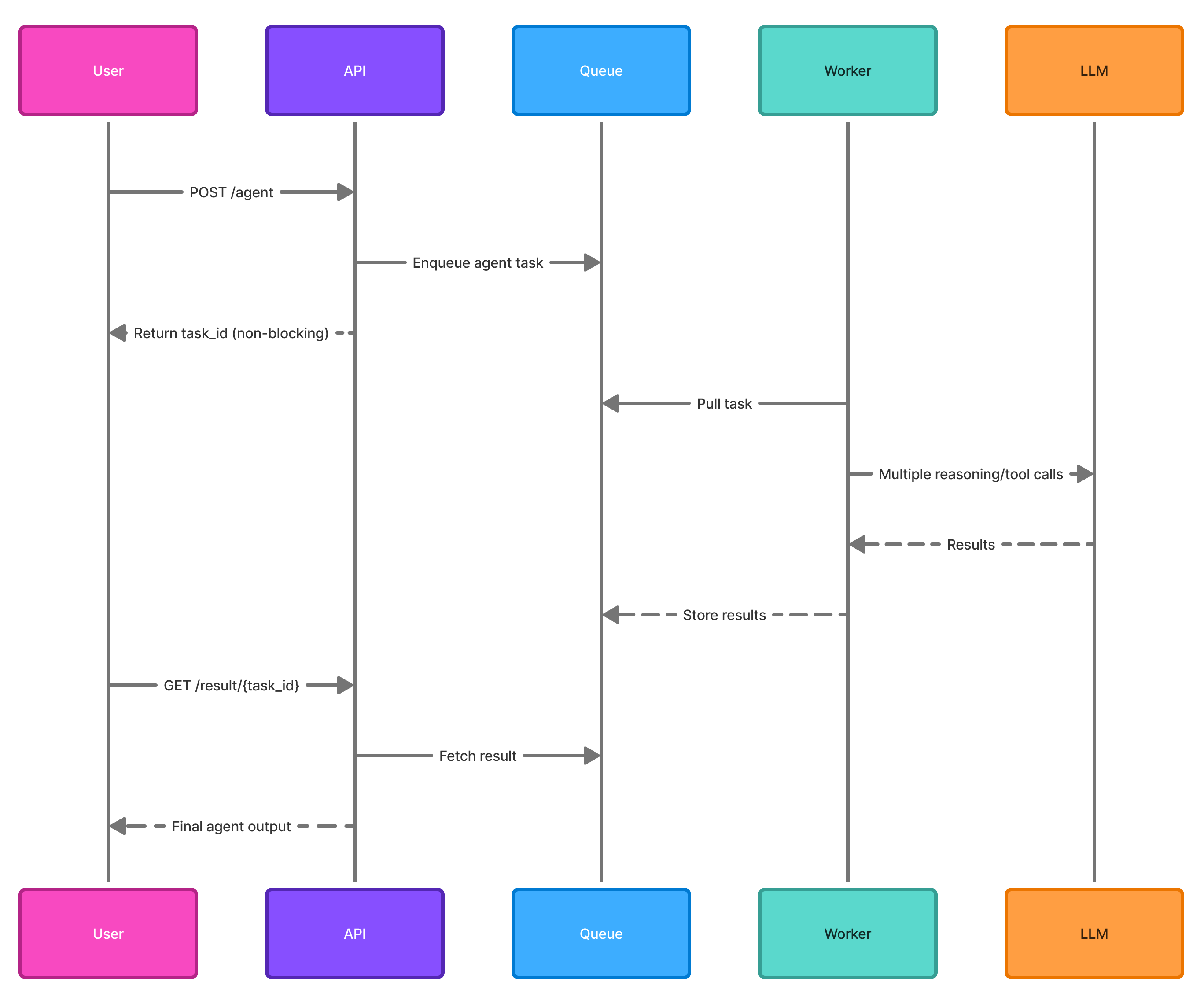
The standard architectural solution for this problem is the asynchronous job pattern. As a software engineer, you've likely encountered this pattern before in contexts like video processing or report generation. The principles are the same here.
The core flow is:
- A client sends a request to an API endpoint to start a long-running task.
- The server validates the request, creates a task, and immediately returns a
202 Acceptedstatus code along with a uniquetask_id. The connection is then closed. - The client can now periodically poll a status endpoint (e.g.,
GET /api/tasks/{task_id}) to check if the task ispending,in-progress,completed, orfailed. - Once the task is
completed, the client can retrieve the final result from the status endpoint or a dedicated result URL.
This decouples the client's lifecycle from the worker's lifecycle, ensuring the system remains responsive and reliable, regardless of how long the task takes. The central component that enables this decoupling is the message queue.
Message Queues: The Engine of Asynchronous Systems
A message queue is a buffer that stores messages, or tasks, in a durable way. A service called a producer adds messages to the queue. On the other end, a service called a consumer (or worker) pulls messages from the queue and processes them at its own pace.
This video from a Meta Staff Engineer provides a fantastic introduction to message queues, framed perfectly for a system design interview.
Message Queues in System Design Interviews w/ Meta Staff Engineer
This video from Hello Interview clearly explains the problems that message queues solve and how they work.
First, watch the motivating example from the beginning. It uses a photo-sharing app to illustrate the problems of a synchronous system: high latency, fragility, and inability to handle bursty traffic. Next, watch the segment from the solution which shows how introducing a message queue elegantly solves these three problems. Finally, watch the formal definition of a message queue from this section. Pay close attention to the terms producer, consumer, and the key property of decoupling.
The producer and consumer don't need to know about each other; they only interact with the queue. This decoupling is what gives the architecture its scalability and resilience.
The following diagram illustrates how this pattern applies directly to an AI agent workflow.
Designing for Reliability and Scale
Introducing a message queue solves the core problem, but for a production-ready system—the kind you'd design in a big tech interview—you need to consider edge cases and failure modes.
The Message Queues in System Design Interviews video you just watched also covers the key design considerations you must be prepared to discuss.
Message Queues in System Design Interviews w/ Meta Staff Engineer
This video provides a masterclass in the practical considerations for using message queues in real-world systems.
Please watch the following three segments carefully, as they address the most common follow-up questions in a system design interview: When to use a queue? Watch the segment on the four signals for introducing a queue. This helps you justify your architectural choice. What if producers outpace consumers? Watch from this section to understand the problem of growing queue depth and the solutions, including autoscaling consumers and applying back pressure. What about messages that always fail? This segment on poisoned messages introduces the critical concepts of max retry counts and the Dead Letter Queue (DLQ). Mentioning DLQs is a strong signal of seniority and practical experience.
Idempotency: A Non-Negotiable for Agents
One critical concept not covered in the video but essential for reliable agent systems is idempotency. An operation is idempotent if calling it multiple times has the same effect as calling it once.
Why is this so important for agents? Imagine your client submits a task, but the network connection drops before it receives the task_id. The client doesn't know if the task was created. Its only safe option is to retry the submission. If your API isn't idempotent, you've just launched a second, duplicate agent to perform the same (potentially expensive) task.
Async Agent Workflows: Designing for Long-Running Tasks
This section of the "Async Agent Workflows" article explains why idempotency is even more critical for agents than for standard APIs.
Read the section Idempotency Keys. The standard pattern is for the client to generate a unique Idempotency-Key (like a UUID) and include it in the request header. The server then ensures that it only creates one task for any given key.
Advanced Architectural Patterns for Multi-Agent Systems
So far, we've discussed a simple producer-consumer setup. In sophisticated AI systems, you often have multiple specialized agents. An event-driven architecture using a message broker becomes a powerful pattern for coordinating their work.
The Agent Broker Pattern is a hybrid approach where a central "broker" agent receives a task and, using an LLM's reasoning capabilities, routes it to the appropriate specialized agent through a message queue.

This AWS blog post provides an excellent deep dive into these advanced patterns. Given your background, you'll appreciate the distinction between orchestration and choreography.
Creating asynchronous AI agents with Amazon Bedrock - AWS
This article details several patterns for multi-agent collaboration, moving from synchronous to fully asynchronous designs.
First, read the section on process automation to understand the difference between synchronous orchestration (led by a supervisor) and asynchronous choreography (event-driven). Next, focus on the section Getting the best of both patterns. This introduces the agent broker pattern, which is the core of our asynchronous design. Then, review the implementation diagram and description in the section Implementing the agent broker pattern. Notice how AWS services like EventBridge (a message bus), SQS (a message queue), and Lambda are combined to create a scalable system. Finally, skim the section on implementing the supervisor pattern. This shows how to add state management (using DynamoDB) on top of the broker pattern to handle complex, multi-step workflows where context must be maintained between agent interactions. We will cover state management in more detail later in the course.
A Practical Example with Python and Celery
To make this more concrete, let's look at how these components are put together in a popular Python ecosystem using Celery, a powerful task queue library. This video demonstrates the full stack: a client application, a message broker (RabbitMQ), workers (Celery), and a results backend (Redis).
Since your Python is basic, focus on understanding the roles of each component and how they fit into the architecture we've been discussing. The use of Docker Compose here is also representative of how you would set up such a system in a professional environment.
Professional Task Queues in Python with Celery, RabbitMQ & Redis
This video by NeuralNine gives a practical demonstration of building an asynchronous task processing system.
Watch the introduction from the beginning. It clearly explains the roles of the Celery client (producer), RabbitMQ (message broker), Celery worker (consumer), and Redis (results backend). Next, skim the section on the Docker Compose setup. This shows how all the services are defined and networked together. This is a common pattern in modern software development. Watch the simple task implementation from this segment. It shows how a task is defined in the worker and how the client submits a task using .delay() and then polls for the result. This is a direct implementation of the async job pattern. Finally, watch the more realistic example using the OpenAI API from this part. It demonstrates how multiple long-running API calls can be executed concurrently by the workers, dramatically improving throughput.
Conclusion
In this lesson, we have designed a complete asynchronous architecture for handling long-running AI agent tasks. You've learned how to move beyond the limitations of synchronous HTTP by adopting the asynchronous job pattern, with the message queue as its cornerstone.
Key Takeaways:
- Decoupling is Key: The primary role of a message queue is to decouple producers (which create tasks) from consumers (which execute them), making the system scalable and resilient.
- The Async Job Pattern: The standard flow is to submit a task, immediately get a
task_id, and poll a status endpoint for the result. - Design for Failure: Production-grade systems must handle failures gracefully using patterns like Dead Letter Queues (DLQs) for "poisoned" messages and idempotency keys to prevent duplicate task execution from client retries.
- Scale with Demand: Message queues enable you to handle bursty traffic by absorbing spikes and allow you to scale your consumer fleet independently based on queue depth.
- Agent-Specific Patterns: For multi-agent systems, the "agent broker" pattern provides a powerful way to dynamically route tasks to specialized agents asynchronously.
You now have the architectural blueprint for building scalable AI systems. In our next lesson, we will get hands-on and implement a producer to enqueue an agentic task and a consumer (worker) to dequeue and execute it, turning this design into running code.