Recommended resources
The freely available resources this lesson will direct you to.
Hello again. Last lesson mapped the responsibilities of a solo AI filmmaker: generating material is only part of the work; selecting and shaping it is just as important. Now we’ll focus on one selection decision: is a generated clip valuable to the story, or merely impressive as a demonstration of AI?
By the end of this lesson, you’ll have a way to judge a clip without dismissing visual ambition or excusing confusing storytelling. Allow about 35–40 minutes, including the short viewing, readings, and a second look at the film excerpt.
Give the clip a job
Imagine a 45-second film about someone offering their only umbrella to a stranger at a bus stop. One generated clip shows a spectacular aerial view: rain turns the whole city into glittering reflections. Another shows the person noticing the stranger, tightening their grip on the umbrella, then extending it.
The aerial view may be technically harder to generate. The second clip may do more story work: it makes a choice visible. That does not mean the aerial view is worthless. It might establish an overwhelming downpour or the characters’ isolation. Its value depends on where it appears and what the audience needs at that moment.
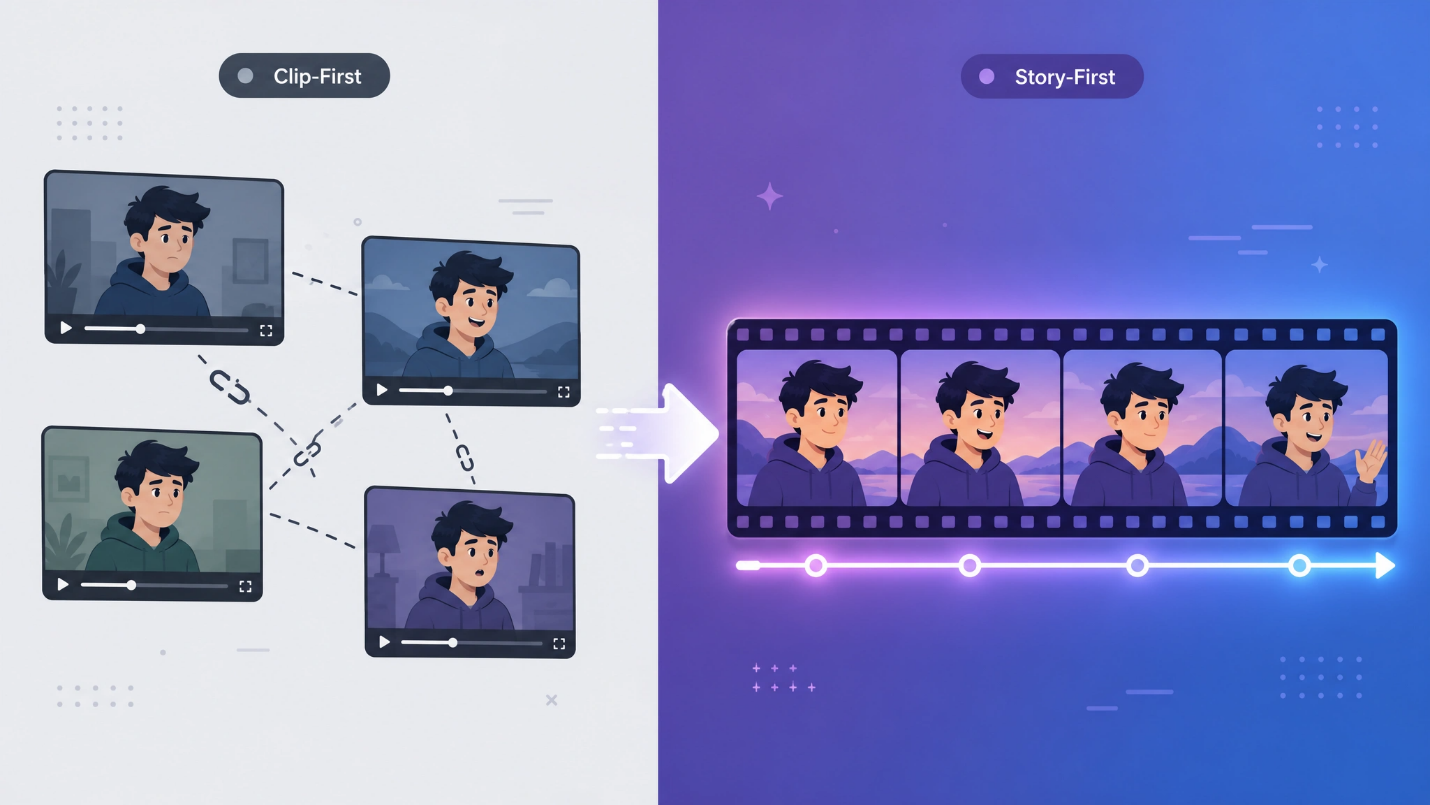
A story-first approach gives you a question to ask before admiring the result: What is this clip meant to let the audience notice, understand, anticipate, or feel? A clip need not tell a complete story by itself. It can establish a place, reveal a problem, delay an answer, show a reaction, or make a turning point legible. Its job becomes clearer when you imagine the shots immediately before and after it.
Technical quality still matters, but it serves that job. Beautiful lighting cannot rescue a crucial gesture if we cannot see what the character does. Conversely, a modest-looking shot may be the one that makes the whole sequence understandable.
Move from an impression to an observation
A useful evaluation distinguishes what you saw from what you inferred. StudioBinder’s “What Is Film Analysis? 8 Elements Explained” offers a compact method for making that distinction.
What Is Film Analysis? 8 Elements Explained (with Examples)
Read StudioBinder’s active-viewing method to see how a general reaction becomes a judgment supported by moments in the film.
Under “How to write a film analysis,” read “1. Watch the Film Actively,” “2. Identify Your Focus,” and “3. Gather Evidence From the Film.” Begin where the first subsection says how to watch first, and continue through the third subsection’s closing point that evidence is verifiable. Focus on the difference between “this feels tense” and identifying the framing, action, or sound cue that creates tension. Stop before “4. Build Your Argument.”
For a short AI clip, you do not need to write an essay. Two viewings and a few notes can be enough:
- First viewing—receive it as an audience member. What do you think is happening? What are you waiting to find out?
- Second viewing—locate the evidence. Which visible action, line, sound, or cut produced that understanding? Where did you become uncertain?
That separation is important with AI imagery. “The rain looks astonishing” describes your response to an effect. “The rain hides the stranger until the protagonist turns toward them” explains a possible storytelling use for it.
Watch a generated sequence for story, not software
Theoretically Media’s “Behind The Scenes Of An AI Film (Masterclass & Cost Breakdown!)” includes a short film sequence called The Bridge. For now, watch only the film excerpt, not the production tutorial surrounding it.
Behind The Scenes Of An AI Film (Masterclass & Cost Breakdown!)
Watch Theoretically Media’s The Bridge excerpt as a piece of storytelling. Knowing how its images were generated is not necessary for this first viewing.
Watch the film excerpt. On the first pass, follow the encounter: what does the traveler need, what is demanded in return, and what new significance does the traveler’s account give to the axe and the master? If you replay it, notice which details help you follow that account and which pull your attention away.
The toll in this encounter is not money but a story. That demand gives the conversation a purpose, while the traveler’s account makes the axe more than an attractive fantasy prop. The mention of a book with missing pages gives the later reference to those pages a connection the viewer can recognize. These are storytelling functions: an immediate obstacle, information about a character, and a detail that gains significance through repetition.
Now consider the images as part of that exchange. An image of a settlement or a fighter is useful not simply because it depicts an elaborate world, but because it helps us place an event in the traveler’s account. A shot of the axe deserves closer scrutiny because the dialogue draws attention to it. The more important an object is to the story, the more a visual inconsistency involving it can cost the audience.
This is a fairer standard than either “AI made it, so it’s impressive” or “I spotted an error, so it fails.” The question is whether a particular strength or flaw changes the audience’s experience of the story.
Test what the clip communicates
StudioBinder’s “What Is Visual Storytelling—Elements & Techniques 101” suggests a useful visual test and names several ways a striking image can lose its purpose.
What is Visual Storytelling — Elements & Techniques 101
Read StudioBinder’s visual-storytelling test and its discussion of common mistakes. They help distinguish an intentional image from one that merely attracts attention.
In “7. Test visually without dialogue,” read the visual test, beginning with the suggestion to remove dialogue and ending just before “Avoid these with Visual storytelling.” Then, under “Common mistakes in visual storytelling,” read from “Visual clutter” through “Unmotivated camera movement”: the four pitfalls. Notice how clutter, inconsistent style, purposeless symbolism, and unmotivated movement can each compete with the story’s focal point.
You can adapt the visual test when assessing a generated clip: watch it without dialogue and ask what you can still understand from position, movement, expression, and timing. Do not treat silence as a universal pass-or-fail test. A revelation carried by a line of speech need not remain fully intelligible without that line. The test asks whether the visuals contribute what they reasonably can—not whether sound is unnecessary. Restore the sound afterward and judge the actual film.
For a practical verdict, consider five connected questions:
| Question | What to look for |
|---|---|
| Narrative purpose | Does the clip establish, complicate, reveal, or resolve something the sequence needs? |
| Clarity of attention | Can you tell what matters in the frame and what action is taking place? |
| Emotional specificity | Does a gesture, pause, framing choice, or sound cue support the intended feeling? |
| Continuity | Can you still recognize important people, objects, positions, and events across cuts? |
| Editability | Is there a usable beginning or ending, and can its duration fit the surrounding shots? |
These questions are related, not independent scores to add up. For example, an inconsistent prop is especially troublesome when recognizing that prop is necessary to understand the action. An unusual shift in appearance could instead be intentional—perhaps the scene represents a memory. Judge the effect in context before calling it a mistake.
Ambiguity is not the same as confusion. You might deliberately withhold who is waiting beyond the bridge; that uncertainty can create interest. If viewers cannot tell who is speaking, why a response follows, or which axe the dialogue concerns, the uncertainty may interrupt the story rather than enrich it.
Decide what to keep, change, or leave out
The creator of The Bridge later discusses imperfections in the generated sequence, including variation in the axe. This is a useful opportunity to compare a maker’s tolerance for a flaw with its possible storytelling cost.
Behind The Scenes Of An AI Film (Masterclass & Cost Breakdown!)
Return to Theoretically Media’s behind-the-scenes video for the creator’s account of visible inconsistencies. Listen for the distinction between recognizing a problem and having the time or resources to fix it.
Watch the flaw discussion. The creator mentions the changing axe and a change in the character’s protective plates. Consider why those two inconsistencies might matter differently to someone watching the story.
The axe is named and discussed, so changes to it may interrupt recognition of an object the film asks us to remember. A brief change in armor might be less consequential if it does not alter who the character is or what is happening. Neither judgment is automatic: screen size, shot duration, and the surrounding edit affect how noticeable a flaw becomes. Production limits matter too. You may decide to accept a minor defect rather than spend another attempt on it.
For the umbrella film, the selection might sound like this: “Keep the close shot because the grip and handoff make the decision readable. Shorten its opening because the hand pauses too long. Use the aerial rain shot only if it helps establish the weather before the choice; otherwise, its scale delays the moment the film is about.” Each decision names a story effect, not just a preference for one visual style.
That is the central habit to carry forward. When a generated clip dazzles you, ask what the audience gains from seeing it here. When a clip looks imperfect, ask whether the imperfection actually obstructs the moment it must convey. Keep, trim, reposition, or replace it on those grounds.
Conclusion
A generated clip earns its place through what it contributes to the film: information, anticipation, emotion, a meaningful change, or a useful transition between moments. Evaluate that contribution with specific evidence from the image, performance, sound, and edit. Technical achievement is worth noticing, but it is neither proof of storytelling value nor a substitute for it.
In the next lesson, we’ll bring this judgment down to the scale of a first production by setting realistic limits on time, cost, device, and scope.