Recommended resources
The freely available resources this lesson will direct you to.
Hello! Welcome back to our module on Market Analysis and Property Due Diligence.
In the last lesson, we focused on the physical asset, learning how to interpret inspection reports and create a CapEx budget. We now have a solid understanding of a property's potential costs. Today, we shift our focus from the "bones" of the building to the lifeblood of the investment: the income stream.
This lesson addresses the learning outcome: Analyze key lease terms including duration, renewal options, and rent escalation clauses.
When you buy a rental property, especially one with a tenant in place, you are not just buying bricks and mortar; you are acquiring a contract. The terms of this contract, the lease agreement (contrato de arrendamiento), dictate the stability, predictability, and growth potential of your rental income. In Spain, residential leases are heavily regulated by the Ley de Arrendamientos Urbanos (LAU), a law designed primarily to protect tenants. Understanding this legal framework is non-negotiable for any serious investor.
We will break down the three most critical components of a Spanish lease agreement:
- Duration: How long is the contract legally binding?
- Renewals/Extensions: What happens when the initial term ends?
- Rent Escalation: How, when, and by how much can you increase the rent?
Mastering these rules is like understanding the core logic of an operating system; it governs everything that can and cannot happen with your investment's primary function—generating income.
1. The Legal Framework: Ley de Arrendamientos Urbanos (LAU)
Before diving into specifics, it's crucial to understand that the LAU treats different types of leases differently. Our focus is on residential leases for a primary home (arrendamiento de vivienda), which have the strongest tenant protections. Leases for other uses, such as commercial properties or seasonal rentals, offer much more contractual freedom.
To get a clear picture of this distinction and the overall purpose of the LAU, please start with this reading.
Ley de Arrendamientos Urbanos (LAU) 2025: Guía Completa
This guide from Cohispania provides an excellent overview of the LAU. We'll start with the basics to understand its scope and the types of contracts it governs.
Please read the section titled 'Qué regula la LAU: tipos de contratos y a quién se aplica'. Focus on the distinction between 'Arrendamientos de vivienda' and 'Arrendamientos de uso distinto al de vivienda'.
As you've just read, when a property serves as the tenant's main home, the rules are strict and largely non-negotiable. This is the scenario we will focus on, as it's the most common for individual investors.
2. Lease Duration and Renewal Options
One of the most significant aspects of the LAU is the mandatory duration of leases. This provides tenants with stability but reduces a landlord's flexibility. Understanding this is key to aligning a property with your investment strategy (e.g., buy-and-hold vs. fix-and-flip).
The following resources explain these rules in detail.
Ley de Arrendamientos Urbanos (LAU) 2025: Guía Completa & Prórroga del contrato de alquiler 2025
The Cohispania article and a more focused piece from elAbogado.com break down the rules on duration and the automatic extensions, known as 'prórrogas'.
In the 'Guía Completa' (LINK), please read section 3, 'Duración del contrato y prórrogas'. Pay close attention to the minimum duration for individuals vs. companies and the concept of 'prórroga obligatoria y tácita'.
Prórroga del contrato de alquiler 2025: derechos y ...
This second article reinforces the duration rules and clarifies the extension process.
In this article, read the sections 'Duración mínima del contrato: 5 o 7 años' and 'Prórrogas tácitas: hasta 3 años adicionales'. This will solidify your understanding of the total potential lease timeline.
Let's synthesize this into a clear, logical flow. The following flowchart is an excellent visual summary of the rules you've just read.
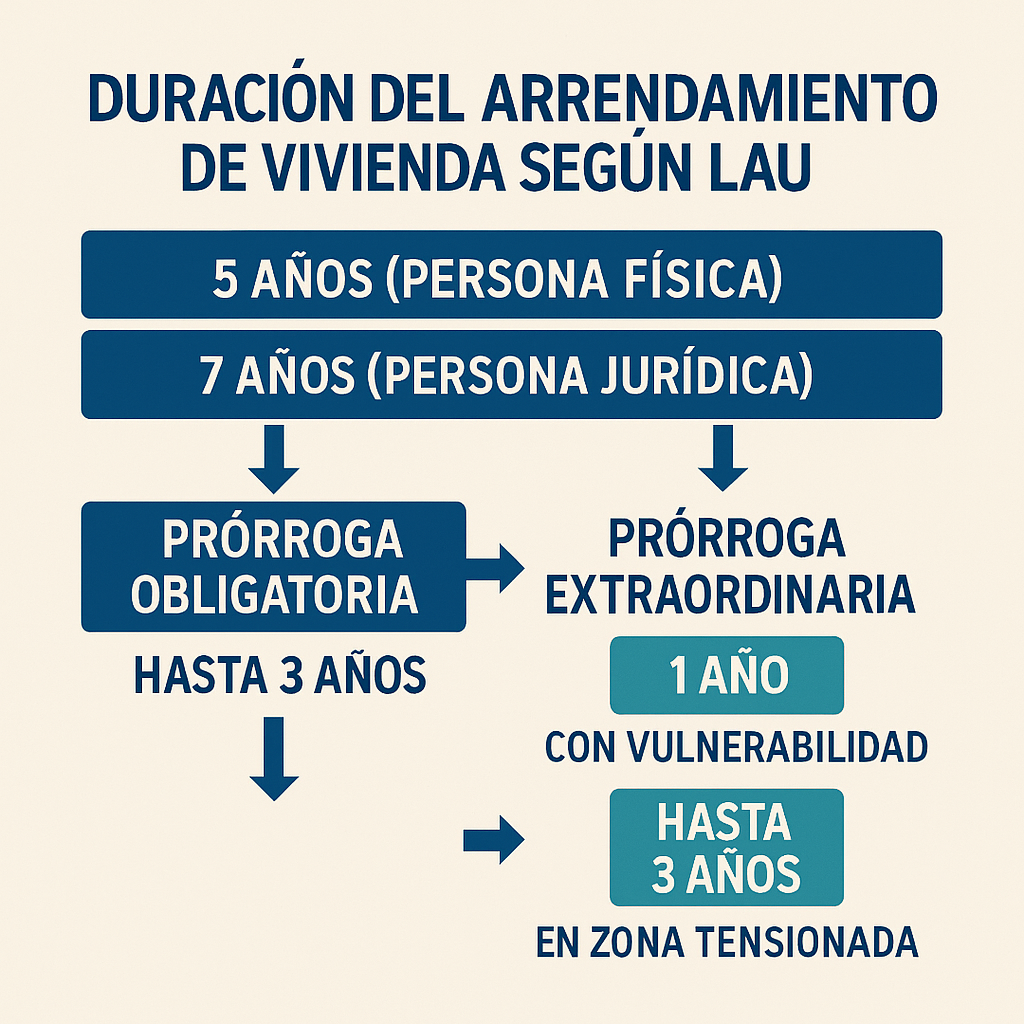
Here is the breakdown of the process:
-
Initial Mandatory Term: Even if you sign a 1-year contract, the tenant has the right to stay for a minimum period.
- 5 years if the landlord is an individual (persona física).
- 7 years if the landlord is a legal entity (persona jurídica), such as a Sociedad Limitada (SL). This is a key difference to consider when deciding on your ownership structure.
-
Tacit Renewal (
Prórroga Tácita): If the initial 5 or 7-year term ends and neither party has given notice, the contract automatically renews.- The renewal happens in one-year increments for a maximum of 3 additional years.
- To prevent this, the landlord must give 4 months' notice. The tenant must give 2 months' notice.
This means a tenant could potentially occupy a property for 8 years (5+3) or 10 years (7+3) without signing a new contract. This provides immense income stability but also means you cannot easily get the property back if you want to sell it vacant or move in yourself (exceptions for proven personal need exist, but are strict).
Test your understanding!
You are considering buying an apartment as an investment through a newly created Sociedad Limitada. The apartment has a tenant who signed a lease 2 years ago with the previous owner, who was an individual (persona física). The current rent is slightly below market.
- How many more years does the tenant have the right to stay under the initial mandatory term?
- If you buy the property, does the landlord's change from persona física to persona jurídica alter the lease term?
- Assuming the tenant stays for the full initial term and the subsequent extension, what is the total duration of their tenure?
Show answer
- The initial lease was signed with a persona física, so the mandatory term is 5 years. Since the tenant has been there for 2 years, they have the right to stay for another 3 years.
- No. When you buy a property with a tenant, you inherit (subrogate) the existing lease under its original terms. The mandatory term remains 5 years, as determined at the time of signing. The 7-year rule would only apply to new leases you sign under your SL.
- The total potential tenure is 8 years: the 5-year initial mandatory term plus the 3-year tacit renewal period, provided neither party gives the required notice to terminate after year 5.
3. Rent Escalation Clauses
You cannot increase rent arbitrarily in Spain. Any increase must be explicitly stated in the lease agreement and must follow specific legal guidelines. This is a critical variable for your long-term financial projections.
For many years, the standard was to update the rent annually based on the Consumer Price Index (IPC). However, recent housing laws have introduced a new, more restrictive system, especially in designated "stressed market areas" (zonas tensionadas).
Let's see how this works.
Ley de Arrendamientos Urbanos (LAU) 2025: Guía Completa & Prórroga del contrato de alquiler 2025
These sections from our previous readings explain the rules for updating rent, highlighting the shift from the IPC to a new reference index.
In the 'Guía Completa' (LINK), please read section 4, 'Renta, actualización y fianza', focusing on the 'Actualización del alquiler' part.
Prórroga del contrato de alquiler 2025: derechos y ...
This article reinforces the new rent update mechanism.
Read the section 'Actualización de la renta en 2025' and FAQ question 5, '¿Pueden subirme la renta durante la prórroga?'. The resources use slightly different acronyms for the new index (IRAV, Índice Estatal de Referencia), but they refer to the same concept: a government-set index that replaces the IPC in many cases.
To summarize the key points:
- Annual Update: Rent can only be updated once per year, on the anniversary of the contract.
- Contract is King: The possibility of an update must be written into the lease. If it's not mentioned, the rent cannot be increased for the entire term.
- The New Index: For contracts signed after the May 2023 Housing Law came into effect, the rent increase is capped by a new Reference Index for Housing Lease Updates (Índice de Referencia para la Actualización de los Contratos de Arrendamiento de Vivienda). This index is designed to be less volatile and generally lower than the IPC. In 2024, the cap was temporarily set at 3%. For 2025 and beyond, the new index applies fully.
The image below shows a practical comparison. It demonstrates how a rent increase would be calculated under the old IPC rules versus the new reference index (here called IRAV).

This has direct implications for your financial modeling. When building a multi-year pro forma (which we'll do in Module 5), you can't just project a generic 3-5% annual rent increase. Your growth assumption must be tied to the legal reality, which is often the more conservative official index.
4. Impact on Your Investment Strategy
Understanding these lease terms is not just a legal exercise; it's a strategic necessity.
- Valuation: When analyzing a property with a tenant, the current rent and the potential for increases directly impact your calculation of Gross Rental Income and Net Operating Income (NOI). A property with a long-term tenant paying significantly below-market rent with limited escalation potential is worth less than an identical vacant property that can be rented at the current market rate.
- Strategy Selection: The long, mandatory lease terms in Spain favor a buy-and-hold strategy. They provide predictable, stable cash flow. Conversely, they make a fix-and-flip strategy very difficult if a tenant is in place, as you cannot easily vacate the property to perform renovations and sell.
- Risk Management: A well-written lease that includes an annual rent update clause tied to the maximum legal index is a key tool for mitigating inflation risk. Failing to include this clause means your rental income is fixed, while your expenses (property taxes, insurance, maintenance) will continue to rise, squeezing your net cash flow over time.
Test your understanding!
You are analyzing two potential deals in a zona tensionada in Barcelona:
- Property A (Vacant): A 50m² apartment. Similar units in the area are renting for €1,000/month.
- Property B (Tenanted): An identical 50m² apartment next door. The tenant has been there for 4 years on a 5-year lease and pays €800/month. The lease agreement includes a clause for annual rent updates based on the legally mandated index.
How do the lease dynamics of Property B affect its value proposition compared to Property A?
Show answer
The lease on Property B presents both a short-term liability and a long-term consideration:
- Short-Term Liability: You cannot immediately raise the rent to the market rate of €1,000. You must wait for the lease anniversary to apply a small, index-limited increase to the current €800 rent. You are locked into below-market rent for at least another year (the final year of the 5-year term) and potentially for another 3 years if the tenant exercises their right to the tacit renewal. This immediate loss of potential income (€200/month or €2,400/year) should be factored into your offer price for Property B. You would likely offer less for B than for A.
- Long-Term Consideration: Since the property is in a zona tensionada, even if you were to rent out the vacant Property A, your starting rent might be capped by a separate reference price system for new contracts in such zones. Furthermore, all future rent increases on both properties would be limited by the new reference index, not the IPC. This means the long-term income growth potential for both properties is similarly constrained by regulation. The main difference is the starting point.
Conclusion
Today, we've dissected the legal engine of a rental property in Spain—the lease agreement. By understanding the rules of the LAU, you can accurately forecast income, assess risk, and make informed strategic decisions.
Key Takeaways:
- Spanish residential leases (arrendamiento de vivienda) are governed by the LAU, which provides strong tenant protections.
- Lease durations are a minimum of 5 years for individual landlords and 7 years for corporate landlords, with a potential 3-year automatic extension. This favors long-term, stable investment strategies.
- Rent increases (escalation) are not arbitrary. They must be included in the lease and are capped by an official government index, which limits your income growth potential.
- Analyzing the existing lease is a critical due diligence step. Its terms directly impact the property's valuation and your ability to execute your investment plan.
Preview of the Next Lesson:
We have analyzed the market, the neighborhood, the building's physical state, and the lease agreement. There is one more crucial human element to consider. In our next lesson, we will cover how to evaluate tenant quality and property management efficiency, completing our comprehensive due diligence checklist before you commit to an investment.