Recommended resources
The freely available resources this lesson will direct you to.
- 4 Framing & Composition Techniques for Beginners | Photography & Video Trainingwww.youtube.com
- Rules of Composition | FREE COURSEwww.youtube.com
- Composition Techniques in Ad Design - by Luke McLaughlinwww.digitalmarketinglaboratory.com
- 8 Essential Composition Rules for Photography in 2025 - AI Photo Generatorwww.aiphotogenerator.net
Welcome to the first lesson of your journey! We're kicking off the "Foundations of Visual Design" module, which is the cornerstone of your goal to create high-end advertising visuals. In this lesson, we will focus on the fundamental principles of composition. You'll learn not just how to make images look good, but how to strategically arrange elements to control a viewer's attention—a critical skill for effective advertising.
By the end of this lesson, you will be able to apply the rule of thirds, leading lines, and symmetry to compose visually balanced and compelling images, laying the groundwork for all the visual content you will create for your future agency.
1. Composition as Attention Orchestration
Before we dive into specific techniques, it's crucial to reframe what composition means in an advertising context. It's not simply about creating a beautiful picture; it's about guiding the viewer's eye through a message in a specific, intended sequence. A perfectly crafted ad can fail if its composition leads the viewer's attention away from the key message or call to action.
To understand this strategic approach, please read the introductory sections of the following article. It powerfully argues that composition is a tool for "attention orchestration," not just aesthetic balance.
Composition Techniques in Ad Design - by Luke McLaughlin
This article from The Digital Marketing Lab will shift your perspective from thinking like an artist to thinking like an advertiser. It explains why the sequence in which a viewer sees elements is more important than static beauty.
Please read the introduction, starting from the initial case study, and continue through the first section, titled Understanding Composition as Attention Orchestration. Pay close attention to the distinction between "aesthetic thinking" and "strategic thinking."
Now that you have this foundational mindset, let's explore the first set of tools you'll use to orchestrate that attention flow.
2. The Rule of Thirds
The Rule of Thirds is the most widely known principle of composition. It provides a simple but powerful way to create more dynamic, engaging, and balanced images by avoiding the static feel of a perfectly centered subject.
Watch this first video for a clear, visual introduction to the four core techniques we'll cover today, starting with the Rule of Thirds.
4 Framing & Composition Techniques for Beginners | Photography & Video Training
This video by Learn Online Video offers a great practical overview of the core composition techniques.
Watch the segment on the Rule of Thirds, from the explanation of the grid to its application in framing a lighthouse and interviews. Notice how activating the grid on your camera is the first practical step.
To build on that introduction, the following text provides more detailed, actionable tips for applying the rule in different scenarios, which will be directly relevant to the variety of ads you'll create.
8 Essential Composition Rules for Photography in 2025 - AI Photo Generator
This guide from AI Photo Generator offers practical steps for mastering composition rules.
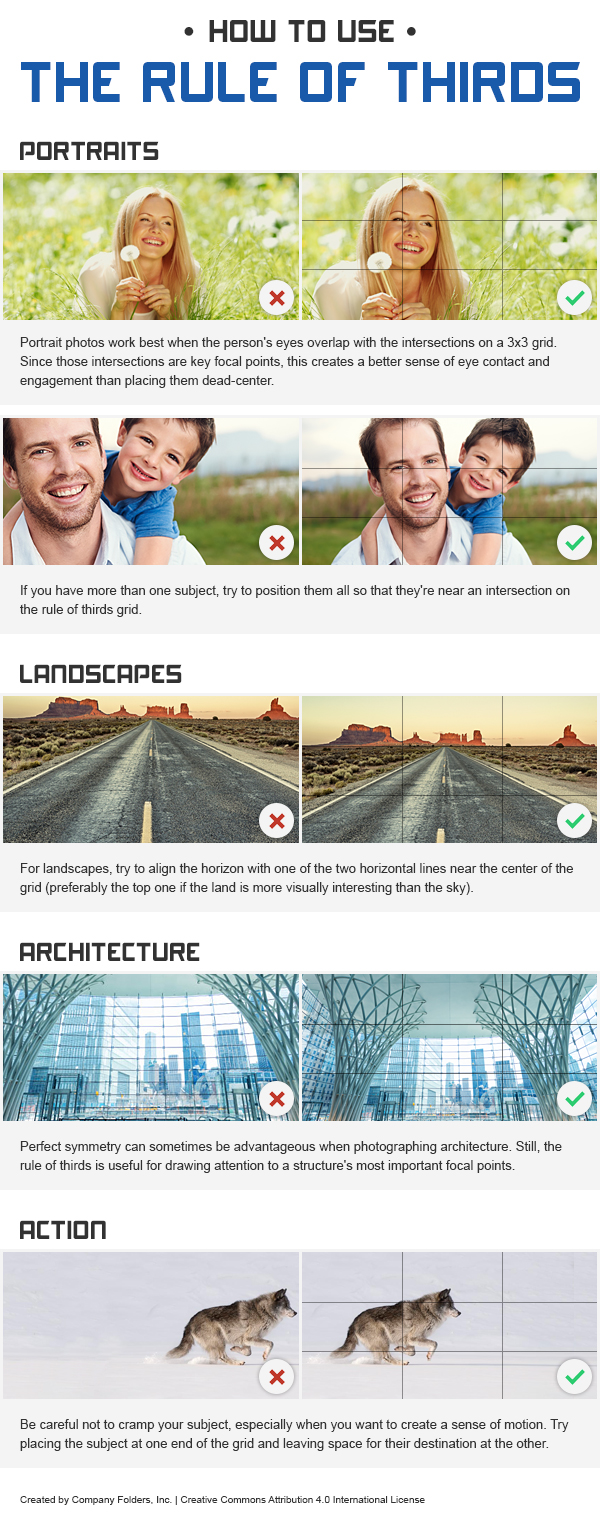
Read the section on the Rule of Thirds. Focus on the specific tips for portraits, landscapes, and moving subjects. The idea of leaving space for a moving subject to "move into" is especially important for creating a sense of narrative and motion.
The infographic below provides excellent before-and-after examples, illustrating how applying the rule of thirds improves composition across different types of photography.
3. Leading Lines
Leading lines are one of the most effective tools for directing the viewer's gaze. They are lines within the image—like roads, fences, or even the alignment of objects—that act as a visual pathway, guiding the eye directly to your focal point.
Let's return to the video from Learn Online Video to see this technique in action.
4 Framing & Composition Techniques for Beginners | Photography & Video Training
We'll continue with the "4 Framing & Composition Techniques" video.
Watch the segment on Leading Lines. The presenter clearly shows how a simple path can be used to draw your eye directly to the lighthouse, making the subject the undeniable destination of the visual journey.
Leading lines can be straight, curved, or diagonal, each creating a different feeling. For a more in-depth look at these variations, the next reading provides further examples.
8 Essential Composition Rules for Photography in 2025 - AI Photo Generator
We'll revisit the same guide for more detail on this second technique.
Read section 2. Leading Lines. Pay particular attention to the "Actionable Tips," which explain how to use S-curves for a calming effect and diagonal lines for energy—choices that directly influence the mood of an ad.
4. Symmetry
While the rule of thirds advises against centering, there are times when a centered, symmetrical composition is the most powerful choice. Symmetry creates a sense of stability, formality, and intentionality. It's often used in architecture or for creating bold, impactful product shots.
The video below explains this concept well.
4 Framing & Composition Techniques for Beginners | Photography & Video Training
Finally, let's look at the third technique from the "4 Framing & Composition Techniques" video.
Watch the section on Symmetry. Note how centering the subject can create a sense of balance and order, which is a deliberate choice, not a default.
Symmetry doesn't always have to be perfect. In fact, one of the most powerful compositional tools is to establish a pattern and then intentionally break it. This immediately creates a focal point and draws the viewer's attention.
8 Essential Composition Rules for Photography in 2025 - AI Photo Generator
This final reading from the photography guide discusses both symmetry and the powerful technique of breaking a pattern.
Please read section 4. Symmetry and Patterns. The tip on "Break the Pattern" is a key strategic concept in advertising design for making a product or message stand out.
Practice Exercise: Composing with AI
Now, let's put these principles into practice. Since you have some experience with AI image generation, this exercise is designed to help you start building your skills and portfolio immediately. Your task is to create three distinct commercial-style images, each applying one of the principles we've discussed.
-
The Rule of Thirds: Generate an image for a luxury wristwatch. Your prompt should explicitly use compositional terms to place the watch off-center, aligned with one of the grid's "power points."
- Example Prompt Idea:
Product photography of a luxury gold wristwatch with a black leather strap, placed on a dark marble surface. The watch face is positioned on the top-right intersection of the rule of thirds grid, with soft studio lighting creating elegant reflections.
- Example Prompt Idea:
-
Leading Lines: Generate an image for a modern electric car. Your prompt should describe a scene where elements like a road, bridge, or architectural lines guide the viewer's eye toward the car.
- Example Prompt Idea:
Cinematic shot of a sleek silver electric car parked on the side of a coastal highway at sunset. The road's yellow dividing lines serve as leading lines, starting from the bottom-left of the frame and guiding the eye towards the car in the middle ground.
- Example Prompt Idea:
-
Symmetry: Generate an image for a high-end perfume bottle. Your prompt should describe a perfectly centered and symmetrical composition that conveys elegance and balance.
- Example Prompt Idea:
Minimalist advertisement for a crystal perfume bottle with a gold cap. The bottle is perfectly centered against a plain, dark gray background. A perfect reflection of the bottle is visible on the glossy surface below, creating a striking vertical symmetry.
- Example Prompt Idea:
Take your time with the prompts. Experiment with different phrasings to see how the AI interprets your compositional instructions. Save the best results—these are your first portfolio pieces.
Conclusion
In this lesson, you've taken the first step in mastering the language of visual design. We've established that in advertising, composition is a strategic tool for directing attention. You've learned how to apply three fundamental principles to achieve this:
- The Rule of Thirds: Creates dynamic, balanced images by placing subjects off-center.
- Leading Lines: Guide the viewer's eye through the image to a specific focal point.
- Symmetry: Creates a sense of order, stability, and deliberate impact through centered compositions.
By practicing these techniques, you're moving beyond simply creating images and are starting to direct them with intent.
In our next lesson, we will build directly on this foundation by exploring visual hierarchy and focal points. You'll learn how to use contrast, size, and color to tell the viewer exactly what to look at first, second, and third, further enhancing your ability to orchestrate the narrative of your advertisements.