Recommended resources
The freely available resources this lesson will direct you to.
Welcome to your third lesson. In our previous session on the sliding window pattern, you saw how a map in Go was instrumental in tracking character frequencies to solve problems like finding the longest substring with unique characters. This was a practical glimpse into the power of hash maps.
Today, we will dive deep into this fundamental data structure. This lesson is dedicated to helping you master the hash map (or dictionary/hash table), a tool you'll use constantly to solve a vast range of interview problems. For a senior backend role, a solid grasp of not just how to use hash maps, but why and how they work is crucial. We'll cover the theory behind them, their implementation details, and most importantly, the common interview patterns where they provide an optimal solution.
From O(n) to O(1): The Core Value Proposition
The primary reason hash maps are so prevalent is their ability to trade space for time. Many problems that have a naive, brute-force solution with nested loops—often resulting in time complexity—can be optimized to a linear solution by using a hash map.
Imagine searching for a user profile by username in a simple array. You'd have to iterate through every single element until you find a match, a process that takes time. A hash map, in contrast, allows you to perform this lookup in average constant time, .
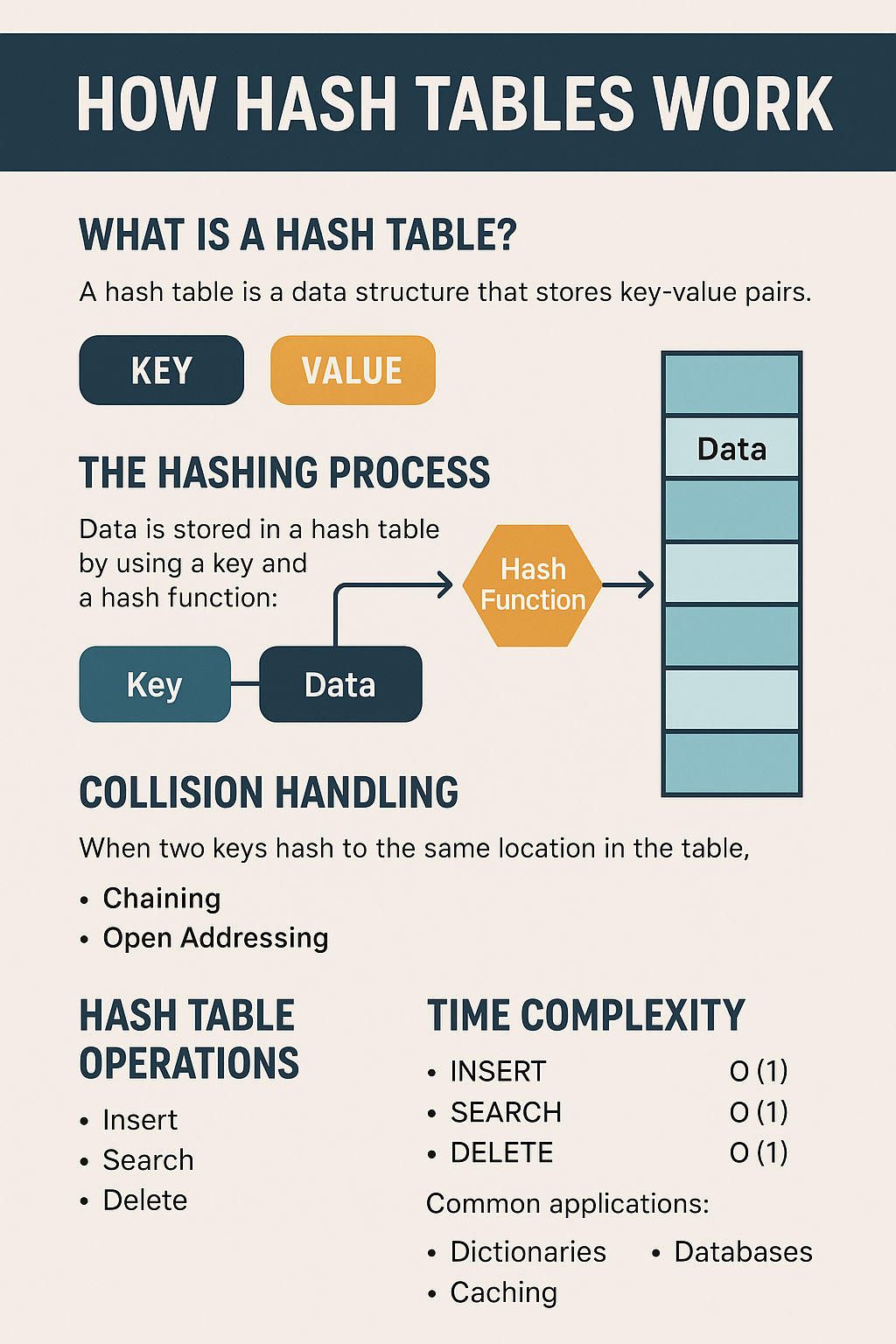
This dramatic performance gain comes from the hash map's internal architecture, which cleverly maps keys (like a username) to indices in an underlying array.
How Do Hash Maps Work?
To understand how to use hash maps effectively and debug potential performance issues, you need to look "under the hood." The magic of lookups relies on three core components:
- An underlying array: The primary storage for our data.
- A hash function: A function that takes a key of any type (e.g., a string) and deterministically produces an integer hash code.
- A collision resolution strategy: A mechanism to handle cases where two different keys produce the same hash code.
The following video provides an excellent and simple explanation of these concepts. It visualizes how we go from an inefficient array lookup to a highly efficient hash map lookup.
HashMaps & Dictionaries, Explained Simply
Watch the video to understand the fundamental problem hash maps solve and how they use hash functions to map keys to array indices.
Start from the beginning and watch until the initial explanation of the problem with array lookups and the introduction of hash functions and collisions. Continue from there to see how the modulo operator is used to fit large hash values into a smaller array, up to the point where collision handling is introduced at the modulo part.
As the video explains, even the best hash functions can produce the same hash code for different keys. This is known as a collision. The efficiency of a hash map is largely determined by how well it handles these collisions.
Collision Resolution and Performance
There are two primary strategies for resolving collisions:
-
Open Addressing: When a collision occurs, the algorithm probes for the next available slot in the same underlying array (e.g., linear probing). This keeps memory usage low and can be cache-friendly, but can lead to "clustering," where long runs of occupied slots slow down future operations. Python's
dictuses this method. -
Separate Chaining: Each slot in the underlying array (called a "bucket") holds a pointer to an independent data structure, typically a linked list, that stores all the key-value pairs that hashed to that index. This is the most common approach and is used by Go's
mapand Java'sHashMap. It's robust and handles high load factors gracefully.
The following resource provides a more technical deep-dive into these mechanics. Understanding these concepts is a hallmark of a senior engineer.
This article explains the core mechanics of hash maps, including the role of hash functions, buckets, load factor, and collision resolution strategies.
Read from the beginning, focusing on the sections What Is a Hash Map?, What Is a Hash Function?, What Is a Bucket?, Load Factor, and Collision Resolution. Pay close attention to the table comparing different collision handling methods.
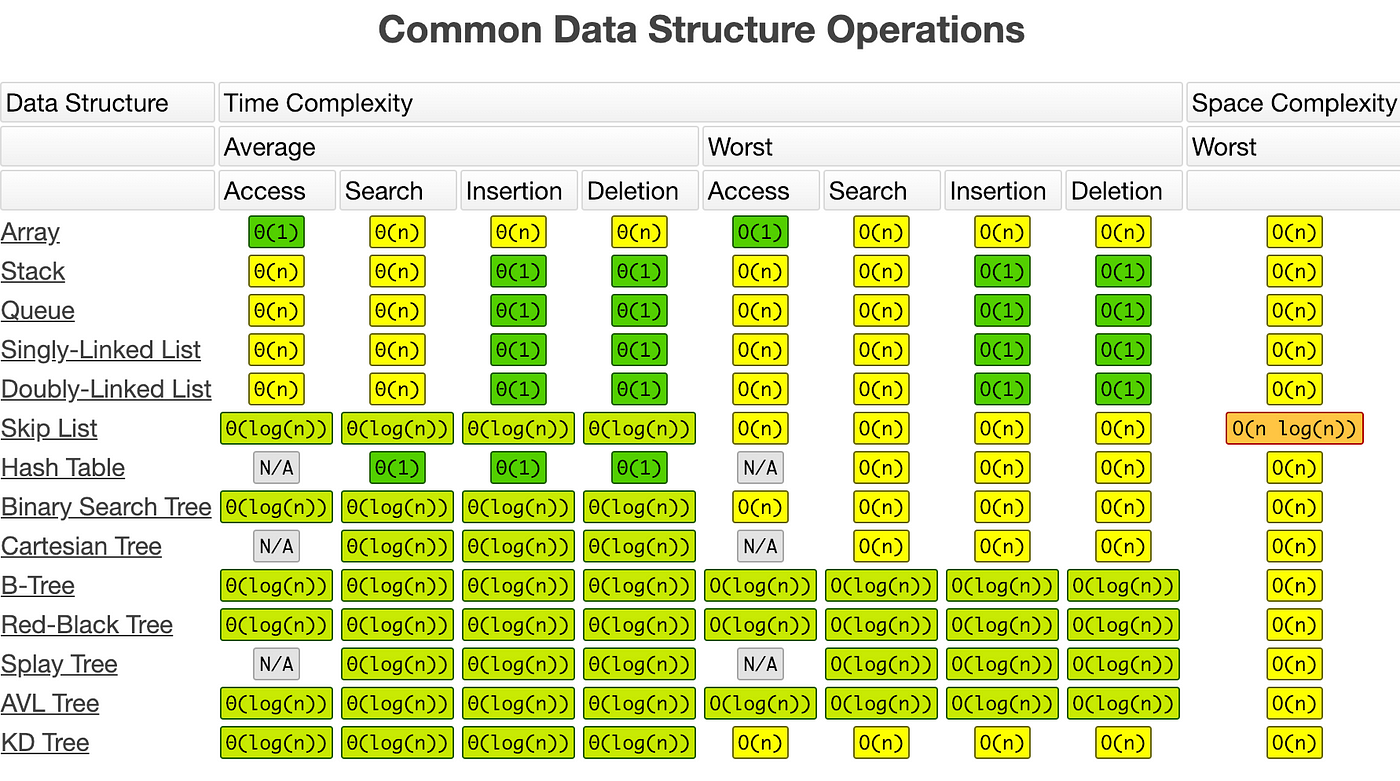
The key takeaway is that while the average time complexity for hash map operations is , the worst-case is . This worst case occurs when all keys collide into a single bucket, effectively degrading the hash map into a simple linked list.
The Golang Perspective
As a Go developer, you're accustomed to using the built-in map type. Go's maps are implemented using separate chaining. To solidify your understanding, this video provides a conceptual overview and then implements a hash table from scratch in Go, which is a common senior-level interview task.
Data Structures in Golang - Hash Tables
This video explains hash table concepts and shows how they are implemented in Go.
Watch the conceptual overview from the beginning, which covers hash functions and the two main collision handling methods, with a focus on separate chaining. Then, watch the explanation of the core operations: Insert, Search, and Delete, and the analysis of time complexity. You can skim the live-coding portion that follows, as we will focus on applying these patterns next.
Recognizing Hash Map Patterns in Interviews
Now that you have a solid theoretical foundation, let's focus on the practical application. In interviews, success often comes from quickly recognizing that a problem can be optimized with a hash map.
The "HashMap Pattern" resource from Dev Weekends is an excellent guide for this. We'll use it to explore the most critical patterns.
HashMap Pattern - Dev Weekends
This resource is a cheat sheet for identifying and solving hash map problems.
First, read the introduction "What is HashMap?" to understand its role in interviews. Then, study the Pattern Recognition Cheatsheet and the Pattern Recognition Checklist. These tables are designed to trigger the "use a hash map" instinct when you see certain keywords in a problem.
Let's walk through three of the most important patterns, with Go implementations.
1. Frequency Counting
This is one of the most common uses. You've already seen it in the sliding window lesson. The goal is to count the occurrences of items in a collection.
Problem Example: Given two strings, determine if the second is an anagram of the first.
An anagram is a word formed by rearranging the letters of another, like "listen" and "silent".
Logic: Two strings are anagrams if and only if they have the same character counts. We can use a hash map to count character frequencies in the first string, then decrement the counts for characters in the second string. If all counts are zero at the end, they are anagrams.
package main

import "fmt"

func isAnagram(s, t string) bool {
    if len(s) != len(t) {
        return false
    }

    // Create a map to store character frequencies of string 's'.
    // In Go, rune is used for characters, which can represent any Unicode code point.
    counts := make(map[rune]int)

    // Populate the frequency map for string 's'.
    for _, char := range s {
        counts[char]++
    }

    // Decrement frequencies based on string 't'.
    for _, char := range t {
        // If a character in 't' is not in our map, or its count is already 0,
        // then it's not an anagram.
        if counts[char] == 0 {
            return false
        }
        counts[char]--
    }

    // In this implementation, if we successfully complete the second loop,
    // it guarantees all counts were matched. An alternative check could be
    // to iterate the map one last time to ensure all values are 0.

    return true
}

func main() {
    fmt.Println(isAnagram("anagram", "nagaram")) // Output: true
    fmt.Println(isAnagram("rat", "car"))         // Output: false
}
2. Complement Lookup (The "Two Sum" Pattern)
This is the quintessential hash map interview problem. It perfectly demonstrates the space-for-time trade-off.
Problem Example: Given an array of integers nums and a target integer target, return the indices of the two numbers such that they add up to target.
Brute-force logic (): Use a nested loop to check every possible pair of numbers.
Hash map logic (): As you iterate through the array, for each element x, calculate its required "complement" y such that x + y = target. The complement is y = target - x. Check if this complement y already exists in your hash map.
- If it does, you've found your pair.
- If it doesn't, add the current element
xand its index to the map for future lookups.
package main

import "fmt"

func twoSum(nums []int, target int) []int {
    // The map will store: value -> index.
    seen := make(map[int]int)

    for i, num := range nums {
        complement := target - num

        // Check if the complement exists in our map.
        // 'j' will be the index of the complement. 'ok' is a boolean.
        if j, ok := seen[complement]; ok {
            // We found the pair.
            return []int{j, i}
        }

        // If not found, add the current number and its index to the map.
        seen[num] = i
    }

    // Return an empty slice if no solution is found.
    return []int{}
}

func main() {
    nums := []int{2, 7, 11, 15}
    target := 9
    fmt.Println(twoSum(nums, target)) // Output: [0 1]
}
This pattern of looking for a "complement" is incredibly powerful and extends to many other problems.
3. Grouping by a Canonical Key
This pattern involves grouping items that share a common property. You achieve this by creating a "canonical" representation to use as the hash map key.
Problem Example: Given an array of strings, group the anagrams together.
Logic: All anagrams of a word become identical if their characters are sorted. For example, sorted("eat"), sorted("tea"), and sorted("ate") all result in "aet". We can use this sorted string as a canonical key in our hash map. The map will store: sorted_string -> list_of_original_strings.
This group_anagrams problem and the two_sum problem are detailed with code in the "HashMap Pattern" resource. Taking a look at these worked examples will reinforce your understanding.
HashMap Pattern - Dev Weekends
This resource provides clear, worked-out solutions for classic hash map problems.
Read through the detailed explanations for Two Sum and Group Anagrams. Notice how they both start by identifying the brute-force approach and then show how the hash map provides an optimized solution.
Conclusion
In this lesson, we've explored the hash map from its theoretical underpinnings to its practical application in coding interviews. It is arguably the most versatile data structure for optimizing problems that are heavy on lookups, searches, or frequency counts.
Key Takeaways:
- The Core Trade-off: Hash maps use extra space (the underlying array and related structures) to achieve remarkable average time complexity for insertion, deletion, and lookup.
- Under the Hood: They work by using a hash function to map keys to an index in an array. Collisions are inevitable and are typically handled with separate chaining (used in Go) or open addressing.
- Performance: While average performance is constant time, the worst-case performance is linear, , which occurs when a large number of keys collide into the same bucket.
- Interview Patterns: Be ready to identify key patterns like frequency counting, complement lookup (Two Sum), and grouping by canonical key (Group Anagrams). Recognizing these will allow you to quickly jump from a brute-force to an optimal solution.
In our next lesson, we will shift our focus to a different class of problems involving intervals. You'll learn techniques for merging, inserting, and managing collections of ranges, which frequently appear in problems related to scheduling, geometric data, and resource allocation.