Recommended resources
The freely available resources this lesson will direct you to.
In our last lesson, we mastered the opposite-end two-pointer pattern for finding pairs in a sorted array. Now, we'll build directly on that foundation to tackle a more complex and classic interview problem: 3-Sum.
The challenge is to find all unique triplets in an unsorted array that sum to zero. This lesson will show you how to elegantly solve this by transforming the problem into a series of two-sum problems. You will learn to combine sorting with the two-pointer technique you've just practiced, paying special attention to the crucial step of handling duplicates—a key detail in coding interviews.
From Three Numbers to Two
The 3-Sum problem (as seen on LeetCode as problem 15) asks:
Given an integer array
nums, return all the unique triplets[nums[i], nums[j], nums[k]]such thatnums[i] + nums[j] + nums[k] == 0.
A brute-force solution would involve three nested loops to check every possible combination of three numbers. This would have a time complexity of O(n³), which is too slow for typical constraints.
The key insight is to reduce the problem's dimensionality. If we fix one number, a, in the triplet, the problem becomes finding two other numbers, b and c, such that b + c = -a. This is exactly the Two Sum problem we've been working on!
To make this efficient, our first step is to sort the input array. Sorting accomplishes two critical things:
- It allows us to use the fast O(n) two-pointer technique for the
b + c = -asubproblem. - It groups duplicate numbers together, which makes them much easier to identify and skip.
The overall strategy is:
- Sort the array
nums. - Iterate through the sorted array with an index
i, pickingnums[i]as our first element,a. - For each
nums[i], run the opposite-end two-pointer algorithm on the remainder of the array (fromi+1to the end) to find a pair(b, c)that sums to-nums[i].
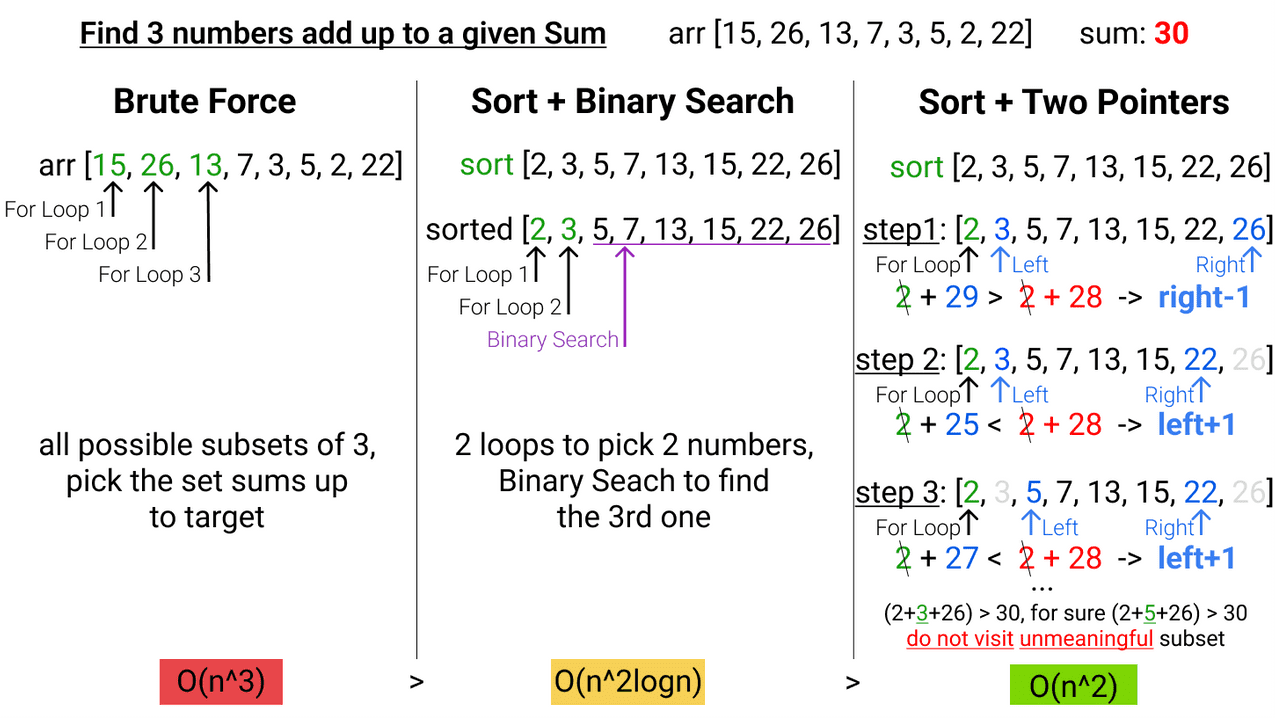
This approach reduces the complexity from a brute-force O(n³) down to O(n²), which is a significant improvement. The following image provides a high-level comparison of the brute-force, a binary search variant, and our target two-pointer approach, clearly showing the gains in efficiency.
The Optimal Two-Pointer Algorithm in Action
Let's dive into the mechanics of the optimal solution. The "take U forward" channel provides one of the clearest and most intuitive walkthroughs of this algorithm. The video first covers the brute-force and hash-based methods, but we will focus on the optimal approach that directly builds on our previous lesson.
3 Sum | Brute - Better - Optimal with Codes
This video explains the brute-force, better (hashing), and optimal (two-pointer) solutions for the 3-Sum problem.
Please watch the section explaining the optimal solution, starting from this point. The presenter does an excellent job of visually demonstrating the entire process on a sorted array. Pay close attention to: How the first element i is fixed, and the j (left) and k (right) pointers are set up for the sub-array. The logic for moving j forward when the sum is too small and k backward when the sum is too large. Most importantly, how the algorithm skips over duplicate numbers for i, j, and k to ensure the final result contains only unique triplets.
As you saw in the video, handling duplicates is the most intricate part of this problem. Let's formalize the logic for skipping them:
- Skipping duplicate
i: The outer loop iterates throughnumsto pick the first element of the triplet. If we encounter a number that is the same as the one before it (e.g.,nums[i] == nums[i-1]), we must skip it. Why? Because we would have already generated all unique triplets starting with that value in the previous iteration. - Skipping duplicates for
jandk: After finding a valid triplet(nums[i], nums[j], nums[k]), we add it to our results. We then need to move both pointers (j++andk--) to continue searching for other potential triplets. However, before resuming the search, we must advance thejandkpointers past any duplicates of their current values. For example, if we just usednums[j]and the next elementnums[j+1]is identical, we must skip it to avoid generating a duplicate triplet.
Step-by-Step Implementation Guide
The AlgoMonster article provides a fantastic, systematic breakdown of the implementation logic. It cleanly separates the algorithm into distinct, understandable steps, reinforcing the concepts from the video.
15. 3Sum - In-Depth Explanation
This article details the intuition, solution approach, and a concrete example for the 3-Sum problem.
Please read the section Solution Approach. It outlines the eight steps of the algorithm, from sorting to the final duplicate-handling logic. This provides a clear mental model for writing the code. After that, follow the Example Walkthrough to see these steps applied to the input [-1, 0, 1, 2, -1, -4]. This will solidify your understanding of how the pointers and duplicate checks work together.
From Algorithm to Code
Now that you have a firm grasp of the logic, let's look at a complete implementation. The following resource provides well-commented code in multiple languages, along with detailed notes on complexity and common pitfalls.
3Sum LeetCode 15 Solution: Two Pointers & Triplets - Sanjay Patidar
This article is a comprehensive guide to solving 3-Sum, featuring code, detailed explanations, and interview tips.
First, find the Python implementation under the heading Optimized Fixed Sliding Window (or choose your preferred language from the list). Study the code and the accompanying comments. Notice how the logic for skipping duplicates is implemented with if i > 0 and nums[i] == nums[i-1]: continue for the outer loop, and while loops for the inner pointers. Next, read through the Step-by-step Algorithm and the ASCII visualization to connect the code back to the dry run you saw in the video. Finally, review the sections on Common Pitfalls and Time & Space Complexity. Understanding these aspects is critical for interview success.
The time complexity is dominated by the nested loop structure, resulting in O(n²), plus the initial O(n log n) for sorting. The space complexity is O(1) (ignoring the space for the output list), as we only use a few variables for pointers. This is highly efficient compared to alternatives that might require O(n) space for hash sets.
Conclusion
In this lesson, you've leveled up from the Two Sum pattern to the more advanced 3-Sum. You learned how to combine sorting with the opposite-end two-pointer technique to solve a problem that initially seems to require three nested loops.
Key Takeaways:
- Reduction: The 3-Sum problem
a + b + c = 0can be reduced to a series of Two Sum problemsb + c = -aby fixinga. - Sorting is Key: Sorting the array is the essential first step that enables both the efficient two-pointer scan and a straightforward strategy for handling duplicates.
- The Pattern: The complete pattern is Sort -> Outer Loop (for
i) -> Two-Pointer Subproblem (forleftandright). - Duplicate Handling: The most critical detail for a correct solution is to systematically skip duplicate values for the outer loop index (
i) and for the two inner pointers (left,right) after finding a valid triplet.
In our next lesson, we'll continue exploring the two-pointer technique but in a different context: the "Container with Most Water" problem. This will demonstrate the versatility of the pattern beyond simple sum-finding tasks.