Recommended resources
The freely available resources this lesson will direct you to.
- Lasting Knowledge from Your Notes and Highlights: My Workflow with Readwisewww.youtube.com
- The Read And Recall Technique - Learn Everything You Studywww.youtube.com
- How to choose a Library configuration - Readwise Docsdocs.readwise.io
- A Strategic Approach to Effective and Efficient Readingmcgraw.princeton.edu
Hello. Earlier lessons separated promising material from the backlog, used a guiding question to read or watch with purpose, and turned remembered ideas into concise notes. This final lesson brings those moves together. The aim is not to process everything you save; it is to make one worthwhile encounter with a source possible in a repeatable 30-minute window, without spending the rest of the day in feeds.
By the end, you will have a default ritual for articles and books, a workable variation for videos, and a weekly reset that keeps your active queue small.
Give each part of the session a job
A good ritual protects time for remembering, not just consuming. If an article takes all 30 minutes, you may finish it but never find out what stayed with you. If you spend the window arranging your apps, you may never begin. The solution is to give selection, consumption, retrieval, and capture separate, modest time limits.
Princeton’s A Strategic Approach to Effective and Efficient Reading offers a useful underlying structure: set a purpose before reading, read with questions in mind, and make what you learned useful afterward. Its examples concern coursework; your “assignment” might instead be a decision, a conversation, a current interest, or simply understanding an idea well enough to revisit it.
A Strategic Approach to Effective and Efficient Reading
Read Princeton’s guide for its before, during, and after structure. Translate its academic examples into purposes that matter to you.
Under “Before: Situate, Strategize & Set Purpose,” read point 2, beginning with setting a purpose. Under “During: Read to Understand, Create a Record/Resource,” read point 3, beginning “Read to fulfill your purpose” and continuing through the final point about anticipating use; focus on reading with questions rather than collecting every detail. Under “After: Make Memorable & Useful,” read point 4, beginning with post-reading and continuing through the suggestion to explain a takeaway to someone else.
Purpose does not need to sound grand. “What is this author’s case for changing a habit?” is enough. It gives you something to look for and, later, something to retrieve. It also gives you permission to stop when a source no longer serves the question.
Keep discovery outside the reading window
Newsletters, magazines, RSS, social posts, and YouTube are valuable ways to discover material. They are poor places to decide, minute by minute, what deserves focused attention: each next item competes with the one you meant to read. Keep your existing routing and value test, but use them before a session or during a bounded queue reset. The 30-minute window begins with a short list of candidates, not an open feed.
Reader can support that boundary in more than one configuration. In Triage, new saves arrive in an Inbox for a decision. In Shortlist, the broad Later collection is distinct from a small active list. You do not need to change configurations for this ritual; what matters is knowing which location is your active commitment and limiting it. If your established cap is three items, for example, a book can occupy one slot for several sessions. “Saved” does not mean “promised.”
How to choose a Library configuration - Readwise Docs
Read the Readwise documentation to identify the location that represents your active queue, rather than treating every saved item as equally urgent.
In “How each configuration works,” read the introductory paragraph, then the “Triage” subsection from its description through the paragraph explaining what happens to newly saved documents. Continue to “Shortlist,” from its description through the paragraph distinguishing immediate priorities from things you might read eventually. Stop before the question about the Shortlist view in Triage.
In Lasting Knowledge from Your Notes and Highlights: My Workflow with Readwise, A Fading Thought describes saving material as a buffer between encountering it and deciding to spend time on it. The creator’s workflow is more elaborate than yours needs to be; notice especially the distance between discovery and consumption, the restraint in marking passages, and the later review of what is still worth keeping.
Lasting Knowledge from Your Notes and Highlights: My Workflow with Readwise
Watch the selected parts of “Lasting Knowledge from Your Notes and Highlights: My Workflow with Readwise” for a concrete example of buffered intake, selective attention, and a regular review.
Watch the intake buffer for the distinction between saving and choosing to read. Then watch focused consumption, paying attention to why the creator does not mark everything. Finally, the weekly assessment shows a review of what has been collected; use its principle, not its particular tagging system.
The default 30-minute ritual
Choose a time and place where you can return regularly. Beforehand, have a book, a previously opened or downloaded article, or another accessible source ready. Test access without a connection if you plan to be offline; do not let a failed download turn reading time into troubleshooting. Paper is sufficient for retrieval and drafting a note.
| Minutes | What you do |
|---|---|
| 0–3: Select | Choose one item from your bounded active queue. Apply your value test briefly, then write one guiding question. Do not open a feed to find a better option. |
| 3–19: Consume | Read or watch one manageable section with that question in mind. Identify its central claim, the support offered, and why either matters to you. Stop at the timer, even mid-book; mark where to resume. |
| 19–23: Retrieve and check | Close or cover the source. For about three minutes, state its claim, strongest support, and relevance from memory. Then reopen it briefly to check a missing or mistaken point. |
| 23–27: Capture | Write a short note in your own words: idea, source, possible use. If the idea does not merit a durable note, record that decision on scratch paper rather than manufacturing one. |
| 27–30: Close | Mark the stopping point, put away or archive a finished item as appropriate, and leave a specific next candidate ready. Stop when the window ends. |
The division between retrieval and checking matters. Looking back while explaining an idea tests your ability to find it; explaining it first tests what you can bring to mind. Your first account can be incomplete. The subsequent check tells you whether you missed a qualification, confused an example with the author’s claim, or attributed stronger evidence than the source supplied.
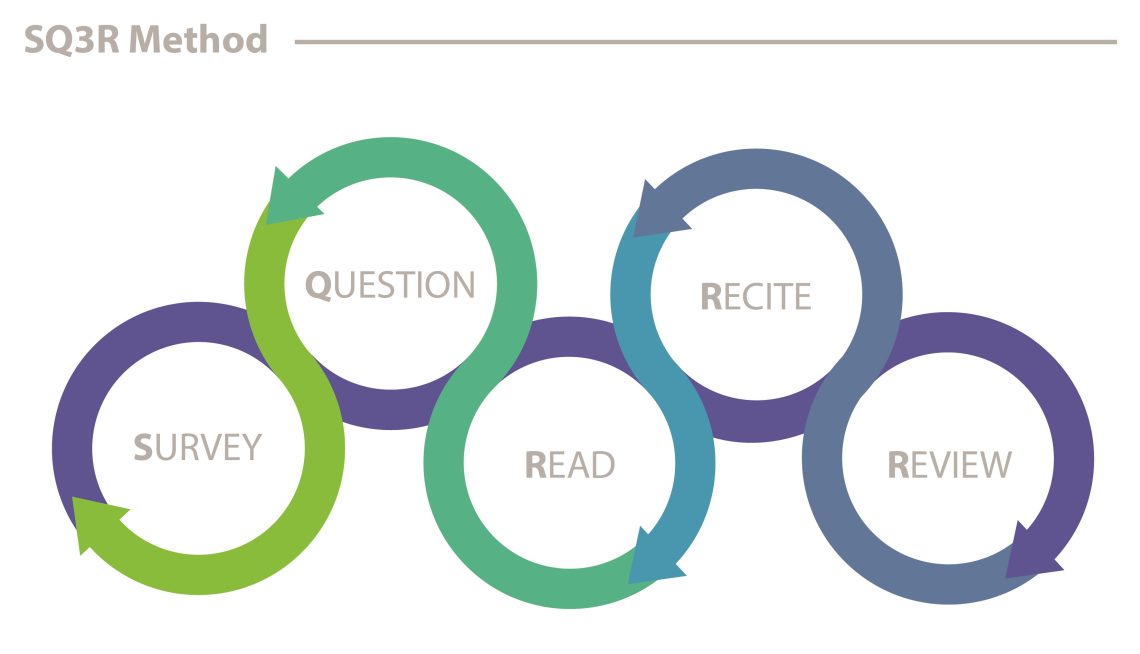
The familiar SQ3R diagram is a compact reminder that reading includes preparation and recall as well as the act of reading. In this ritual, your quick inspection and guiding question serve Survey and Question; the timed section is Read; closed-source retrieval is Recite; checking now and revisiting later contribute to Review.
For a long book, the 16-minute block is a chunk, not a demand to finish. Your retrieval should describe what this section contributed; do not invent the entire book’s argument from a few pages. For an article, you may finish or stop at a natural section break. If the material is dense, shorten the portion you consume rather than borrowing minutes from recall.
A Capacities note can remain very small. After reading Princeton’s guide, for instance, a note might say: “Setting a question before reading helps me notice which parts answer it, instead of highlighting indiscriminately. Source: A Strategic Approach to Effective and Efficient Reading. Possible use: decide what I want from a long article before opening it.” That is a personal takeaway, not a substitute for the source. If Capacities requires a connection in your setup, draft the three lines offline and enter them during a scheduled connected window; keep a clear mark until that transfer is done.
On video days
Use the same stages, but choose the video or a specific portion in advance. A video that exceeds the consumption block can be watched across sessions. If it must be streamed, watch in full screen, turn off autoplay where possible, and close the site when the timer ends. One connected video session does not defeat a mostly offline routine; letting recommendations choose the next hour would. Download for offline viewing only when that option is available and permitted.
Make the reset regular, not endless
A daily closing minute keeps the next session easy; a weekly reset keeps the queue honest. Once a week, use this 30-minute variation rather than adding an unlimited “catch-up” session:
| Minutes | Weekly variation |
|---|---|
| 0–6 | Open your intake locations deliberately. Clear finished items from the active queue; decline or archive candidates that fail your value test; promote only enough items to stay within your cap. Check whether a recurring source is consistently worth its place. |
| 6–9 | Choose one active item and write a guiding question. |
| 9–19 | Consume a smaller section. |
| 19–23 | Retrieve with the source closed, then check. |
| 23–27 | Capture an idea and its possible use, or record that none was worth keeping. |
| 27–30 | Prepare the next item and close the apps. |
Six minutes is not enough to inspect a vast historical backlog—and it does not need to be. Reset the active queue and a bounded batch of new arrivals. If the inbox is large when time expires, leave the rest unprocessed. Your cap prevents that remainder from silently becoming your reading plan. A full book, article, or video also does not need a note for every session; capture an idea when you can say what it means and where it might be useful.
The ritual will occasionally meet real constraints: an unexpectedly absorbing chapter, a source that turns out to be poor, or a day with no connection. Keep the sequence, not a perfect completion record. Stop a poor source early and use the remaining consumption minutes on your prepared alternative—or proceed to retrieval and record why it was not useful. If an offline source or note app is unavailable, use paper. The useful measure is whether, over repeated sessions, you are choosing deliberately, recalling before checking, and keeping the queue bounded.
Closing
Your 30 minutes now have a clear shape: select from a limited queue, consume one purposeful portion, retrieve it without looking, check your understanding, capture what is useful, and prepare to return. The weekly version adds a short reset so newsletters, feeds, saved articles, books, and videos remain candidates rather than obligations.
This completes the course. The most useful next step is to keep the ritual modest enough to repeat, then adjust its time limits based on where your attention actually goes—not on how much material remains saved.