Recommended resources
The freely available resources this lesson will direct you to.

Hello! Welcome back to our exploration of recent advances in quantum error correction.
In our last lesson, we diagnosed a critical weakness in the standard surface code: its performance significantly degrades under biased noise. We saw that because the plaquette (-type) stabilizers are "blind" to the dominant dephasing () errors, the code's error correction threshold paradoxically drops from ~15.5% to ~10.9% just when the noise becomes more structured and seemingly simpler.
Today, we'll address this problem head-on. The issue was a mismatch between the code's structure and the noise's structure. The solution, therefore, is to tailor the code to the noise. This lesson will focus on a powerful example of this principle: the XZZX surface code. We will describe its design and explain precisely how its modified structure provides dramatically enhanced protection against biased noise.
1. A Simple Redesign with Major Consequences
The core idea behind the XZZX surface code is remarkably simple. Instead of having two different types of stabilizers—vertex operators made of Pauli-s and plaquette operators made of Pauli-s—we define a single, uniform stabilizer type for every plaquette on the lattice.
As the name suggests, this new stabilizer generator is the four-body Pauli operator , arranged around a plaquette. While this seems like a small local change, it fundamentally alters how the code interacts with errors.
The paper "The XZZX surface code" by Bonilla Ataides et al. provides the original and clearest description of this code. Let's start by familiarizing ourselves with its basic structure.
Please read this section from 'The XZZX surface code' to understand the fundamental definition of the code's stabilizers.
Please read the first paragraph of Section II, 'THE XZZX SURFACE CODE', which introduces the stabilizer generators. Pay close attention to Figure 1(a) mentioned in the text, which shows the placement of the Pauli operators on the lattice.
To visualize this change, the following image contrasts the conventional CSS surface code with the XZZX variant.
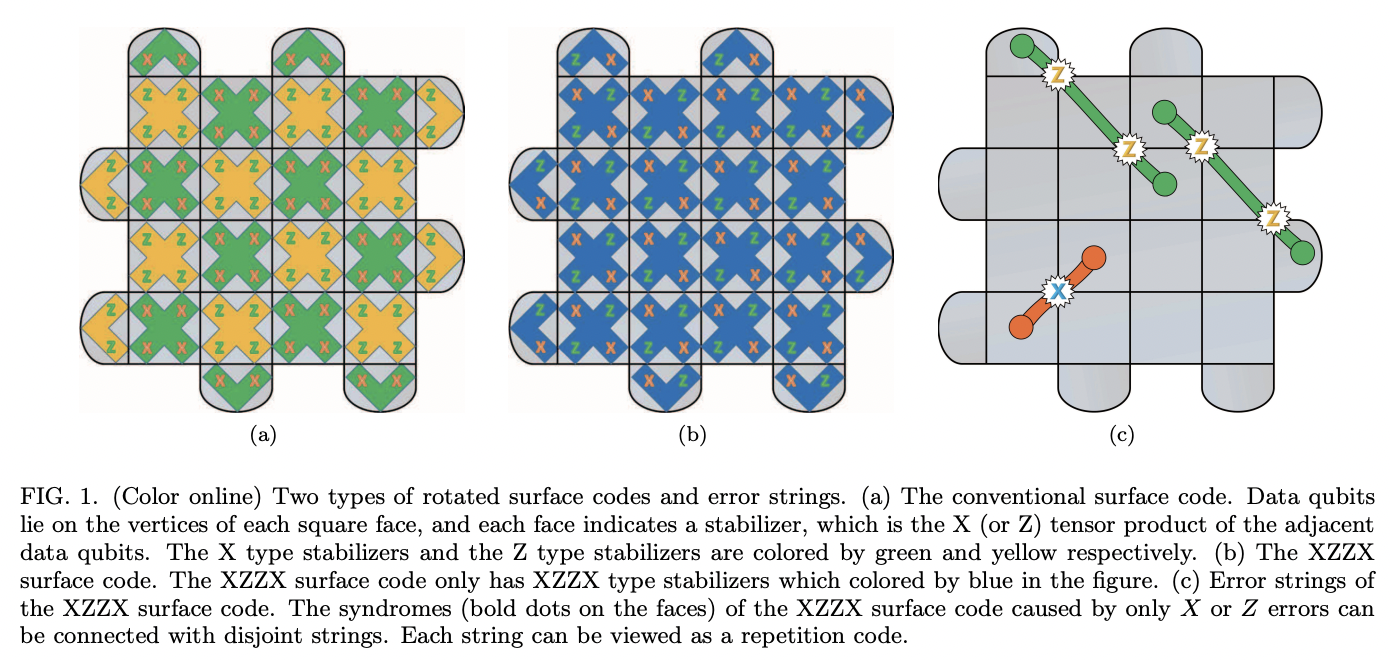
As you can see, the XZZX code is more uniform. This uniformity is the key to overcoming the "blind spot" that plagued the standard code.
2. The Mechanism of Enhanced Protection
Now for the crucial question: why does this structure work so well against Z-biased noise?
Let's trace the effect of a single Pauli- error on a data qubit.
- In the standard CSS code, a error commuted with the -type plaquette stabilizers and anti-commuted with the two adjacent -type vertex stabilizers. Half the stabilizers were blind to it.
- In the XZZX code, every stabilizer contains two operators and two operators. A single error on a qubit will commute with the two stabilizers where it overlaps with a operator, but it will anti-commute with the two stabilizers where it overlaps with an operator.
This means a single error creates a pair of syndrome defects. Crucially, every stabilizer is now capable of detecting the dominant errors. There are no more blind spots.
This leads to a beautiful simplification. As explained in the reading from "The XZZX surface code," Pauli- errors create defects at the endpoints of one-dimensional strings that align along a specific direction on the lattice (diagonally in the paper's convention). The problem of decoding Z-errors on a 2D lattice is thus transformed.
For a deeper understanding of this transformation, let's turn to another paper that provides an excellent explanation.
Bias-tailored quantum LDPC codes
This paper, 'Bias-tailored quantum LDPC codes' by Roffe et al., elegantly explains why the XZZX structure is so effective. It introduces the idea that the XZZX code can be viewed as a 'Hadamard-rotated' version of the standard code.
Please read Section 4.3, 'The XZZX toric code'. Focus on the explanation for the improved performance: the redefinition of stabilizers causes the error correction problem to reduce to a set of decoupled repetition codes in the infinite-bias limit. The discussion around Figure 5 is particularly insightful.
As the reading highlights, in the limit of pure Z-noise (), the 2D decoding problem for the XZZX code decouples into a set of independent 1D repetition codes. You are already familiar with the 3-qubit repetition code for correcting bit-flips. Here, the logic is analogous: a chain of errors is detected by stabilizers at its ends, and the decoder's job is simply to find the shortest path between these defects along the predefined direction, just like in a repetition code.
Since the threshold of a repetition code is 50%, the threshold of the XZZX code against pure Z-noise is also 50%. This is a monumental improvement over the 10.9% threshold of the standard surface code.
Test your understanding!
In the previous lesson, we saw that the standard surface code's -stabilizers were "blind" to -errors. Does the XZZX code have a similar blind spot for any single-qubit Pauli error (, , or )? Explain your reasoning.
Show answer
No, the XZZX code does not have a blind spot for any single-qubit Pauli error.
- A Z-error anti-commutes with the two adjacent stabilizers at the positions of the operators.
- An X-error anti-commutes with the two adjacent stabilizers at the positions of the operators.
- A Y-error () anti-commutes with all four adjacent stabilizers because it anti-commutes with both and parts of each stabilizer.
Since every stabilizer has both and components, no single-qubit Pauli error can "hide" from the entire set of stabilizers. This is the fundamental reason for its robustness.
3. Quantifying the Superior Performance
The intuitive argument that the threshold should rise to 50% in the limit of pure bias is borne out by detailed numerical simulations. The XZZX code not only fixes the performance degradation seen in the standard code but achieves near-optimal thresholds across the entire spectrum of single-qubit Pauli noise.
Let's examine the evidence from the original paper.
This section presents the results of numerical simulations that calculate the error correction threshold of the XZZX code for various noise models and compare it to the standard CSS surface code.
Please read Section III, 'OPTIMAL THRESHOLDS'. Focus on the description of Figure 2, which shows the threshold error rate for all possible single-qubit Pauli noise channels (represented as a triangle). Contrast the behavior of the XZZX code (which stays high) with the CSS surface code (which dips significantly for X- and Z-biased noise).
The results are striking. The standard CSS code has a threshold that dips from ~18% for depolarizing noise down to ~10.9% for pure X or Z noise. In contrast, the XZZX code's threshold forms a convex shape, with its lowest point at ~18.7% for depolarizing noise and rising to ~50% at the corners (pure X, Y, or Z noise).
This means that no matter the type of single-qubit Pauli noise, the XZZX code performs at or near the theoretical best possible performance (the "hashing bound"). It completely solves the biased-noise vulnerability of the standard code.
4. Practical Considerations and Asymmetric Lattices
The structure of the XZZX code also allows for clever optimizations in resource usage. Since errors form chains in one direction and errors form chains in the orthogonal direction, we can use a rectangular lattice instead of a square one if the noise is highly biased.
For instance, if errors are much more common, their error chains are the primary concern. These chains run along the code's logical operator direction. We need a large code distance in this direction to suppress logical errors. However, since errors are rare, we can afford a much smaller code distance in the orthogonal direction. This leads to the possibility of using highly asymmetric codes with , which can drastically reduce the number of physical qubits required compared to a symmetric layout, a point alluded to in the paper "The XZZX surface code" (Section VI, Fig. 9).
Conclusion
In this lesson, we have seen how a targeted modification to a quantum error-correcting code can yield dramatic improvements in performance by tailoring it to a realistic noise model.
Key Takeaways:
- Design: The XZZX surface code replaces the separate and stabilizers of the standard code with a single, uniform -type stabilizer on every plaquette.
- Mechanism: This uniform structure ensures that all stabilizers can detect all types of Pauli errors, eliminating the "blind spot" that hampered the standard code under biased noise.
- Enhanced Protection: In the limit of high Z-bias, the 2D decoding problem decouples into a set of 1D repetition codes. This simplification elevates the error correction threshold from the standard code's 10.9% to a near-optimal 50%.
- Generality: This principle of modifying stabilizers via local Clifford operations (like the "Hadamard rotation" trick) is a powerful and general technique for designing noise-aware codes.
Preview of the next lesson:
Designing a good code is only half the battle; we also need an efficient algorithm—a decoder—to interpret the error syndromes and determine the correction to apply. While classical algorithms like minimum-weight perfect matching are effective for codes like the surface code, another exciting frontier is the use of machine learning for decoding. In our next lesson, we will take the first step in this direction by learning how to generate a training dataset of error syndromes and corresponding Pauli errors for a small stabilizer code, setting the stage for building a neural network-based decoder.