Recommended resources
The freely available resources this lesson will direct you to.
Hello! Welcome to the first lesson of your personalized course on Popperian realism, tradition, and rationalism.
I'm excited to embark on this intellectual journey with you. Your goal is to forge a philosophy of "Critical-Traditionalist Rationalism," and our starting point is a foundational problem in epistemology that shook the foundations of science and philosophy: David Hume's Problem of Induction.
Lesson 1: The Crack in the Foundation of Knowledge
Introduction
In this lesson, we will tackle the first learning outcome of our course: Articulate Hume's Problem of Induction and its challenge to traditional empiricism.
Why start here? Because Karl Popper's entire philosophical project, which is the cornerstone of our course, is a direct and radical response to the challenge laid down by Hume. Understanding this problem is not just a historical footnote; it's the key to unlocking why Popper rejected traditional scientific methods and proposed a new way of thinking about knowledge. For someone with your deep background in statistics and econometrics—fields that are fundamentally about drawing inferences from data—this problem cuts to the very heart of the matter.
We will cover:
- Hume's Fork: The crucial distinction between two types of knowledge.
- The Logic of Induction: How we generalize from experience.
- The Problem: Why our most common form of reasoning about the world rests on a logically unjustifiable assumption.
This lesson should take you approximately 45 minutes to complete.
1. Two Types of Truth: Hume's Fork
To begin, we need to understand how Hume categorized human knowledge. He argued that all propositions, or statements of belief, can be divided into two distinct types.
Please watch the following video from Wireless Philosophy, which introduces this fundamental distinction. Pay close attention to the definitions and examples of "relations of ideas" and "matters of fact."
PHILOSOPHY - Epistemology: Hume's Skepticism and Induction, Part 1 [HD]
Focus on the segments explaining Relations of Ideas (1:15 - 3:10) and Matters of Fact (3:10 - 4:08).
As you just saw, Hume creates a powerful classification system for knowledge:
| Category | Relations of Ideas | Matters of Fact |
|---|---|---|
| Nature | Truths of logic and definition. | Truths about the state of the world. |
| Justification | Knowable a priori (by "the mere operation of thought"). | Knowable a posteriori (through experience/observation). |
| Test | Its denial is a contradiction (inconceivable). | Its denial is not a contradiction (conceivable). |
| Your World | "All bachelors are unmarried." "" A theorem from linear algebra. |
"The UK base rate is 5.25%." "Jupiter is the largest planet in our solar system." The estimated coefficient in your OLS regression. |
This distinction is crucial. "Relations of ideas" give us certainty but tell us nothing about the world itself. They are true by definition. "Matters of fact" tell us about the world, but as we are about to see, they seem to lack the certainty of logic. The problem arises when we want to make claims about matters of fact that we haven't directly observed, which is, of course, the entire basis of scientific prediction and forecasting.
2. The Leap of Faith: Induction
So, how do we form beliefs about matters of fact we haven't observed? We use a pattern of reasoning called induction. We observe a regularity in the past and project it into the future.
This second video explains how induction works and exposes the deep philosophical problem it conceals.
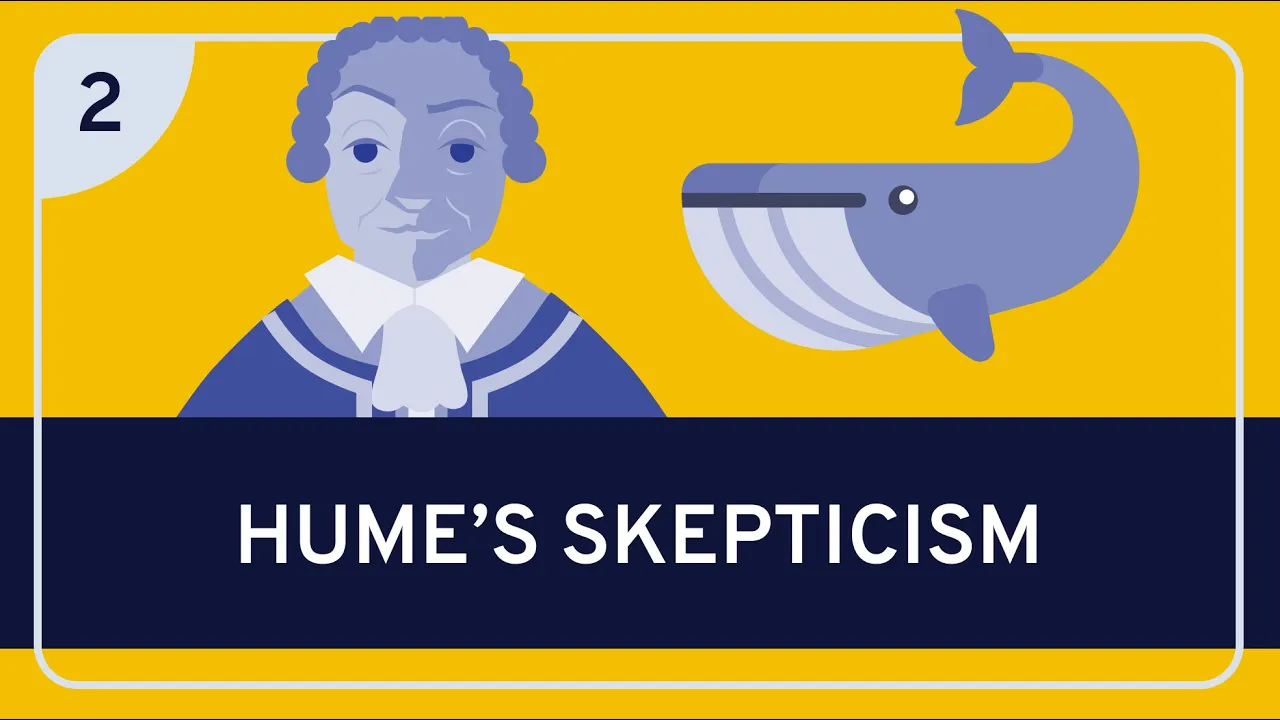
Please focus on these key segments:
- The definition of induction (1:04 - 1:50): Moving from "all observed Fs are G" to "all unobserved Fs are G."
- The hidden assumption (2:53 - 4:32): The principle of the "Uniformity of Nature."
- The circular argument (4:16 - 8:20): Why we can't rationally justify this hidden assumption.
3. Hume's Argument Unpacked
Let's break down the devastatingly simple logic of Hume's argument.
-
Premise 1: All our reasoning about unobserved matters of fact is based on induction. When you build an econometric model to forecast inflation, you assume that the relationships between variables observed in your historical data will hold for future, unobserved data.
-
Premise 2: Inductive reasoning relies on a hidden assumption: The Principle of the Uniformity of Nature (PUN). This is the belief that the future will resemble the past; that the "laws" or regularities we've seen so far will continue to hold.
-
The Challenge: How can we justify our belief in PUN? Using Hume's Fork, we have only two possible avenues for justification:
-
Is PUN a "Relation of Ideas"? No. We can easily conceive of a world where nature is not uniform. We can imagine gravity suddenly reversing or the laws of thermodynamics failing tomorrow. Since its denial is not a contradiction, it cannot be an a priori logical truth.
-
Is PUN a "Matter of Fact"? To justify it as a matter of fact, we would have to rely on observation. The argument would look like this: "In the past, the future has always resembled the past. Therefore, in the future, the future will continue to resemble the past."
-
-
The Vicious Circle: Do you see the problem? This argument—that induction has worked before, so it will work again—is itself an inductive argument! It assumes the very principle (PUN) it is trying to prove.
As the video memorably explains, this is no different from justifying a Magic 8 Ball's predictions by asking the Magic 8 Ball if it is reliable. It's a circular, question-begging fallacy.
The Challenge to Traditional Empiricism
This leads us to the core of this lesson's learning outcome. Traditional empiricism is the philosophy that all substantive knowledge about the world originates from sensory experience and is built up through rational inference. Hume, himself an empiricist, showed that the primary tool for building this knowledge—induction—is not based on reason at all. It's based on what he called "custom or habit."
We expect the sun to rise tomorrow not because of a logical proof, but because it has become a powerful habit of mind. This is a deeply unsettling conclusion. It suggests that science, which we hold up as the pinnacle of rational inquiry, is ultimately founded on a leap of faith. There is no rational reason to prefer the predictions of an econometric model over those of a crystal ball.
This is the Problem of Induction. It's a crack in the very foundation of empirical knowledge.
Conclusion
In this lesson, we have dissected one of the most significant problems in the philosophy of knowledge.
Key Takeaways:
- Hume divides knowledge into Relations of Ideas (knowable by logic alone) and Matters of Fact (knowable through experience).
- To reason about unobserved Matters of Fact, we use induction, which involves projecting past regularities into the future.
- Induction relies on the Principle of the Uniformity of Nature, the belief that the future will resemble the past.
- This principle cannot be justified logically (a priori) or empirically (a posteriori) without resorting to a circular argument.
- This Problem of Induction fundamentally challenges traditional empiricism by showing that scientific inference is based on habit, not rational justification.
Looking Ahead
Hume's problem created a crisis. If our scientific laws can't be rationally justified, what separates them from myth or superstition? In our next lesson, we will examine the most ambitious 20th-century attempt to "solve" this problem: Logical Positivism and its verification principle. We will see why it failed, setting the stage for Karl Popper's brilliant and game-changing alternative.