Recommended resources
The freely available resources this lesson will direct you to.
Hello! Welcome back to our module on Contemporary Analytic Metaphysics and Epistemology.
In our last lesson, we explored the problem of universals and mapped out the two main camps: realism, which holds that universals like 'Redness' are real entities, and nominalism, which denies their existence. We focused on Platonic Realism as a primary example, where universals exist as transcendent Forms. As I previewed, this view faced a formidable challenge from its earliest days—a challenge formulated by Plato himself.
Your learning outcome for this lesson is to: Analyze the 'Third Man Argument' against simple forms of realism about universals.
Today, we will dissect this famous argument. We will see how it attempts to show that the Theory of Forms, in its simple presentation, leads to a vicious infinite regress. Given your background in mathematics, you will appreciate that our focus will be on the argument's logical structure, exposing a deep inconsistency in the theory's underlying premises.
1. The Stage: Plato's Parmenides and the Properties of Forms
The Third Man Argument (TMA) makes its first appearance in Plato's dialogue, Parmenides. In a fascinating piece of intellectual honesty, Plato presents a scenario where a young Socrates, championing his new Theory of Forms, is systematically dismantled by the older, revered philosopher Parmenides.
The argument targets two fundamental assumptions of the Platonic theory you encountered in earlier modules:
- Separation (or Non-Identity): The Form is separate and distinct from the particular things that instantiate it. A particular large rock is not the same thing as the Form of Largeness. Any particular that has a property is not identical to the Form that explains that property.
- Self-Predication: The Form corresponding to a property F is itself F. The Form is the perfect exemplar of the property. Therefore, the Form of Largeness is itself large, the Form of Beauty is itself beautiful, and the Form of Justice is itself just.
With these two assumptions in mind, Parmenides springs his trap.
2. The Argument: A Vicious Infinite Regress
The argument's name, "Third Man," comes from Aristotle's later discussion of it, using the example of "man." Let's walk through the logic.
- Suppose we have a collection of particular men (Socrates, Plato, etc.). To explain what they have in common—their shared property of being a man—we posit the existence of a Form: Man-1. All the particulars are men because they participate in this Form.
- According to the Self-Predication assumption, the Form Man-1 is itself a man.
- But now we have a new collection of things that are all men: the original particular men, plus the Form Man-1.
- To explain what this new, larger collection has in common, we must posit another Form, according to the same "one over many" principle. Let's call it Man-2.
- But of course, Man-2 must also be a man (Self-Predication). This creates yet another collection (particulars, Man-1, Man-2), which requires a Man-3 to explain their commonality... and so on, ad infinitum.
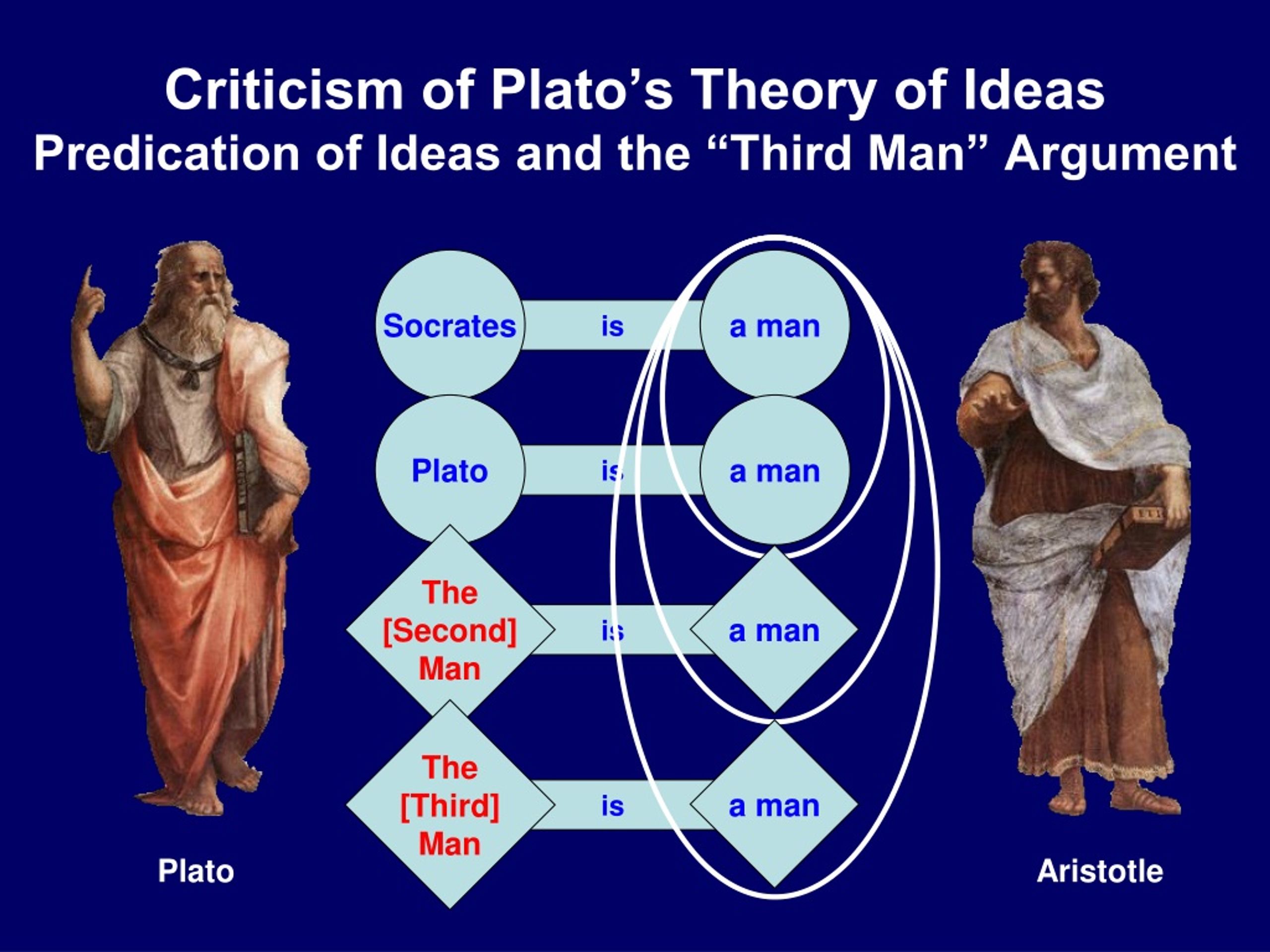
This is a vicious regress because the explanatory task is never completed. The whole point of positing the Form of Man was to explain what makes men men. But since each Form introduced requires another Form to explain it, the explanation is forever deferred.
To see a detailed walkthrough of this argument, please watch the following segment. The presenter connects the logic to set-theoretic paradoxes, an analogy that should be familiar from your mathematical studies.
In this clip from his lecture on Plato's 'Parmenides', Adam Rosenfeld provides a clear, step-by-step explanation of the Third Man Argument.
Watch from 01:03:23 to 01:10:41. Focus on how the principle of Self-Predication forces the creation of a new, larger set of things that share a property, thus requiring another Form and kicking off the infinite regress. Pay attention to the graphical explanation and the parallel drawn with the set of all sets.
3. A Rigorous Analysis: Vlastos's Reconstruction
The infinite regress is a symptom of a deeper problem. The great 20th-century classicist Gregory Vlastos, in a landmark 1954 paper, demonstrated that the regress arises because the two core assumptions—Self-Predication and Non-Identity—are logically inconsistent.
Your background in formal systems makes you perfectly suited to appreciate Vlastos's precise, premise-by-premise diagnosis. He shows that you don't even need the infinite regress to see the theory's flaw; the contradiction is present from the start.
I will outline the two crucial premises as Vlastos identifies them, and then have you read his own words to see how he shows they clash.
- The Self-Predication Assumption (SP): Any Form F-ness is itself F.
- The Non-Identity Assumption (NI): If anything
xis F, thenxcannot be identical with F-ness.
Now, let's see what happens when we combine them:
- From (SP), we assert: F-ness is F.
- Now, let
xin the (NI) assumption be F-ness itself. - This yields the conditional: If F-ness is F, then F-ness cannot be identical with F-ness.
- Since we've already asserted the antecedent ("F-ness is F") from (SP), we must accept the consequent.
- The result is a blatant contradiction: F-ness cannot be identical with F-ness.
The logical foundations of this simple version of the Theory of Forms collapse. Please read the section where Vlastos himself lays this out with formal clarity.
The Third Man Argument in the Parmenides
The paper 'The Third Man Argument in the Parmenides' is a masterclass in philosophical analysis. The following short section contains Vlastos's famous identification of the two hidden, inconsistent premises.
Please read from the paragraph beginning 'We need, first of all, what I propose to call the Self-Predication Assumption...' to the end of the paragraph ending with '...The infinite regress would not materialize.' This corresponds to pages 324-326 in the PDF. Focus on how Vlastos defines premises (A3) and (A4) and then demonstrates that they are 'mutually inconsistent'.
As Vlastos demonstrates, the infinite regress is simply the spectacular result of trying to build a system on top of this fundamental contradiction.
Test your understanding!
Using Vlastos's analysis, formalize the contradiction that arises from the following two statements about the Form of Beauty:
- The Form of Beauty is itself beautiful (Self-Predication).
- Anything that is beautiful cannot be identical to the Form of Beauty (Non-Identity).
Show answer
Let's formalize this:
- Premise 1 (SP): Beauty-ness is beautiful.
- Premise 2 (NI): For any x, if x is beautiful, then x ≠ Beauty-ness.
- Substitution: Let x = Beauty-ness in Premise 2. This gives us: "If Beauty-ness is beautiful, then Beauty-ness ≠ Beauty-ness."
- Inference (Modus Ponens): We accept the antecedent ("Beauty-ness is beautiful") from Premise 1. Therefore, we must accept the consequent.
- Contradiction: Beauty-ness ≠ Beauty-ness.
The assumptions lead directly to a logical impossibility.
4. Is There a Way Out?
The Third Man Argument is a powerful critique, but it applies to a simple form of Platonic realism. How might a more sophisticated realist respond? The contradiction arises from the conjunction of the Self-Predication and Non-Identity assumptions. Therefore, to save the theory, one must be modified or rejected.
-
Option 1: Reject Self-Predication. One could argue that Forms are not exemplars of themselves. The Form of Redness is not red; the Form of Humanity is not a human. The Form is the abstract nature or definition of the property, not a thing that has the property. This is a very common modern move. However, it forces one to give up the intuitive idea of Forms as perfect paradigms and raises questions for certain Forms (e.g., does the Form of Being not exist? Is the Form of Unity not one?).
-
Option 2: Modify Non-Identity. As Vlastos points out, one could weaken the NI assumption to state that it only applies to particulars. That is: "If a particular thing
xis F, thenxcannot be identical to F-ness." This blocks the contradiction because you can no longer substitute the Form F-ness forx. This would stop the regress dead, as the reason for positing a new Form (Man-2) disappears. One can simply say that the Form Man-1 explains its own man-ness. The drawback is that this move can seem ad hoc—a rule invented specifically to solve the problem.
This shows the productive power of philosophical critique: the TMA forces the realist to be much more precise about the nature of Forms and the "participation" relation.
Conclusion
Today we've delved into one of philosophy's most famous arguments, analyzing it from an intuitive picture of infinite regress to its core logical inconsistency.
Key Takeaways:
- The Third Man Argument (TMA) is an infinite regress argument, first stated by Plato, that critiques his own Theory of Forms.
- It relies on two key assumptions of a simple realist theory: Self-Predication (The Form of F is F) and Non-Identity (An F thing cannot be the Form of F).
- The core of the issue, as shown by Vlastos, is that these two assumptions are logically inconsistent and lead to a direct contradiction.
- The TMA forces realists to refine their theory, typically by either abandoning Self-Predication or weakening the Non-Identity principle.
This kind of rigorous analysis, which reveals hidden premises and exposes contradictions, is a hallmark of the analytic tradition you are interested in.
Preview of the Next Lesson:
We will now pivot from metaphysics to epistemology. In our next lesson, we will analyze another paradigm-shifting argument from the 20th century: Edmund Gettier's critique of the traditional analysis of knowledge as "justified true belief." We will see how a few simple counterexamples threw thousands of years of epistemology into question.