Recommended resources
The freely available resources this lesson will direct you to.
Hello! Welcome to our next lesson in the module on Contemporary Analytic Metaphysics and Epistemology.
In our previous lesson, we saw how Edmund Gettier's counterexamples shattered the traditional "Justified True Belief" (JTB) analysis of knowledge. He demonstrated that a person can have a belief that is both justified and true, but which isn't knowledge due to a dose of "epistemic luck." The justification for the belief, in Gettier cases, is not properly connected to the factor that makes the belief true.
This raises a crucial question: what exactly is justification, and what kind of connection to the truth must it provide? The attempt to answer this question has led to one of the most fundamental debates in modern epistemology. Today, we will explore this debate.
Your learning outcome for this lesson is to: Distinguish between internalist and externalist theories of epistemic justification.
We will unpack what it means for justification to be "internal" or "external" to a believer's mind, explore the core thought experiments that motivate each side, and see how this debate reframes our entire understanding of what it means for a belief to be properly grounded.
1. Defining the Divide: Internalism vs. Externalism
At its heart, the debate is about what kinds of facts determine whether a belief is justified.
- Internalists argue that justification depends entirely on factors that are internal to the believer's own mind or perspective.
- Externalists argue that justification can, and often does, depend on factors that are external to the believer's mind.
To start, let's get a clear and intuitive overview of this distinction.
Internalism and Externalism - Epistemology Video 13
This video from Victor Gijsbers' epistemology series provides a concise introduction to the core ideas of epistemic internalism and externalism.
Please watch the first 3 minutes and 41 seconds of the video. Focus on the initial definitions provided for internalism and externalism, and the example used to illustrate what 'accessible to you on reflection' means.
As the video explains, the debate can be framed with a formal precision that will be familiar from your background in mathematics. Specifically, it can be understood as a disagreement about a supervenience thesis.
For a more rigorous definition, please read the introductory section of the following article from the Stanford Encyclopedia of Philosophy.
Internalist vs. Externalist Conceptions of Epistemic Justification
The Stanford Encyclopedia of Philosophy article 'Internalist vs. Externalist Conceptions of Epistemic Justification' offers a precise, academic framing of the debate. It's an excellent resource for a deep and accurate understanding.
Read the introduction (the first four paragraphs) and the subsection '1. Terms of the Debates'. Focus on these key points: The core supervenience claim that defines internalism: 'if two thinkers are internal duplicates, the same things will be justified for them'. The two main ways of understanding what 'internal' means: accessibilism and mentalism.
To summarize and connect the video and the text:
- Internalism: Justification supervenes on the internal. This means there can be no difference in justification without a difference in internal states. If you and a perfect mental duplicate hold the same belief, you are equally justified.
- Externalism: Denies the supervenience thesis. An externalist believes that you and your mental duplicate could hold the same belief, yet one of you could be justified while the other is not, due to some difference in the external world.
The SEP article and the video both highlight that "internal" can be understood in a few ways. The most common are:
- Accessibilism: The justifying factors must be accessible to you through reflection alone. You can become aware of your reasons just by thinking.
- Mentalism: The justifying factors must be part of your mental states (your beliefs, experiences, memories), regardless of whether you are currently accessing them.
2. The Case for Internalism: The New Evil Demon Problem
The most powerful intuition pump for internalism is a thought experiment that builds on the kind of radical skepticism you encountered with Descartes.
Imagine you have a twin—a perfect internal duplicate. This twin has all the same thoughts, experiences, memories, and apparent reasons as you. The only difference is that your twin lives in a world run by a Cartesian "evil demon" who systematically deceives them. Every time you see a tree, your twin has an identical visual experience of a tree, but it's just a hallucination produced by the demon.
The question is: Is your twin's belief "there is a tree" justified?
The powerful internalist intuition is yes. From their perspective, they are doing everything right. They are forming beliefs based on their evidence in a perfectly rational way. If you are justified, and they are your perfect internal duplicate, then they must be justified too. This is the core of the New Evil Demon Problem for externalism.
Internalist vs. Externalist Conceptions of Epistemic Justification
The SEP article provides a clear analysis of this classic thought experiment.
Please read section 2.4, 'The New Evil Demon Objection'. Notice how the argument is structured to directly support the internalist supervenience thesis.
Externalists have responses, of course. They might "bite the bullet" and insist the demon's victim is not justified. Or, more commonly, they might distinguish between being justified and being merely blameless or rational. They could say the victim is rational, but not truly justified, because their beliefs have no reliable connection to the truth.
3. The Case for Externalism: The Truth Connection and Clairvoyance
The primary motivation for externalism is the idea that justification cannot be completely divorced from truth. What's the point of being "justified" if it doesn't make your belief any more likely to be true? The evil demon victim's justification seems worthless in this regard. Externalists argue that justification must involve some reliable, objective connection to the world.
This leads to the paradigmatic externalist theory: Reliabilism.
Internalism and Externalism - Epistemology Video 13
Let's return to Victor Gijsbers' video to see how reliabilism serves as a model for an externalist theory.
Watch the segment from 13:04 to 16:09. Pay close attention to the core claim of reliabilism: knowledge is true belief acquired through a reliable method, and—crucially—the believer does not need to know that the method is reliable.
Reliabilism states that a belief is justified if it is produced by a reliable cognitive process (e.g., perception, memory). The reliability of the process is an external fact about how that process functions in the world.
To see the intuitive appeal of externalism, consider a thought experiment that is the mirror image of the evil demon: the Clairvoyance Problem for internalism.
Internalism and Externalism - Epistemology Video 13
The next segment of the video presents a famous counterexample to internalism involving a person with a reliable but mysterious ability.
Watch from 17:17 to 19:51. This describes the case of John, who has a reliable gift for predicting football match outcomes but has no internal access to any reasons for his beliefs.
Here's the dilemma:
- The internalist must say John is not justified. He has no reasons, no evidence, no argument he can access via reflection. His belief is just a blind hunch.
- The externalist (especially a reliabilist) is inclined to say John is justified. He is using a perfectly reliable belief-forming process. His belief is not just a lucky guess; it's the product of a process that reliably connects his belief to the truth.
Test your understanding!
Consider a novice and an expert bird watcher looking at the same bird. The expert immediately and correctly identifies it as a pileated woodpecker. The novice, who has an identical visual experience, forms the same belief but is essentially guessing.
How would an internalist and an externalist explain the difference in their justification?
Show answer
- An internalist would say the difference is also internal. The expert has a wealth of stored background knowledge, memories of other woodpeckers, and an understanding of key identifying features. These internal mental states are part of their evidence and justify their belief. The novice lacks these internal justifiers.
- An externalist (like a reliabilist) would say the expert has a highly reliable belief-forming process for identifying birds, honed through training and experience. The novice's process is unreliable guesswork. The difference in justification comes from the difference in the objective reliability of their cognitive processes, which is an external fact.
4. Two Concepts of Justification?
The intractability of this debate has led some philosophers to suggest that internalists and externalists are simply talking about two different, but equally important, concepts that have been conflated under the single term "justification."
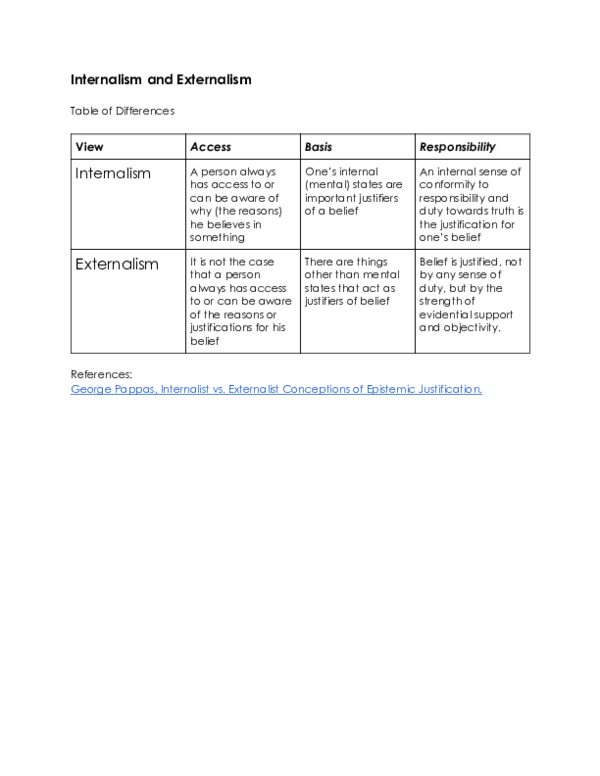
This idea is that the two sides are tracking two different kinds of epistemic excellence:
- Internalist Justification (or Rationality/Responsibility): This concept is about epistemic duty and guidance. It's about being a responsible believer, doing the best you can with the evidence available to you. This is what the victim in the evil demon world has.
- Externalist Justification (or Warrant/Truth-Conduciveness): This concept is about having a belief that is objectively likely to be true due to a reliable connection to the world. This is what the clairvoyant has.
Grasping this distinction is key to understanding the deep philosophical motivations on both sides.
Conclusion
Today we've mapped out one of the major fault lines in contemporary epistemology. The distinction between internalism and externalism isn't just a technical detail; it reflects a profound disagreement about the very purpose of justification.
Key Takeaways:
- Internalism holds that justification supervenes on factors internal to the believer's mind (either mental states or states accessible via reflection).
- Externalism holds that justification can depend on external factors, most notably the reliability of the belief-forming process.
- The New Evil Demon Problem provides a powerful intuition for internalism by highlighting the importance of subjective rationality and epistemic responsibility.
- Clairvoyance cases and the general need for a truth-connection provide strong motivation for externalism.
- The debate might ultimately be about two distinct concepts: one concerning rationality and responsibility (internalist) and another concerning an objective link to truth (externalist).
Preview of the Next Lesson:
We have introduced reliabilism as the paradigmatic externalist theory. It was developed not only as an account of justification but also as a direct response to the Gettier problem. In our next lesson, we will examine this theory in greater detail, exploring how it aims to define knowledge in a way that is immune to Gettier-style counterexamples. Our learning outcome will be to: Describe reliabilism as a prominent externalist theory of knowledge.