Recommended resources
The freely available resources this lesson will direct you to.
- Research Aims, Objectives & Research Questions (The Golden Thread) - Definitions + Examples 📚www.youtube.com
- 💪 How to Write Research Objectives and Research Questions Like a Pro: : A Step-by-Step Guide 🎓www.youtube.com
- How to Write Research Objectives: Definition, Examples, Tips | Editage USAwww.editage.us
- Guide for Writing a Research Proposal (Protocol)ovpr.uchc.edu
Hello! In clinical laboratory research, an aim and a set of objectives may describe the same study, but they do different jobs. The aim states the study’s overall purpose. The objectives make that purpose concrete. In this lesson, you will distinguish the research aim, the general objective, and specific objectives, then see how the three fit together in a laboratory example.
The aim: the study’s overall purpose
Imagine that a laboratory is unsure how closely two methods agree when measuring creatinine in specimens with elevated bilirubin. A study of that uncertainty needs a statement of its overall direction:
Research aim: To evaluate agreement between Jaffe and enzymatic methods for measuring serum creatinine in icteric specimens at Hospital X.
This is an aim because it tells us what the study seeks to accomplish as a whole. It identifies the central comparison and setting, but it does not yet divide the investigation into separate results to obtain.
Watch how Grad Coach distinguishes a broad aim from the more concrete objectives that support it. You do not need the later discussion of research questions for this lesson.
Research Aims, Objectives & Research Questions (The Golden Thread) - Definitions + Examples 📚
Watch “Research Aims, Objectives & Research Questions (The Golden Thread)” from Grad Coach for its distinction between an overarching purpose and the narrower actions undertaken to fulfil it.
Watch the research aim for the definition and examples of a broad study purpose. Continue with research objectives to hear how objectives make that purpose more concrete, then watch worked examples to see one aim divided into several objectives. Focus on the difference in scope, not just on the verbs used.
A useful test is to ask, “What is this study trying to accomplish overall?” The answer should resemble its aim. Although an aim is broad relative to its objectives, it is not limitless: “to improve laboratory medicine” would be too broad to direct a single study. The creatinine aim names a particular measurement, comparison, specimen group, and setting.
The general objective: the same destination, stated as a research task
A general objective is the overarching objective of the study. It usually mirrors the aim closely, while expressing the overall work the researchers intend to carry out. For the creatinine study, it might read:
General objective: To assess agreement between Jaffe and enzymatic serum creatinine results in icteric specimens tested at Hospital X.
Notice how little has changed. That is not necessarily a fault. Both statements describe the same destination; the general objective frames it as the study’s principal task. Depending on a course or institution’s terminology, a proposal may state an aim, a general objective, or both. If both are required, they should be consistent—not artificially made different by adding an unrelated goal.
Read the short definitions and the “General vs. Specific Objectives” subsection before going further.
How to Write Research Objectives: Definition, Examples, Tips | Editage USA
Read Editage’s definitions and its comparison of general and specific objectives to clarify why the aim and general objective can sound similar without being identical in function.
In the opening glossary table headed “Term” and “Definition,” read the rows from “Research aim” through “Specific objective”; the aim definition marks the broadest level. Then go to “Types of Research Objectives,” subsection “General vs. Specific Objectives.” Read the explanation and its immediately following medical-example table. Stop before “Types Based on Research Purpose.” Treat the suggested numbers of objectives as examples of common practice, not fixed rules.
The distinction here is chiefly functional:
| Statement | Question it answers | Scope |
|---|---|---|
| Research aim | What is the study’s overall purpose? | Broad, but bounded |
| General objective | What overarching research task will pursue that purpose? | Nearly as broad as the aim |
| Specific objectives | What distinct results must the study produce to fulfil that task? | Narrower and individually assessable |
Wording alone cannot reliably identify the category. “To evaluate” could begin either an aim or an objective. Instead, look at the statement’s role in the study and its relationship to the statements around it.
Specific objectives: the distinct results needed to fulfil the aim
Specific objectives break the general objective into smaller, logically connected parts. Each should identify something the study will determine, estimate, compare, or otherwise establish. For the creatinine study, possible specific objectives are:
- To estimate the mean difference between paired Jaffe and enzymatic serum creatinine results in icteric specimens tested at Hospital X.
- To determine whether the difference between paired results varies across predefined bilirubin concentration groups in those specimens.
- To estimate the proportion of paired results whose difference exceeds a predefined allowable limit.
Each objective contributes different evidence about agreement. The first addresses the typical difference between methods; the second addresses whether disagreement varies with bilirubin concentration; the third addresses how often disagreement crosses a chosen limit. Together, they give the broad aim a more assessable meaning.
An objective is not simply a laboratory activity. “To collect specimens and run both assays” describes part of a method. It says what researchers will do operationally, but not what they intend to find out from the results. By contrast, “to estimate the mean difference between paired results” names an answer the study can report.
Nor must every study have exactly three specific objectives. The appropriate number depends on what must be learned to address the aim without introducing work outside its scope. If this study suddenly added an objective about staff satisfaction with laboratory software, that objective would not help answer its stated purpose, however well written it might be.
The three levels can therefore be close in subject matter while different in resolution: the aim gives the whole study direction, the general objective expresses its principal research task, and each specific objective identifies a distinct contribution to the eventual answer.
Reading a visual outline without losing the study’s focus
The image below shows three separate examples, each with a research question, an aim, and three numbered objectives. Use it to observe how one broad statement can be broken into several narrower ones—not as a template whose wording must be copied.
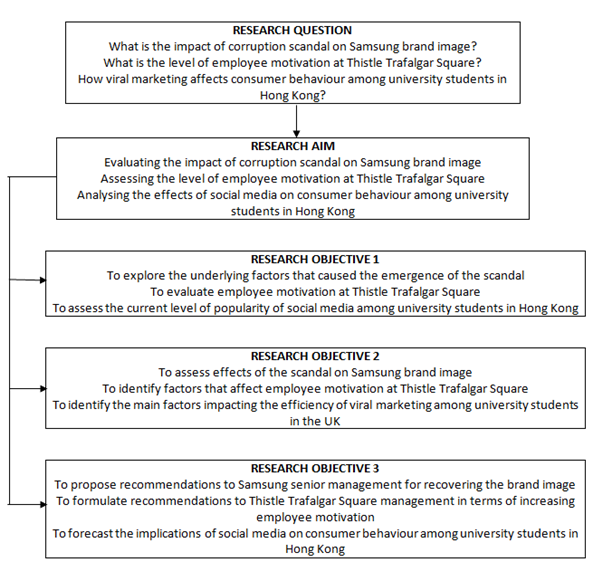
For instance, the employee-motivation example begins with an aim to assess motivation at a named workplace. Its later objectives attempt to address different aspects of that purpose. The image also shows why alignment matters: in the marketing example, the population changes from students in Hong Kong to students in the UK in one objective. That objective cannot contribute cleanly to the stated Hong Kong study without revising either the objective or the study’s scope.
In a clinical laboratory proposal, apply the same check to the specimens or patients, measurements, comparisons, and setting. If the aim concerns creatinine agreement in icteric specimens at Hospital X, a specific objective about a different analyte or an unrelated patient group needs a clear justification—or it belongs to another study.
Conclusion
A research aim states the study’s overall purpose. A general objective states the closely related overarching research task; it may resemble the aim so strongly that some proposals use only one of those labels. Specific objectives divide that task into distinct, assessable results. The strongest distinction is not a particular opening verb, but the level of scope and the job each statement performs.
Next, you can build on this distinction by choosing action verbs that accurately express what each objective will establish.