Recommended resources
The freely available resources this lesson will direct you to.
- Renta 2024 - Exención por reinversión en la compra de la vivienda habitualwww.youtube.com
- “Así se calcula la GANANCIA PATRIMONIAL en Hacienda (PASO A PASO REAL)” 🏚️www.youtube.com
- Reglas generales de cálculosede.agenciatributaria.gob.es
- Cómo Calcular la Ganancia Patrimonial al Vender un Inmuebleconsult.tax
Hello! Welcome to the first lesson in our new module, "Taxation of Spanish Real Estate Dispositions."
In the previous module, we did a deep dive into the annual performance of a rental property, culminating in building a Python model to calculate after-tax cash flow. Now, we shift our focus from the operational life of an investment to its conclusion: the sale. Understanding the tax implications of selling a property is just as crucial as analyzing its yearly returns.
The cornerstone of this calculation is the capital gain (ganancia patrimonial), which is the profit you make from the sale. In Spain, this is calculated as the difference between the property's transmission value and its acquisition value.
Therefore, our first step is to master the cost basis of the investment. In this lesson, you will learn to calculate the adjusted acquisition cost (valor de adquisición) for a property under Spanish tax law. This figure isn't just the price you paid; it's a comprehensive value adjusted for all associated costs, improvements, and even the tax deductions you've claimed over the years.
1. Understanding the 'Valor de Adquisición'
When you sell a property, the Spanish Tax Agency (Hacienda) needs to determine your profit to tax it. To do this, they don't simply subtract the original purchase price from the sale price. Instead, they use an adjusted acquisition cost (valor de adquisición).
The fundamental formula is:
Let's break down each component of this formula. The most authoritative source for this is the Spanish Tax Agency's own manual.
To begin, let's get the official definition from the source. Please read the following sections from the IRPF 2024 manual by the Agencia Tributaria. It details exactly what can be included in the acquisition value.
Read the section 'A. Valor de adquisición'. Focus on the parts describing acquisitions 'a título oneroso' (paid transactions). Pay attention to the four main components listed: the real amount, cost of improvements, expenses and taxes, and the deduction for amortizations. You can skim the parts about 'título lucrativo' (inheritances/donations) for now.
Now, let's dissect these components with practical examples.
2. The Components of Acquisition Cost
a) Importe Real de Adquisición (Real Acquisition Amount)
This is the most straightforward part: it's the purchase price that appears on the public deed of sale (escritura).
However, it's important to be aware of the valor de referencia (reference value). Since 2022, this is an official value assigned by the Cadastre, used as the minimum tax base for transfer taxes (ITP and ISD). If you buy a property for a price lower than its valor de referencia, the transfer tax will be calculated on the higher reference value. In such a case, this higher value becomes your acquisition value for future capital gains calculations.

b) Gastos y Tributos Inmanentes (Inherent Expenses and Taxes)
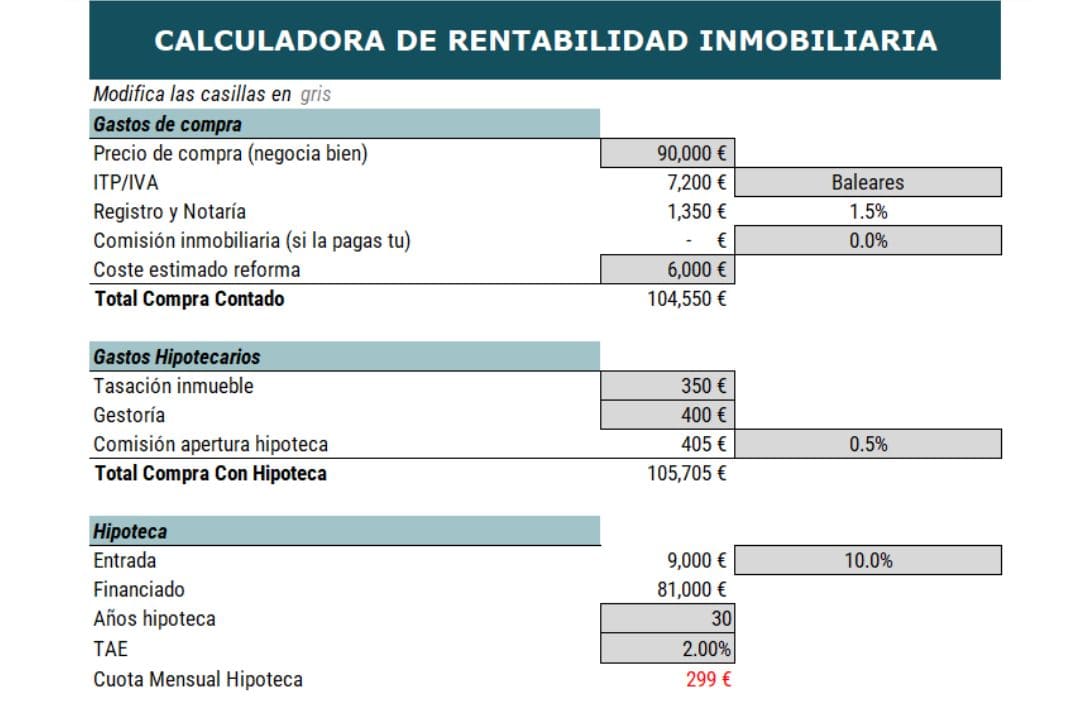
This is where you add all the costs you incurred to acquire the property. These are not yearly operating expenses; they are one-time costs directly related to the purchase.
Common examples include:
- Taxes: Either the Property Transfer Tax (
Impuesto de Transmisiones Patrimoniales- ITP) for resale homes or VAT (IVA) for new builds. - Notary Fees (
Gastos de Notaría): The cost of the public official who witnesses and legitimizes the deed. - Property Registry Fees (
Gastos de Registro de la Propiedad): The cost to inscribe your ownership in the public registry. - Real Estate Agency Commission (
Comisión de la Inmobiliaria): If you used an agent to find and buy the property. - Mortgage-related Costs: Certain costs associated with setting up the mortgage, such as the appraisal (
tasación), can also be included.
This short video from the Agencia Tributaria quickly lists these costs.
Renta 2024 - Exención por reinversión en la compra de la vivienda habitual
Watch this brief clip from an official Agencia Tributaria video. It directly lists the key expenses that form part of the acquisition cost.
Watch from 01:31 to 02:09. The narrator clearly itemizes the expenses you can add to the acquisition price.
This image of a real estate calculator provides a great visual summary of these typical upfront costs.
c) Inversiones y Mejoras (Investments and Improvements)
This category includes significant capital expenditures that are not simple repairs but fundamentally improve the property. The distinction is crucial:
- Improvement (
Mejora): Adds value, extends the property's useful life, or increases its capacity (e.g., adding a bathroom, a major kitchen overhaul, enclosing a balcony). These costs are added to your acquisition value. - Maintenance (
Conservación): Keeps the property in good working condition (e.g., repainting, fixing a leaky faucet, servicing the boiler). These are deductible as operating expenses against rental income but do not increase your acquisition cost.
The video from the Agencia Tributaria also touches on this. Section 1 (from 01:50 to 02:16) explains that improvements increase the acquisition cost.
d) Amortizaciones Fiscalmente Deducibles (Fiscally Deductible Amortizations)
This is the only component that reduces your acquisition cost. It's a direct link to our previous module.
Recall that when you rent out a property, Spanish tax law allows you to deduct depreciation (amortización) as a non-cash expense each year to lower your taxable rental income. Because you already received a tax benefit from this deduction during the holding period, you must subtract the total amount of depreciation you've claimed from your acquisition cost when you sell.
This prevents "double-dipping" on the tax benefit.
Crucially, the law states you must subtract the amortization that was fiscally deductible, even if you failed to deduct it in your annual tax returns. This is the concept of amortización mínima.
The article below gives a clear summary of these components and provides a practical example.
Cómo Calcular la Ganancia Patrimonial al Vender un Inmueble Arrendado
This article from a tax advisory firm provides a clear, practical breakdown of how to calculate the acquisition value, including the role of amortizations.
Read the sections titled 'Valor de Adquisición del Inmueble', 'Cálculo de Amortizaciones', and 'Ejemplo de Cálculo de Amortización'. This will solidify your understanding of how the components, especially depreciation, come together in a real calculation.
3. A Worked Example
Let's calculate the valor de adquisición for a hypothetical property.
- Purchase Price: €200,000 (in 2018)
- Land Value (from
recibo de IBI): €40,000 (20% of the price) - Total Acquisition Costs (ITP, notary, registry): €18,000
- Holding Period: 6 years, rented out the entire time.
- Major Improvement (new windows & insulation in 2021): €12,000
Calculation Steps:
-
Initial Cost Base:
- Purchase Price + Acquisition Costs = €200,000 + €18,000 = €218,000
-
Add Improvements:
- Initial Cost Base + Improvements = €218,000 + €12,000 = €230,000
-
Calculate Total Depreciation:
- The annual depreciation base is 3% of the greater of the cadastral value (construction part) or the acquisition cost (construction part). Let's use the acquisition cost.
- Acquisition cost of the building (excluding land): €218,000 * (1 - 0.20) = €174,400.
- Annual Depreciation = €174,400 * 3% = €5,232
- Total Depreciation over 6 years = €5,232 * 6 = €31,392
- (Note: The depreciation rules for improvements can be more complex, but for this primary calculation, we depreciate the original acquisition cost as standard.)
-
Calculate Final Adjusted Acquisition Cost:
- (Initial Cost Base + Improvements) - Total Depreciation
- €230,000 - €31,392 = €198,608
Notice the final result: despite spending €230,000 out-of-pocket, the cost basis for calculating your capital gain is only €198,608. This is because you benefited from €31,392 in tax deductions over the six years.
4. Application in Code
Let's make this tangible by extending the SpanishRentalProperty class we built in the last lesson. We can add a method to perform this exact calculation. This makes our class a more complete tool for analyzing the full lifecycle of an investment.
# Assuming the SpanishRentalProperty class from the previous lesson exists

class SpanishRentalProperty:
    # ... (all previous methods: __init__, _calculate_irpf, etc.)

    # ... previous code ...
    def __init__(self, property_data: dict, owner_data: dict):
        """
        Initializes the property model with raw data.
        """
        self.property_data = property_data
        self.owner_data = owner_data
        self.results = {}

    # ... other methods ...

    def calculate_adjusted_acquisition_cost(self, holding_period_years: int, total_improvement_costs: float) -> float:
        """
        Calculates the adjusted acquisition cost ('valor de adquisición') at the end of a holding period.

        :param holding_period_years: The number of years the property was rented out.
        :param total_improvement_costs: The total cost of capital improvements made during the holding period.
        :return: The final adjusted acquisition cost.
        """
        # 1. Start with the purchase price and acquisition costs
        price = self.property_data['purchase']['price']
        acq_costs = self.property_data['purchase'].get('acquisition_costs', 0)
        initial_cost_base = price + acq_costs

        # 2. Add improvements
        cost_base_with_improvements = initial_cost_base + total_improvement_costs

        # 3. Calculate and subtract total depreciation
        # Note: We assume the property was rented for the entire holding period.
        land_value = self.property_data['purchase']['land_value']

        # The base for depreciation is the acquisition cost of the building
        depreciation_base_building = initial_cost_base - land_value

        annual_depreciation = depreciation_base_building * 0.03
        total_depreciation = annual_depreciation * holding_period_years

        # 4. Final calculation
        adjusted_acquisition_cost = cost_base_with_improvements - total_depreciation

        print(f"--- Calculating Adjusted Acquisition Cost ---")
        print(f"{'Initial Cost Base (Price + Costs)':<40}: €{initial_cost_base:,.2f}")
        print(f"{'Cost Base + Improvements':<40}: €{cost_base_with_improvements:,.2f}")
        print(f"{'Total Depreciation over ' + str(holding_period_years) + ' years':<40}: -€{total_depreciation:,.2f}")
        print(f"{'Final Adjusted Acquisition Cost':<40}: €{adjusted_acquisition_cost:,.2f}")

        return adjusted_acquisition_cost

# --- Example Usage ---
if __name__ == '__main__':
    # Add 'acquisition_costs' to our sample property data
    sample_property = {
        "purchase": {
            "price": 200000,
            "acquisition_costs": 18000, # ITP, Notary, etc.
            "land_value": 40000
        },
        # ... (rest of the data from the previous lesson)
    }

    # Dummy owner data, not needed for this specific calculation
    sample_owner = {}

    property_investment = SpanishRentalProperty(property_data=sample_property, owner_data=sample_owner)

    # Use the new method, matching our worked example
    property_investment.calculate_adjusted_acquisition_cost(
        holding_period_years=6,
        total_improvement_costs=12000
    )
Test your understanding!
An investor buys an apartment for €300,000. The associated acquisition costs are €25,000. The land is valued at €60,000. They live in it for 4 years as their primary residence. Then, they move out and rent it for 10 years, during which they make no capital improvements. What is the valor de adquisición at the end of the 14-year holding period?
Show answer
Here's the breakdown:
- Initial Cost Base: €300,000 (price) + €25,000 (costs) = €325,000.
- Improvements: €0.
- Total Depreciation: Depreciation is only deductible for the period the property was rented.
- Rental Period: 10 years.
- Depreciation Base (Building): €325,000 (Initial Cost Base) - €60,000 (Land Value) = €265,000.
- Annual Depreciation: €265,000 * 3% = €7,950.
- Total Depreciation: €7,950 * 10 years = €79,500.
- Final Adjusted Acquisition Cost: €325,000 (Cost Base) - €79,500 (Total Depreciation) = €245,500.
The 4 years it was a primary residence are irrelevant for the depreciation calculation.
Conclusion
In this lesson, you've learned how to calculate a crucial figure for any real estate investor in Spain: the adjusted acquisition cost.
Key Takeaways:
- The
valor de adquisiciónis more than just the purchase price; it includes acquisition costs and capital improvements. - The total amount of depreciation deducted during the rental period must be subtracted from this cost base.
- This means that the tax benefit of depreciation on annual income effectively increases the taxable capital gain upon sale.
- Getting this calculation right is the essential first step to determining your final tax liability when you sell a property.
Preview of the Next Lesson:
Now that we have mastered the "cost" side of the capital gain equation, our next lesson will focus on the other side: calculating the gain subject to IRPF capital gains tax. We will look at how to determine the valor de transmisión (transmission value) and then combine it with the valor de adquisición to find the net gain that will be taxed.