Recommended resources
The freely available resources this lesson will direct you to.
Introduction
Welcome back. In our last two lessons, we took a deep dive into the NVIDIA CUDA programming model. We started with its core abstractions—grids, blocks, and threads—and then explored the performance dynamics of kernel launches, thread divergence, and occupancy. This has given you a solid, albeit NVIDIA-centric, view of GPU programming.
However, the world of GPU computing is not a monolith. The dominance of CUDA has naturally spurred the development of alternatives, driven by the need for vendor independence, cross-platform portability, and competitive markets. As an AI systems designer, understanding this landscape is crucial for making informed decisions about hardware and software stacks.
This lesson will broaden your perspective to address the learning outcome: Compare the goals and ecosystems of major GPU programming frameworks: CUDA, OpenCL, and ROCm/HIP. We will analyze each framework's design philosophy, its target audience, and the ecosystem of tools, libraries, and hardware that surrounds it.
1. The "Chaotic" but Innovative State of GPU Programming
Before diving into specifics, it's helpful to understand why the GPU programming landscape can seem fragmented. Unlike CPU programming, where standards like the x86 instruction set and POSIX APIs provide a high degree of uniformity, GPU programming is much more diverse. Each major vendor—NVIDIA, AMD, and Intel—has its own hardware architecture and, consequently, its own preferred programming model.
This diversity creates challenges for developers aiming for cross-platform support but also fosters innovation as vendors compete on performance, features, and developer experience. The following video provides an excellent overview of this situation, introducing the main players and the core problem they are trying to solve.
The Chaotic State of GPU Programming
This video, 'The Chaotic State of GPU Programming,' sets the stage perfectly by explaining why GPU programming is complex and introduces the key frameworks we'll be discussing today.
Please watch from the beginning to 00:13:12. As you watch, focus on: The core problem of cross-platform GPU development. The description of CUDA as the dominant, but proprietary, framework. The introduction of OpenCL as the cross-platform answer. The mention of ROCm and oneAPI as other vendor-specific open source alternatives.
As the video highlights, the central tension in GPU programming is between the high performance and rich features of a vendor-specific ecosystem like CUDA and the portability offered by an open standard like OpenCL. This sets the stage for our comparison.
2. CUDA: The High-Performance Incumbent
We are already familiar with CUDA, but let's formalize its position in the ecosystem.
- Goal: To provide the highest possible performance and the most comprehensive feature set for programming NVIDIA GPUs. The goal is vertical integration—from hardware to libraries to the programming model—to create a powerful but proprietary "walled garden."
- Ecosystem:
- Vendor: NVIDIA.
- Hardware: Exclusively NVIDIA GPUs.
- Programming Model: CUDA C/C++, which extends C++ with a syntax that maps directly and intuitively to the GPU hardware (grids, blocks, threads).
- Key Strengths:
- Market Dominance: The de facto standard for AI and HPC, meaning most research, frameworks (TensorFlow, PyTorch), and developers start with CUDA.
- Maturity and Stability: Over 15 years of development have produced a robust and well-documented platform.
- Rich Library Support: A vast ecosystem of highly optimized libraries is a key advantage (e.g., cuDNN for deep learning, cuBLAS for linear algebra, NCCL for multi-GPU communication).
- Excellent Tooling: A mature suite of profilers (Nsight), debuggers (cuda-gdb), and management tools.
- Primary Weakness: Vendor lock-in. Code written in CUDA is not directly portable to hardware from other vendors like AMD or Intel. This is a significant strategic risk for large-scale system deployments.
3. OpenCL: The Open, Cross-Platform Standard
OpenCL (Open Computing Language) was created as a direct response to the proprietary nature of CUDA.
- Goal: To be an open, royalty-free standard for cross-platform, parallel programming of heterogeneous systems. Its ambition is wider than CUDA's, targeting not just GPUs but also CPUs, FPGAs, and other accelerators. Portability is its chief design goal.
- Ecosystem:
- Steward: The Khronos Group, an industry consortium.
- Hardware: Supports GPUs from all major vendors (NVIDIA, AMD, Intel), CPUs, and other processors.
- Programming Model: Uses a variant of C (OpenCL C) for kernels. The API for managing the device and dispatching kernels is known for being more verbose and less "developer-friendly" than CUDA.
- Key Strengths:
- Portability: The "write once, run anywhere" promise is its main appeal. A single OpenCL program can theoretically run on a wide variety of hardware.
- Primary Weaknesses:
- Performance Portability: While code is portable, performance is not. Achieving good performance often requires extensive, device-specific tuning, undermining the "write once" ideal.
- Lowest Common Denominator: As a standard developed by a committee, it often standardizes on features that all vendors can support, meaning it can lag behind the cutting-edge features offered by native APIs like CUDA.
- Ergonomics: The API is often criticized for its verbosity and complexity compared to CUDA. The blog post we'll read next memorably describes using it as "about as comfortable as hugging a cactus."
- Waning HPC Relevance: While still used, especially in mobile and certain embedded systems, it has largely failed to unseat CUDA in the high-performance computing and AI domains.
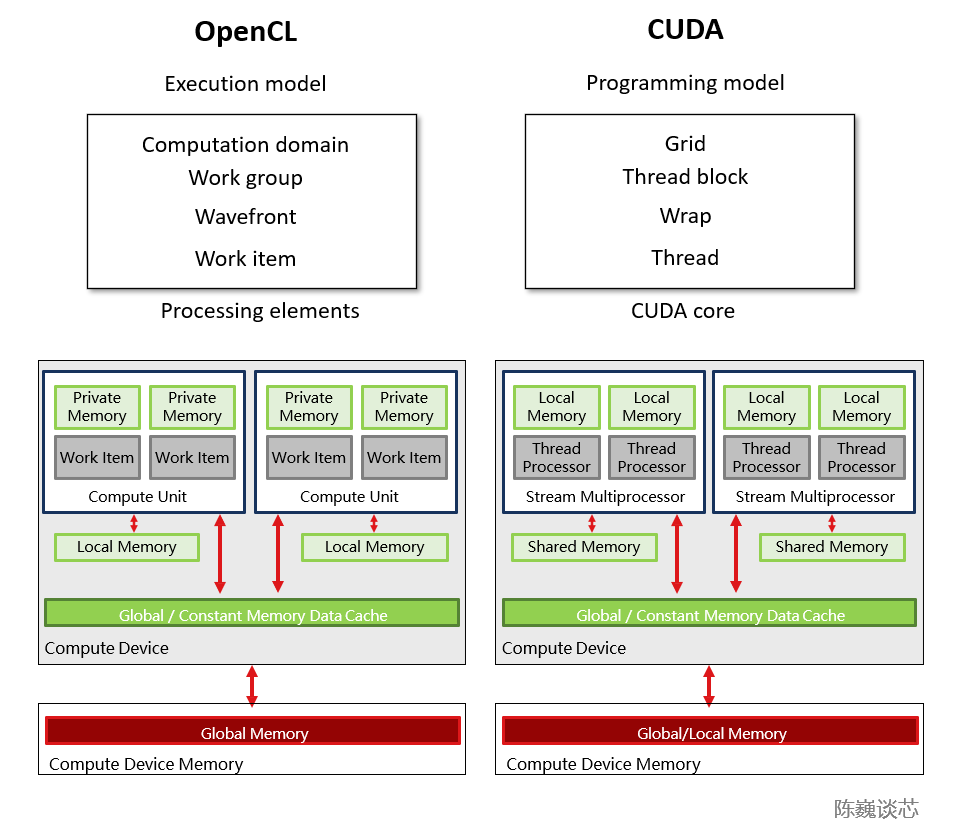
The following image illustrates the conceptual mapping between the CUDA and OpenCL programming models. Note the similar hierarchical structure but different terminology.
4. ROCm and HIP: The Pragmatic Challenger
Recognizing CUDA's dominance and OpenCL's shortcomings, AMD developed the ROCm (Radeon Open Compute) platform, with HIP (Heterogeneous-compute Interface for Portability) as its centerpiece programming model.
- Goal: To provide a direct, high-performance competitor to CUDA for AMD GPUs, with a primary focus on making it easy to migrate existing CUDA code. The goal is not abstract portability like OpenCL, but pragmatic, source-level compatibility with CUDA.
- Ecosystem:
- Vendor: AMD.
- Hardware: Primarily targets AMD GPUs, but also includes a backend to compile and run HIP code on NVIDIA GPUs (by translating HIP API calls into CUDA API calls).
- Programming Model: HIP is a C++ runtime API and kernel language. Its syntax, function names, and structure are deliberately almost identical to CUDA's.
- Key Strengths:
- Easy Porting from CUDA: AMD provides a
hipifytool that can automatically convert ~95% or more of CUDA source code to HIP source code. This dramatically lowers the barrier to entry for developers with a large CUDA codebase. - Open Source: The entire ROCm stack is open source, appealing to developers who want to avoid proprietary lock-in.
- Growing Library Support: AMD provides its own ecosystem of libraries that mirror CUDA's, such as rocBLAS (vs. cuBLAS), MIOpen (vs. cuDNN), and RCCL (vs. NCCL).
- Easy Porting from CUDA: AMD provides a
- Primary Weaknesses:
- Maturity and Market Share: The ROCm/HIP ecosystem is younger and less mature than CUDA's. The community is smaller, and documentation or solutions to niche problems can be harder to find.
- Performance on NVIDIA: While HIP code can run on NVIDIA hardware, it does so by translating back to CUDA. This makes it a portability layer, not a native competitor, on NVIDIA's platform.
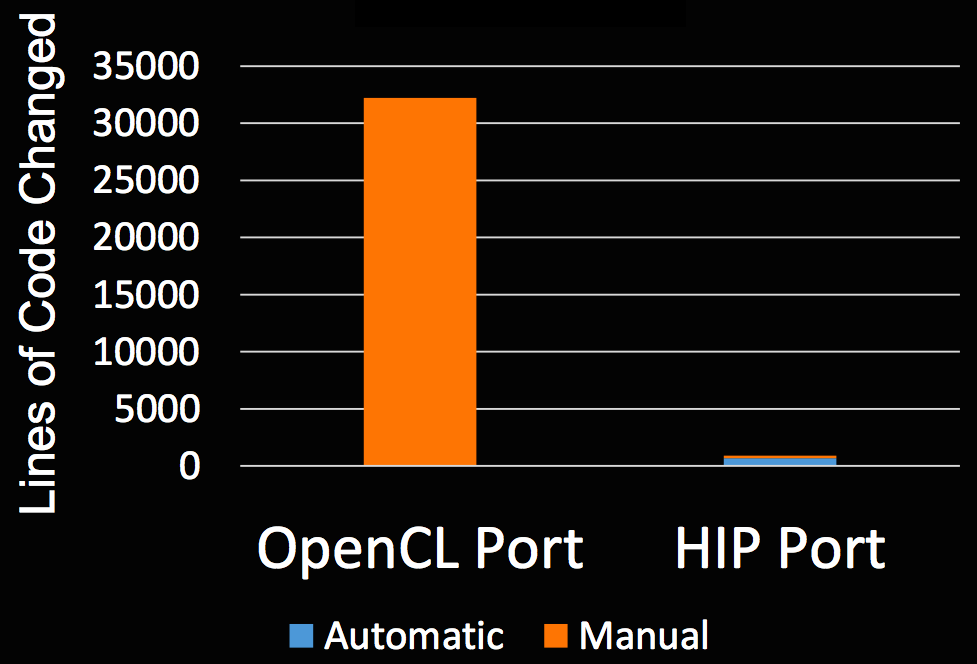
The following image starkly visualizes the value proposition of HIP. It shows the effort required to port a deep learning framework from CUDA to OpenCL versus from CUDA to HIP.
5. A Comprehensive Comparison
To synthesize this information, let's study a document that provides a structured overview of the GPU programming landscape, focusing on vendor compatibility.
[PDF] GPU Programming Model vs. Vendor Compatibility Overview
This research paper, 'GPU Programming Model vs. Vendor Compatibility Overview', provides a detailed and systematic comparison of the support for various programming models across GPU vendors. It's an excellent resource for a structured understanding of the ecosystem.
This paper is quite dense, so focus your reading on these key parts: Read the Introduction (Section 1) to understand the context of the evolving GPU landscape. Study Figure 1, the main overview table. Pay close attention to the rows for NVIDIA and AMD and the columns for CUDA and HIP. Read the detailed Descriptions (Section 4) for the following entries: NVIDIA: Item 1 (CUDA C++), Item 3 (HIP C++), and Item 5 (SYCL C++). AMD: Item 18 (CUDA C++), and Item 20 (HIP C++). Finally, read the Discussion (Section 5), particularly the paragraphs on 'Model Selection' (which explains why OpenCL was excluded from the main table) and 'Topicality'.
Based on the resources and our discussion, we can summarize the comparison in a table.
| Feature | NVIDIA CUDA | Khronos OpenCL | AMD ROCm/HIP |
|---|---|---|---|
| Primary Goal | Peak performance on NVIDIA hardware | Cross-platform & cross-vendor portability | Easy porting from CUDA to AMD hardware |
| Governing Body | NVIDIA (Proprietary) | Khronos Group (Open Standard) | AMD (Open Source) |
| Hardware Support | NVIDIA GPUs only | GPUs (NVIDIA, AMD, Intel), CPUs, FPGAs, etc. | AMD GPUs (primary), NVIDIA GPUs (via CUDA backend) |
| Programming Model | C++ extension (CUDA C++) | C-based kernel language (OpenCL C) | C++ API & language, mimics CUDA |
| Ecosystem | Extremely mature, vast libraries, huge community | Less traction in AI/HPC, fragmented support | Growing, mimics CUDA's libraries, smaller community |
| Key Advantage | Performance, maturity, and tooling | True hardware independence | Drastically reduced porting effort from CUDA |
| Key Disadvantage | Vendor lock-in | "Write once, tune everywhere," poor ergonomics | Less mature than CUDA, smaller ecosystem |
Conclusion
In this lesson, we stepped outside the NVIDIA-centric world to survey the broader landscape of GPU programming. You now have a framework for understanding the strategic goals and trade-offs behind the major GPU programming models.
Key Takeaways:
- The GPU programming ecosystem is a complex interplay between vendor-specific, performance-oriented frameworks and open, portability-focused standards.
- CUDA is the dominant incumbent, offering the best performance and richest ecosystem on NVIDIA hardware, but at the cost of vendor lock-in.
- OpenCL is the open standard for heterogeneous computing, promising portability but often falling short on performance-portability and developer ergonomics, which has limited its adoption in HPC.
- ROCm/HIP is AMD's pragmatic and strategic response, designed to lure developers from the CUDA ecosystem by providing a very similar programming model and tools for easy migration.
Understanding this landscape is not just an academic exercise. When designing a large-scale AI system, choosing a hardware platform and its associated software stack involves weighing these factors: a mature but proprietary ecosystem (CUDA), an open but potentially lower-performing standard (OpenCL), or a promising but less mature open alternative (ROCm/HIP).
Preview of the Next Lesson:
Having explored the high-level landscape, our next lesson will return to the practicalities of writing efficient GPU code. We will focus on a fundamental technique common to all these frameworks: "how to use shared memory and synchronization primitives to facilitate efficient on-chip data sharing." This will be crucial for optimizing memory-bound kernels, a common challenge in AI workloads.