Recommended resources
The freely available resources this lesson will direct you to.
Hello! Welcome to the fourth module of our course, "The Global Carbon Cycle."
In the previous modules, we established the fundamental physics of the Earth's energy balance and the role of greenhouse gases. Now, we will shift our focus to the biogeochemical systems that regulate the concentration of these gases, starting with the most significant one: carbon dioxide.
This first lesson addresses the foundational question: Where is the Earth's carbon? We will identify the planet's major carbon reservoirs and, crucially, estimate their size. Understanding the sheer scale of these carbon "stocks" is the first step toward appreciating how anthropogenic emissions are perturbing this vast, ancient system. This "stock and flow" perspective should be familiar from your background in economics and systems analysis.
Our learning outcome for this lesson is to: Estimate the order of magnitude of the Earth's major carbon reservoirs (atmosphere, oceans, land biosphere, and lithosphere).
Let's begin by defining what these reservoirs are.
1. The Major Carbon Reservoirs
The global carbon cycle can be conceptualized as a system of interconnected reservoirs, or pools, where carbon is stored. The movement of carbon between these reservoirs is known as a flux. For this lesson, we will concentrate on the reservoirs themselves.
To get an overview of these primary storage compartments, please read the following introductory section from Wikipedia's page on the carbon cycle.
This brief reading from Wikipedia introduces the main conceptual divisions of the global carbon cycle, which will form the basis of our discussion.
Please read the section titled 'Main compartments'. It provides a high-level list of the key carbon reservoirs.
As the text outlines, the global carbon cycle is typically divided into four major reservoirs:
- The Atmosphere: Carbon exists here primarily as carbon dioxide (CO₂) and methane (CH₄).
- The Oceans: Carbon is stored as dissolved inorganic carbon and in marine life.
- The Land (Terrestrial) Biosphere: This includes all carbon in living and dead organic matter on land, such as plants, animals, and soils.
- The Lithosphere: This is the Earth's crust and upper mantle, containing vast quantities of carbon in rocks and fossil fuels.
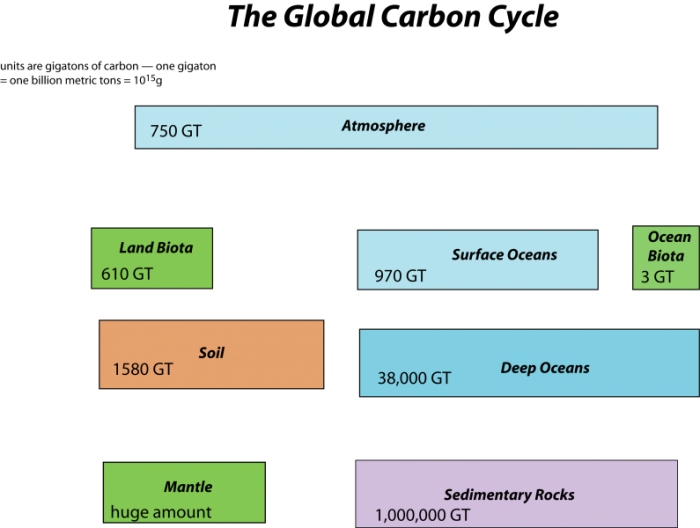
The image below provides a simplified visual representation of these reservoirs and their relative sizes.
2. Quantifying the Reservoirs
Now that we have identified the main reservoirs, our primary goal is to quantify them to understand their relative importance in terms of mass. The standard unit for this is the gigaton of carbon (GtC). One GtC is one billion metric tons of carbon.
The following resource provides a detailed table of estimates for these reservoirs.
This table from the Wikipedia article provides quantitative estimates for the amount of carbon stored in each major reservoir and their sub-components.
Focus on the table titled 'Size of major carbon pools on the Earth'. Pay close attention to the total quantities for the Atmosphere, Ocean, Terrestrial biosphere, and Lithosphere. Note how some reservoirs are broken down into sub-pools, like the ocean's surface and deep layers.
Based on the data you just reviewed, let's summarize the approximate sizes of the key reservoirs.
| Reservoir | Size (GtC) |
|---|---|
| Atmosphere | ~720 |
| Terrestrial Biosphere (Plants & Soil) | ~2,000 |
| Ocean (Total) | ~38,000 |
| Surface Layer | ~670 |
| Deep Layer | ~37,000 |
| Lithosphere (Sediments & Rocks) | > 75,000,000 |
| Fossil Fuels | ~4,130 |
From this table, we can draw some immediate, striking conclusions about the orders of magnitude:
- The Lithosphere is Dominant: The amount of carbon stored in rocks (e.g., limestone) and organic kerogens is orders of magnitude larger than all other reservoirs combined. However, the exchange of carbon with this reservoir is extremely slow, operating on geological timescales of millions of years.
- The Ocean is the Largest Active Reservoir: The ocean contains over 50 times more carbon than the atmosphere. Notice the vast difference between the deep ocean and the surface layer. This partitioning is critical for understanding the timescale of ocean carbon uptake.
- The Land Biosphere is Significant: The carbon stored in plants and soils is nearly three times the amount in the atmosphere.
- The Atmosphere is a Small but Critical Reservoir: Despite being the smallest of the major reservoirs (excluding the aquatic biosphere), the atmosphere is the central hub of the fast carbon cycle. Because its carbon content directly controls the Earth's surface temperature via the greenhouse effect, even relatively small changes to this reservoir have major consequences.
It's important to recognize that these numbers are estimates derived from a wide range of measurements and models. Different sources may provide slightly different values. To illustrate this and to learn more about the form carbon takes in each reservoir, let's consult one more resource.
Follow the Carbon: Earth & Environmental Science Activity
This resource from the Exploratorium provides another set of estimates and, importantly, describes the chemical form of carbon in each reservoir.
First, look at the table under 'Principal Carbon Reservoirs' and compare the values to the Wikipedia table. Then, read the descriptions below the table for each reservoir (Rock, Atmosphere, Ocean, etc.) to understand what form the carbon takes in each.
You may have noticed a difference in the atmospheric estimate (900 GtC in the Exploratorium resource vs. 720 GtC in Wikipedia). This reflects both the uncertainty inherent in such large-scale accounting and the fact that these pools are not static—the atmospheric value, for instance, increases year on year due to emissions. For our purposes, what matters is the consistent order of magnitude: the atmosphere contains hundreds of GtC, the land thousands, the oceans tens of thousands, and the lithosphere tens of millions.
The second resource also clarifies the form of carbon:
- Atmosphere: Gaseous CO₂ and CH₄.
- Ocean: A chemical equilibrium of dissolved CO₂, carbonic acid (H₂CO₃), bicarbonate ions (HCO₃⁻), and carbonate ions (CO₃²⁻).
- Terrestrial Biosphere: Complex organic molecules in plants and soils.
- Lithosphere: Solid carbonate minerals (CaCO₃) and hydrocarbons (fossil fuels).
3. A Systems View of the Carbon Cycle
To bring all this information together, it is helpful to use a diagram that shows both the reservoirs (stocks) and the fluxes (flows) between them.
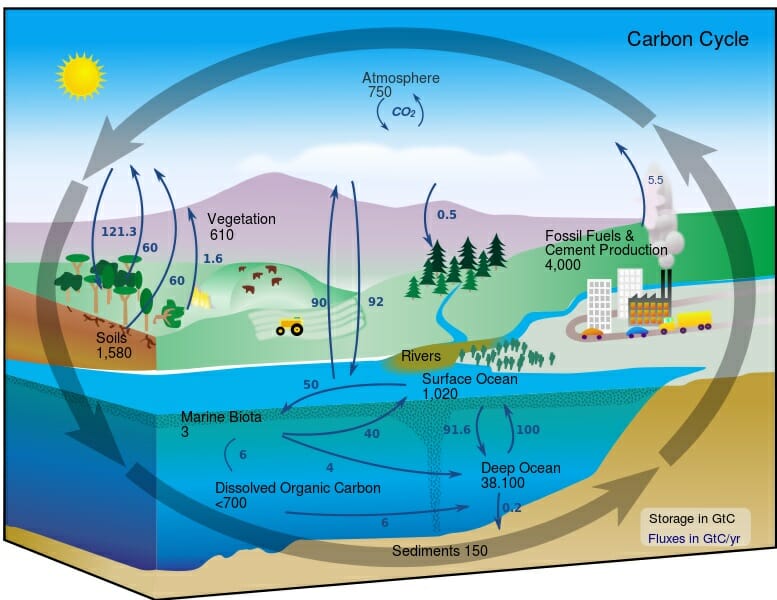
For this lesson, focus on the numbers inside the boxes. You can see the values we've discussed: Atmosphere (~589, which is the pre-industrial value), Vegetation (~550), Soils (~1500), Surface Ocean (~1020), and Deep Ocean (~38,100). This diagram visually reinforces the relative sizes of the reservoirs and provides a preview of the dynamics we will explore next.
Conclusion
In this lesson, we have established a quantitative, order-of-magnitude understanding of the Earth's major carbon reservoirs.
Key Takeaways:
- The largest carbon reservoir is the lithosphere (>75,000,000 GtC), but it participates in a very slow cycle.
- The ocean is the largest reservoir in the active carbon cycle (~38,000 GtC), holding about 50 times more carbon than the atmosphere. Most of this is in the deep ocean.
- The land biosphere (~2,000 GtC) and fossil fuels (~4,000 GtC) are also significant reservoirs.
- The atmosphere (~720-900 GtC) is a comparatively small reservoir, which makes it highly sensitive to perturbations from the burning of fossil fuels.
You now have a static map of the carbon cycle. In our next lesson, we will bring this map to life by examining the fluxes—the natural and anthropogenic flows of carbon between these reservoirs. This will allow us to understand how human activities are altering the balance of this critical planetary system.