Recommended resources
The freely available resources this lesson will direct you to.
Hello Alex,
Welcome to the first lesson of our course on Popperian realism, tradition, and rationalism. I'm excited to embark on this intellectual journey with you. Given your extensive background in economics, statistics, and political philosophy, I believe you'll find this synthesis of ideas both challenging and deeply rewarding.
Our goal in this course is to construct a coherent philosophy that reconciles the value of evolved traditions with the necessity of critical reason—what we'll call 'Critical-Traditionalist Rationalism'. To do that, we must first understand the intellectual traditions that this philosophy engages with and critiques.
This first lesson will take approximately one hour to complete. We will begin by exploring one of the most powerful and influential theories of historical development: Karl Marx's historical materialism. We will then introduce Karl Popper's concept of 'historicism' and see how Marx's theory serves as a prime example of what Popper argued against. This will lay the crucial groundwork for understanding Popper's broader philosophy of science and politics.
The Learning Outcome for this Lesson:
Define 'historicism' as critiqued by Popper and connect it to teleological theories like Marx's historical materialism.
Let's begin by building a clear picture of the theory Popper was reacting to.
Part 1: Understanding Historical Materialism
To grasp Popper's critique, we first need a solid understanding of its target. Karl Marx developed a comprehensive theory of history known as Historical Materialism. You've encountered aspects of this before, particularly the concepts of 'base' and 'superstructure'. Now, we'll delve into the mechanics of the theory to see how it purports to explain the grand sweep of historical change.
Marx's project was an ambitious attempt to create a scientific theory of history, one that could explain historical development through discernible laws, much like a physicist explains the motion of planets. This stood in direct contrast to idealist philosophies, like Hegel's, which saw history as the unfolding of consciousness or Spirit. For Marx, the engine of history wasn't ideas, but material conditions.
To get a detailed "rational reconstruction" of this theory, please watch the following segments from a lecture by Dr. Darren Staloff. Focus on how he builds the theory from a few core principles into a system of historical laws.

- Introduction to the Project (00:00 - 05:22): Pay attention to the core aim: to create a scientific, causally determined explanation for human history, specifically to counter Hegel's idealism.
- Core Concepts: Base and Forces (13:22 - 19:41): This part defines the key entities in Marx's system: the forces of production (technology, skills) and the relations of production (ownership, class structure). Their sum constitutes the economic base of society.
- The Superstructure (19:41 - 25:15): This covers the relationship between the economic base and the superstructure (law, politics, culture, ideology). Note the deterministic argument: the superstructure is shaped by the base to legitimize the existing economic relations.
- Laws of Historical Development (25:15 - 31:35): This is the most crucial part for our purposes. Dr. Staloff outlines the "scientific laws" that Marx believed govern the transition between different modes of production (e.g., feudalism to capitalism).
From these clips, we can distill the core claims of historical materialism:
- Materialist Premise: The way a society produces its material life (its economic base) is the primary factor determining its social, political, and intellectual structure (its superstructure).
- Engine of History: The primary driver of change is the development of the forces of production (technology, science, technique).
- Contradiction and Revolution: History progresses through stages, or 'modes of production'. A given mode persists as long as its 'relations of production' (class structure) facilitate the growth of its productive forces. When these relations become a fetter on further development, a period of social revolution ensues, leading to a new mode of production.
- Law-like Progression: This process is not random but follows predictable, law-like patterns. Marx identified a sequence from slave society, to feudalism, to capitalism, and predicted its future progression to communism.
This framework is powerful. As you know from your econometrics and stats background, building a model that explains past data and predicts future outcomes is the gold standard. Marx was attempting to do just that for human history.
Part 2: Popper's Critique of Historicism
Now, let's bring Karl Popper into the picture. Popper, an Austrian-British philosopher, was deeply concerned with the rise of totalitarian ideologies in the 20th century, namely fascism and communism. He traced their intellectual roots to a particular philosophical error he termed historicism.
So, what is 'historicism'?
In Popper's words, historicism is the belief that history is governed by specific historical or evolutionary laws whose discovery would enable us to prophesy the destiny of man.
Key features of historicist thinking include:
- The belief that history has a discernible plot or direction.
- The claim to have discovered the "laws of motion" that govern this plot.
- The use of these laws to make large-scale, unconditional historical predictions about the future.
Does this sound familiar? Marx's historical materialism is Popper's quintessential example of a historicist doctrine. The "laws of development" you just learned about—predicting that a mode of production will persist until it fetters the productive forces, at which point a revolution will occur—are precisely the kind of historical laws Popper targets. The prediction of capitalism's inevitable demise and the subsequent rise of communism is the unconditional historical "prophecy."
This connects to the concept of teleology. A theory is teleological if it explains something based on its end, purpose, or goal (from the Greek telos, meaning 'end'). Historical materialism is teleological because it frames history as a process moving toward a specific end-point: communism. Each stage (feudalism, capitalism) is implicitly judged by its role in bringing about this final, problem-solving state. Capitalism is "progressive" because it develops the productive forces necessary for communism, but it is ultimately doomed because its internal contradictions prevent the final realization of that potential.
The Problem with Prophecy
Popper argued that this historicist approach is both unscientific and politically dangerous. Dr. Staloff touches upon this exact point in the conclusion of his lecture. Please watch this final segment.
- The Prophetic Nature of Marxism (39:40 - 43:10): Focus on the critique that Marx is judging a present reality (capitalism) based on a future, yet-to-be-realized state (communism). Staloff calls this "prophecy."
Popper's critique runs deeper than this.
- It's Unscientific: A core tenet of science (which we'll explore in the next lesson) is that theories must be testable. How can one test a prophecy about the long-term destiny of society? If the revolution doesn't happen, a historicist can always say "the conditions aren't ripe yet." The theory becomes irrefutable, shielding itself from criticism.
- It's Politically Dangerous: This is the crux of Popper's argument in The Open Society and Its Enemies and The Poverty of Historicism. If you believe you know the inevitable direction of history, you might feel justified in making immense sacrifices to "speed up" the process. This leads to what Popper calls "utopian social engineering": attempts to tear down the existing social order and remake it from scratch according to a grand blueprint. This approach, Popper argued, inevitably leads to violence and totalitarian control, as it dismisses the real-world suffering caused by its radical policies as a necessary cost of reaching utopia.
Your familiarity with Oakeshott and Hayek is highly relevant here. Oakeshott's critique of "Rationalism in Politics" and Hayek's "knowledge problem" are powerful allies to Popper's argument. The utopian social engineer, armed with their historicist blueprint, vastly overestimates their ability to know and control a complex society, ignoring the immense body of dispersed, practical knowledge that keeps it functioning.
Part 3: A More Nuanced View
It is important to engage with the strongest version of an argument. Some Marxists would argue that Popper attacks a simplified "straw man" version of historical materialism. They contend that Marx's method is a tool for analysis, not a rigid, deterministic formula.
This short video makes precisely that point. Please watch this clip.
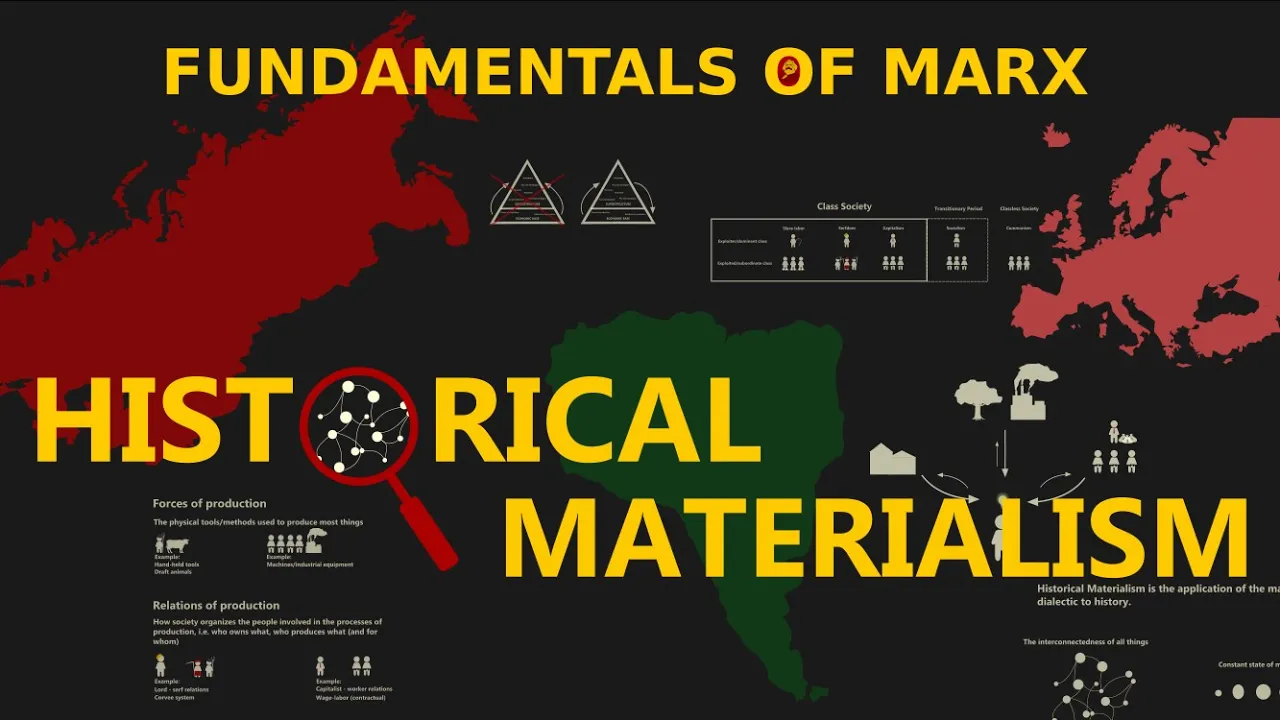
- Critique of Linear History (05:26 - 06:51): Note the argument against a "linear or deterministic vision of history" and the claim that such an interpretation is not true to Marx's method.
This adds a layer of sophistication to our analysis. Was Popper critiquing Marx's actual, nuanced method, or a vulgarized version of it that became dogma for political movements?
This is a live debate. However, from a Popperian perspective, even the more nuanced version is problematic if it retains a teleological core—the idea that history is heading in a particular direction (towards the resolution of class conflict) and that we can analyze the present in terms of its progress towards that goal. The temptation to make large-scale predictions and justify policy based on a presumed "arc of history" remains.
Conclusion
In this lesson, we have laid the first crucial stone in the foundation of our course. We have explored Karl Marx's historical materialism as a powerful, scientific-style theory of history and connected it to Karl Popper's critique of historicism.
Here are the key takeaways:
- Historical Materialism is a theory that explains historical development through the evolution of a society's forces of production and the resulting conflicts in its relations of production. It posits law-like regularities governing this process.
- The theory is teleological because it sees history as progressing toward a final end-state—communism—which resolves the contradictions of all previous epochs.
- Historicism, as defined by Popper, is the belief that history is governed by discoverable laws that allow for unconditional prophecies about the future of society.
- Popper critiqued historicism as unscientific (because its prophecies are untestable) and politically dangerous, as it provides a justification for 'utopian social engineering' and totalitarianism.
Preview of the Next Lesson
Popper's critique of historicism stems from his fundamental views on what separates science from non-science. To fully understand his position, we need to look at the philosophical landscape he was arguing against. In our next lesson, we will deconstruct the core tenets of Logical Positivism, including the verification principle. This will set the stage for understanding Popper's famous alternative—falsifiability—which is a cornerstone of his entire philosophy.