Recommended resources
The freely available resources this lesson will direct you to.
- How to hear Anahata Dhwani or unstruck sound?www.youtube.com
- SADHGURU - THE SCIENCE BEHIND CHANTING A MANTRA - Why Sound Is More Important Than Meaning ?!www.youtube.com
- Mantra Sastra - Hindupedia, the Hindu Encyclopediahindupedia.com
- Nada Yoga and Spirituality: The Transformative Power of ...sangeetgalaxy.co.in
Introduction
In our last lesson, we established a crucial link between musical practice and Jain soteriology. You learned how the disciplined use of mantra and raga serves as a form of Gupti (control), enabling Samvar—the stoppage of karmic inflow—by steadying the mind, speech, and body. We saw that this is not merely a psychological exercise but a direct engagement with the mechanics of karma.
This lesson takes the final and most profound step in our exploration of music as a tool for Dharma Dhyan. Having learned to use external sound to quiet the inner world, we now ask: what happens next? The answer lies in a journey inward. Our objective is to explain the conceptual journey from relying on external music (ahata nada) to cultivating awareness of internal sound (anahata nada). This transition from an external support to an internal source is the very essence of advancing in meditative practice, moving from dependency towards spiritual self-reliance.
The Two Worlds of Sound: Ahata and Anahata
Indian philosophy, across various schools, makes a fundamental distinction between two types of sound, or Nada. Understanding this is key to grasping the entire arc of a sound-based spiritual practice.
-
Ahata Nada (आहत नाद): Struck Sound. This refers to any sound that is produced by the striking or interaction of two objects. It is the sound of the physical world: a voice chanting, a raga played on a sitar, the wind in the trees, the beat of a drum. It is perceptible by our ears, has a beginning and an end, and is a manifestation of vibration in a physical medium. In the context of our course, all the mantras we chant and the music we listen to fall into this category.
-
Anahata Nada (अनाहत नाद): Unstruck Sound. This is a much subtler concept. It refers to the primordial, eternal vibration that is not caused by any physical striking. It is the "sound of the universe," the "cosmic hiss" that underlies all of creation. It is not heard with the physical ears but is perceived directly by the consciousness in a state of deep meditation. It is eternal, without beginning or end.
Let's ground this distinction in the foundational principles of Mantra Sastra.
Mantra Sastra - Hindupedia, the Hindu Encyclopedia
This article from Hindupedia provides a concise and clear explanation of the difference between Ahata and Anahata sound and how one leads to the other.
Please read the section titled Mantra Yoga. Focus on the opening paragraph, which states: "Sound is produced through contact, vibration and obstruction. This is called Ahata. However cosmic hiss if one can hear is eternal and existent. This is called Anahata. It is not produced by us but only heard."
This establishes the core idea: the audible sounds we create (Ahata) are a pathway to perceiving the inaudible sound that already exists (Anahata).
Ahata Nada as a Bridge to the Internal
Why begin with external sound if the goal is to hear the internal one? Because the mind, in its ordinary state, is too agitated and outwardly focused to perceive something as subtle as Anahata Nada. External sound, when used with discipline, becomes a powerful tool to train and quiet the mind.
Think of it from a software development perspective: you can't interact directly with the CPU's fundamental clock cycle. You use high-level programming languages and compilers that create a structured environment, which then translates your intentions into the machine's native operations. Similarly, Ahata Nada is the high-level interface we use to prepare our consciousness to interact with its own fundamental, native vibration.
The speaker Sadhguru offers a compelling perspective on why focusing on the pure sound of a mantra, rather than its intellectual meaning, is so effective for this purpose.
SADHGURU - THE SCIENCE BEHIND CHANTING A MANTRA - Why Sound Is More Important Than Meaning ?!
In this talk, Sadhguru explains why the vibrational quality of a mantra is more important than its linguistic meaning. This helps clarify the function of Ahata Nada as a vibrational tool.
Watch the segment from this timestamp, where he explains that meanings are psychological constructs, while sound is the essence of creation. Then, from this point, he presents the powerful analogy of a mantra as a "combination lock"—a specific arrangement of sound that opens a doorway.
The practice of mantra chanting (japa) itself contains a built-in progression from the external to the internal. The Mantra Sastra text you just read outlines three traditional grades of japa:
- Bahya (Vaikharī): Aloud chanting. This fully engages the body and speech, imposing a powerful, orderly vibration that overrides mental chatter.
- Upamsu: Whispering or chanting with only lip movement. The practice becomes more subtle, withdrawing energy from the gross physical realm.
- Antar (Manas): Mental chanting. Here, the sound is produced entirely within the mind. This is the direct bridge from a self-created sound to a self-existing one.
This progression is a clear, practical path showing how the practitioner systematically shifts their focus from the outer world of sound to the inner.
Perceiving the Unstruck Sound
As the mind becomes progressively stilled and focused through the practice of Ahata Nada, a new sensitivity develops. The practitioner begins to be able to perceive the subtle, pre-existing vibrations of the Anahata Nada. This perception is often associated with the Anahata Chakra, the energy center located in the region of the heart. The name of the chakra itself means "unstruck."
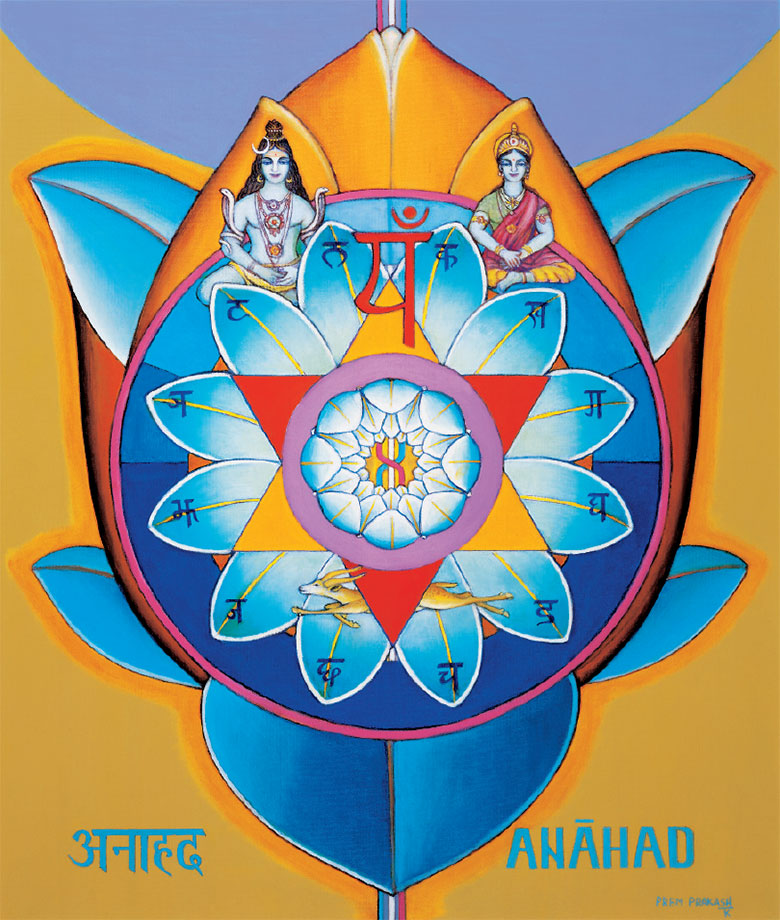
What does one "hear" at this stage? It is not a singular event but a progression of deepening awareness.
How to hear Anahata Dhwani or unstruck sound?
This short, explanatory video details the practical experience of hearing the Anahata Dhwani (unstruck sound).
Watch the entire video. It describes how the perception evolves, starting from bodily sounds like breath and heartbeat. As focus deepens, these give way to more mystical sounds like a conch, drum, or bell. The video also introduces a practical technique, the Shanmuki Mudra (closing the seven gates of perception—eyes, ears, nostrils, mouth), which is used to block external sensory input and facilitate this inward listening.
The Four Stages of Nada Yoga
The conceptual journey from the external to the internal can be beautifully mapped out through the four stages of Nada Yoga, the "Yoga of Sound." These stages provide a clear framework for the process of refining one's awareness.
Nada Yoga and Spirituality: The Transformative Power of ...
This research paper provides an excellent overview of Nada Yoga, defining the two sounds and then detailing the progressive stages of practice.
First, refresh the distinction between the two sounds by reading the paragraph that starts "The Nada idea is classified..." Then, the most important part for our purpose is the section titled "Stages of Nada Yoga." Carefully read the descriptions of the four stages, starting from Vaikhari and ending with Paranada.
Let's summarize this crucial framework:
- Vaikhari (Audible Sound): This is the starting point. Our awareness is on gross, external sounds, like the mantra we chant aloud.
- Madhyama (Mental Sound): The focus shifts inward to sounds produced in the mind, like mental chanting (Antar Japa). The sound is no longer physical but is still being actively created by the practitioner.
- Pashyanta (Subconscious Sound): Awareness deepens further to a pre-verbal, almost visual level of vibration. Here, the practitioner is no longer "creating" the sound but "witnessing" a more fundamental impulse of thought and energy.
- Paranada (Transcendent Sound): This is the final stage, the experience of Anahata Nada itself. The practitioner perceives the unmanifest, unstruck cosmic vibration that is independent of their own mind. This is a state of unity, where the distinction between the listener and the sound dissolves.
From Alambana to Atma: The Jain Perspective
This journey from Vaikhari to Paranada has a direct parallel in the Jain path of meditation. The initial reliance on external music and mantras (Ahata Nada) is a form of Dharma Dhyan using an alambana (आलम्बन), or a support. This support is essential for steadying the mind, pacifying the kashayas, and achieving Samvar.
However, the ultimate goal of Jain meditation is to transcend the need for any external support. The transition to perceiving Anahata Nada signifies a shift towards a more advanced, self-sustaining meditation. The soul begins to cease its reliance on an external object made of pudgal (sound-matter) and turns its awareness towards its own intrinsic nature. While the experience of Anahata Nada is a profound milestone, in the Jain context, it is the final gateway to the ultimate goal: Atma Dhyan—meditation on the true self. The final "sound" is the silent, pure vibration of consciousness itself.
Conclusion
Today, we have mapped the complete spiritual trajectory of a sound-based practice. We began with the sounds of the external world and charted a course into the silent stillness of the inner world.
Key Takeaways:
- Ahata vs. Anahata: Spiritual sound practice is a journey from Ahata Nada (struck, external sound) to Anahata Nada (unstruck, internal sound).
- External Sound as a Tool: Mantras and music (Ahata Nada) are not the destination but a necessary bridge. They act as a vibrational technology to quiet the mind and prepare it for subtler perceptions.
- A Progressive Path: The journey inward is systematic, progressing through stages like the grades of japa (Vaikhari, Upamsu, Manas) and the levels of Nada Yoga (Vaikhari, Madhyama, Pashyanta, Paranada).
- From Support to Self: This journey mirrors the meditative path from relying on an external support (alambana) to achieving self-reliant awareness of the soul (Atma Dhyan).
You have now explored the physics of sound, the structure of mantra, the emotional power of raga, the psychoacoustics of music, and the karmic implications of practice, culminating in this journey from the audible to the transcendent.
In our final module, we will synthesize all this knowledge. The next lesson will guide you in designing your own personal sadhana, integrating these principles into a structured daily practice tailored to your unique spiritual objectives.