Recommended resources
The freely available resources this lesson will direct you to.
- Understanding HEAVY Menstrual BLEEDING - Dr Lora Shahinewww.youtube.com
- Heavy periods: Signs and treatment | NHSwww.youtube.com
- Context | Heavy menstrual bleeding: assessment and management | Guidance | NICEwww.nice.org.uk
- Contemporary evaluation of women and girls with abnormal uterine bleeding: FIGO Systems 1 and 2pmc.ncbi.nlm.nih.gov
Hello. This course begins by clarifying the problem before choosing a product. In the first module, you’ll frame the heavy-flow opportunity, identify assumptions, and decide what evidence to gather. That matters especially while customer conversations are still underway: a technology idea should not determine who counts as a potential customer.
Today’s distinction is between “my flow feels heavy”, which describes a person’s experience, and heavy menstrual bleeding (HMB), a term used in clinical guidance. The two overlap, but neither can be reduced to a product count or a single symptom. By the end, you should be able to describe the opportunity accurately without diagnosing interview participants or dismissing needs that fall outside a clinical label.
Start with the experience, not a threshold
When someone says, “I have a heavy period,” they may mean that they bleed more than they used to, change products frequently, worry about leaks, plan their day around bathroom access, or find the expense difficult to manage. Another person with similar bleeding might not use the word heavy at all. They may regard their pattern as normal because it has always been that way.
Neither account is a precise measurement of blood loss. Both are useful discovery evidence. For a founder, the first question is not “Does this person meet a medical cutoff?” but “What experience are they describing, and what, if anything, does it prevent them from doing?”
The NHS’s short video gives concrete examples of signs people may notice.
Heavy periods: Signs and treatment | NHS
Watch “Heavy periods: Signs and treatment” from the NHS for a concise account of commonly reported signs and when their effects warrant a conversation with a clinician.
Watch common signs, noting the difference between a bleeding pattern and its effects on clothing, bedding, or energy. Then watch daily-life impact and care prompts. Notice that symptoms such as bleeding between periods call for clinical attention; they should not simply be folded into a “heavy periods” category.
The Cleveland Clinic illustration gathers several recognizable signs in one place:
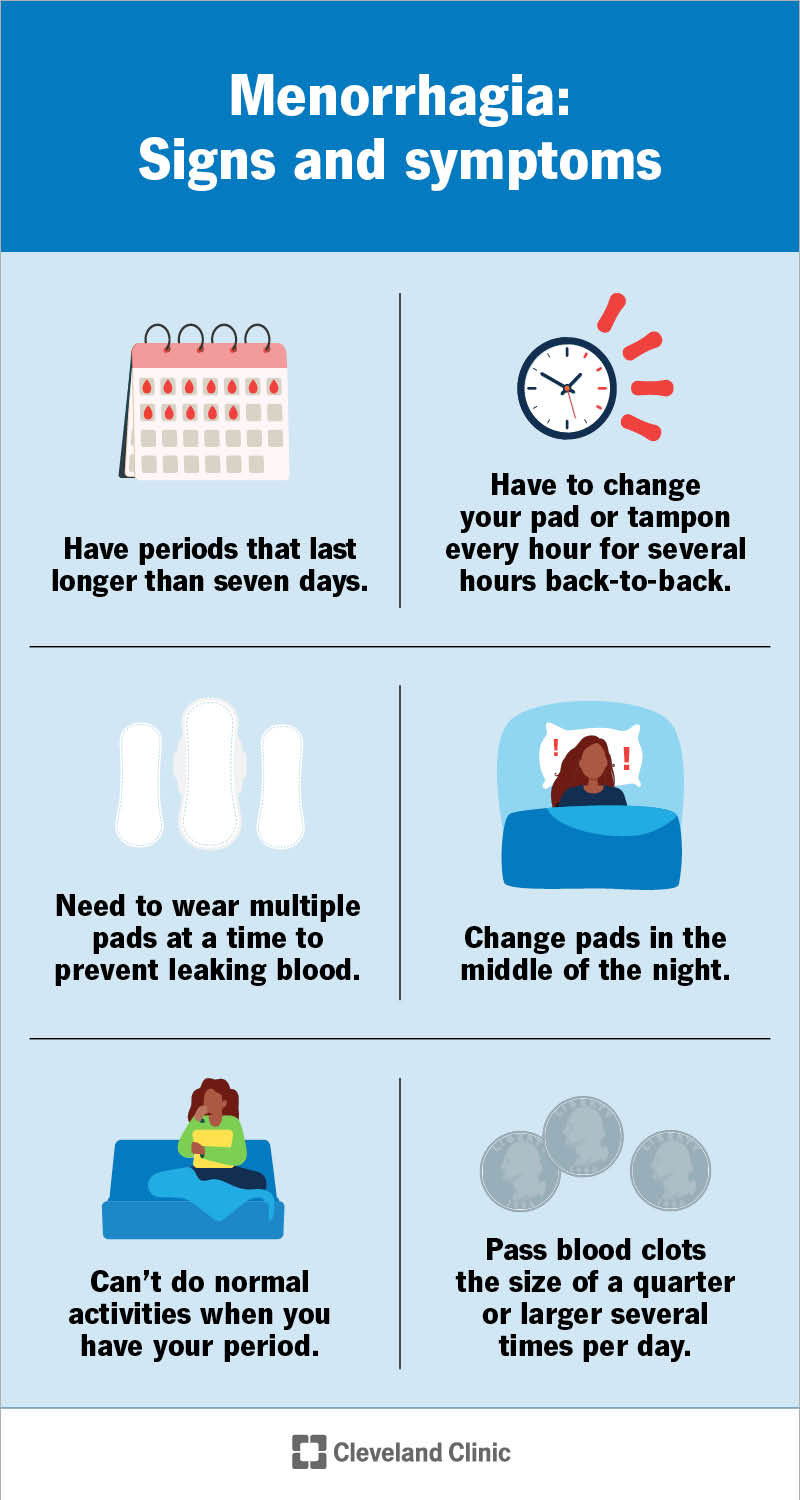
The illustration uses menorrhagia, an older term for heavy menstrual bleeding. Its signs are valuable prompts for understanding what a person manages day to day. They are not six requirements someone must satisfy, nor is any one sign proof of a particular condition. For example, changing a pad often could reflect rapid saturation, a preference to change early, or the absorbency of the product available. A useful customer conversation would distinguish those circumstances rather than treating “changes every two hours” as a self-explanatory data point.
What the clinical definition adds
Clinical language does not simply replace a person’s account with a volume measurement. The NICE guideline defines HMB in terms of both excessive menstrual blood loss and its interference with quality of life.
Context | Heavy menstrual bleeding: assessment and management | Guidance | NICE
Read the “Context” section of the NICE guideline to see how its definition connects bleeding with physical, social, emotional, and material effects.
In “Context,” read the opening definition, from the first sentence through the statement that HMB may occur alongside other symptoms. Pay particular attention to the range of quality-of-life effects named there.
That definition changes how you interpret an interview. Imagine two people who each describe one day of substantial flow:
- One says it is noticeable but manageable with their usual supplies and does not change their plans.
- The other avoids a shift at work, wakes repeatedly to check for leaks, and spends money on backup products they cannot comfortably afford.
A product count alone might make them look similar. Their unmet needs may be quite different. NICE’s reference to material quality of life is particularly important for an opportunity in flow management: cost, access to suitable products, and the resources required to avoid leaks can matter alongside physical symptoms.
There is an equally important distinction in the other direction. Someone need not say “I have HMB” for the effects to be substantial. If they describe repeatedly missing activities or organizing each cycle around fear of bleeding through, that impact deserves attention even if they call their period “normal.” Conversely, someone’s statement that their flow is heavy should be recorded faithfully even if they report little disruption. It may still point to a need, and it is not a founder’s role to overrule their language.
A clinical definition is a framework for understanding a health concern, not permission for a startup to diagnose an interviewee. A clinician may use a history and, where appropriate, further assessment to investigate symptoms and possible causes. Your discovery notes should preserve what a person reported without converting it into an unverified clinical conclusion.
Describe the pattern without mistaking a clue for a diagnosis
“Heavy” describes one aspect of bleeding. Clinical conversations can also distinguish how often periods occur, how long bleeding lasts, and whether cycles are regular. FIGO’s framework for abnormal uterine bleeding provides a useful vocabulary for keeping these dimensions separate.
Contemporary evaluation of women and girls with abnormal uterine bleeding: FIGO Systems 1 and 2
Read the article’s account of FIGO System 1 to understand why clinicians describe a bleeding pattern using more than flow volume alone.
In “4 FIGO SYSTEM 1,” subsection “4.1 Normal and abnormal uterine bleeding definitions and terminology,” begin with the structured-history account. Continue through the “Frequency,” “Duration,” “Regularity,” and “Flow volume” subsections, stopping at the sentence about the NICE definition. Focus on how the author separates these four descriptors, and on the statement that clinical flow-volume categories can be determined by the patient.
The point is subtle but important: self-report and clinical practice are not opposites. In FIGO’s description, flow volume may be recorded as light, normal, or heavy according to the patient. A structured clinical history gives that report context. It asks whether a person means unusually frequent cycles, prolonged bleeding, heavy flow during a period, or some combination. It may also ask about bleeding between periods, which is a distinct feature rather than simply “more heavy flow.”
This helps resolve an apparent contradiction among public-facing signs. The NHS video and Cleveland Clinic illustration mention bleeding beyond seven days as a clue; the FIGO text describes duration using its own formal parameters. These resources serve different purposes. A duration indicator can prompt a closer conversation, but days of bleeding do not, by themselves, define HMB. Likewise, a large clot, an overnight change, or frequent product changes is informative without establishing either the amount of blood lost or its cause.
Be cautious with seemingly precise volume estimates. Pads, tampons, cups, and period underwear have different capacities; people replace them for different reasons; and a count of products does not tell you how saturated each was. A diary of dates, changes, and disruptions may help someone describe their experience, but an app should not present a rough product count as an exact measurement of menstrual blood loss.
For venture research, it helps to keep three kinds of statement separate:
| Statement | What it tells you | What it does not establish |
|---|---|---|
| “My periods are heavy.” | The person’s own characterization of their flow. | A measured volume or a specific cause. |
| “I miss activities and change fully soaked products repeatedly.” | A pattern of behavior and disruption worth understanding. | A diagnosis made by your team. |
| “A clinician told me I have HMB.” | The person reports having received that assessment. | Independent verification of their medical record. |
This discipline does not make discovery less empathetic. It makes the evidence more usable: you can compare what people say, what happens during their cycles, and what they need, without collapsing all three into one label.
Frame the opportunity without deciding who “qualifies”
Consider two possible descriptions of the startup opportunity:
Too narrow and too certain: “We are building an app for patients diagnosed with HMB who lose a specified amount of blood each month.”
Unless your interviews already establish that diagnosis and measurement are essential to the problem, this framing excludes people with meaningful flow-management difficulties. It also presumes both a clinical criterion and a solution.
Better for discovery: “We are investigating how people who experience difficult-to-manage menstrual flow handle leaks, interruptions, planning, and costs, and where current options leave them without the control they want.”
The second statement is deliberately provisional. It describes an experience and potential unmet needs; it does not claim that everyone in the group has HMB or that an app is the answer. You can still note whether participants describe an HMB diagnosis, substantial quality-of-life effects, or a different bleeding concern. Those distinctions may eventually reveal different customer segments or different responsibilities for a product.
In interviews, ordinary language usually works better than asking participants to apply a clinical label to themselves. “What makes a day feel heavy to you?” can surface their own definition. “What do you change, avoid, carry, or pay for on those days?” can reveal the management job. If someone mentions fatigue, breathlessness, bleeding outside their usual period, or severe disruption, record their account accurately rather than interpreting its cause. A product-discovery conversation is not a substitute for medical care.
The distinction also protects future claims. A tool that helps someone record experiences or prepare to discuss them with a clinician is not automatically a tool that detects HMB, measures blood loss accurately, or identifies an underlying condition. Whether such claims could be supported—and what obligations they might create—will be addressed later in the course. For now, keep your problem statement faithful to the evidence you can actually gather.
Takeaways
Self-reported heavy flow is a person’s description of their experience; it is valuable evidence, but not a precise volume measurement or a diagnosis. Clinical HMB guidance gives weight to interference with physical, social, emotional, or material quality of life, while clinical histories also distinguish flow from frequency, duration, regularity, and other bleeding patterns. Symptom clues can guide questions and care conversations, but should not become a founder-made diagnostic checklist.
For your opportunity framing, include people on the basis of the management difficulty you are investigating, and preserve their own words, reported impacts, and reported clinical assessments as separate pieces of evidence. Next, you’ll use that distinction to write a solution-neutral opportunity thesis that names the user, context, unmet need, and desired outcome without prematurely committing to a product.