Recommended resources
The freely available resources this lesson will direct you to.
Introduction
Welcome to the first lesson of our course. We will begin our exploration into the mind by addressing the foundational question: what is hypnosis? Your goal is to understand the mechanisms of influence—both external and internal—and this lesson will lay the groundwork by demystifying the hypnotic trance. We will move beyond common caricatures to a scientific understanding of hypnosis as a distinct state of consciousness.
By the end of this lesson, you will be able to explain the specific neurological and psychological shifts that occur in the brain during a hypnotic state. We will focus on the roles of three critical brain networks: the executive control network, the salience network, and the default mode network. We will also examine the psychological components of this state, including the concept of suggestibility, which is more precisely understood as a form of cognitive flexibility. This foundation is essential for our later discussions on mental defense, therapeutic self-hypnosis, and the parallels with Jain philosophical concepts.
The Modern View of Hypnosis: Absorption, Dissociation, and Flexibility
Contrary to its depiction in popular culture, modern neuroscience does not view hypnosis as sleep or a loss of control. Instead, it is defined as a state of highly focused attention, reduced peripheral awareness, and an increased capacity to respond to suggestion.
Dr. David Spiegel of Stanford University, a leading researcher in this field, breaks down the hypnotic state into three core psychological components:
- Absorption: A state of intense focus where you become so engrossed in an experience—a thought, an image, a memory—that you tune out everything else. Your attention narrows, and distractions fade away.
- Dissociation: The separation of experiences that are normally integrated. This is the mechanism that allows for a disconnect between an action and the awareness of that action. For example, a person in a trance might feel their arm lifting "by itself." This is a key process that we will revisit when discussing mental defense.
- Cognitive Flexibility: This is a more precise term for what has traditionally been called "suggestibility." It does not imply gullibility or weakness. Rather, it refers to a temporary suspension of judgment and a willingness to consider new ways of thinking and perceiving. It's the ability to "try on" a new perspective without the usual internal critique.
To explore these ideas further, you can start with this brief overview.
Neuroscience and Hypnosis · A Pain in the Mind
This article provides a concise, scientifically-grounded introduction to the hypnotic state.
Please read the introductory section under the heading Brain Activity, and then the summary section titled Hypnosis and the Brain’s Narrative. These sections define the hypnotic state and summarize how it reorganizes brain communication.
The Neurological Signature of Hypnosis
Groundbreaking research using functional magnetic resonance imaging (fMRI) has identified a distinct pattern of brain activity that defines the hypnotic state. A pivotal study from Stanford University revealed three consistent changes in the brains of highly hypnotizable individuals during hypnosis.
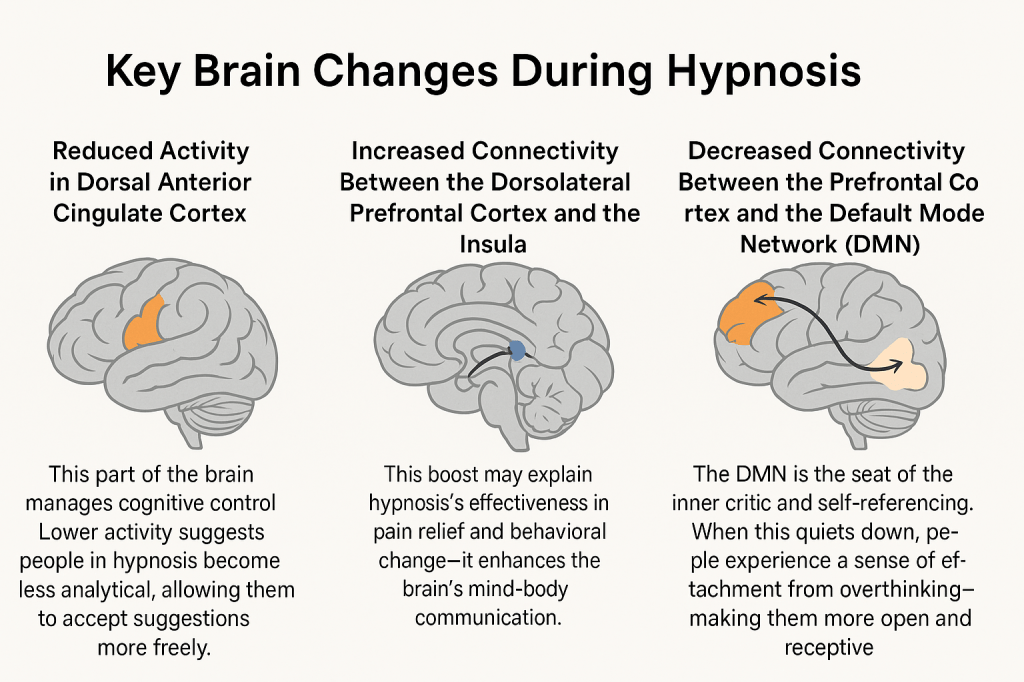
Let's examine each of these three hallmarks:
1. Reduced Activity in the Salience Network
The first change is a decrease in activity in the dorsal anterior cingulate cortex (dACC). This brain region is a key part of the "salience network," which acts as the brain’s alarm system. It constantly scans the environment for anything noteworthy or concerning and directs your attention accordingly.
By turning down the activity in the dACC, hypnosis allows you to become fully absorbed without being easily distracted by external stimuli or internal worries. This neurological quieting corresponds directly to the psychological experience of absorption.
2. Decreased Connectivity with the Default Mode Network (DMN)
The second key change is a reduction in the functional connection between the dorsolateral prefrontal cortex (a hub for executive control and planning) and the Default Mode Network (DMN).
The DMN is active when your mind is wandering or engaged in self-reflection—thinking about the past, worrying about the future, or considering what others think of you. Dr. Spiegel humorously calls it the "my fault mode network." By decoupling the executive control center from this self-referential network, hypnosis quiets the inner critic. This allows a person to engage in suggested activities without self-consciousness or judgment, facilitating the psychological states of dissociation and cognitive flexibility.

3. Increased Connectivity Between Executive Control and the Insula
The third hallmark is an increase in the connection between the dorsolateral prefrontal cortex and the insula. The insula is a critical region for interoception—the sense of the internal state of the body. It acts as a mind-body conduit.
This strengthened link enhances the brain's ability to process and control what's happening in the body. It provides a direct neural pathway for suggestions to influence bodily sensations, which is why hypnosis can be so effective for modulating pain or other physical feelings. This reinforces the brain’s capacity for top-down control over perception.
To consolidate your understanding, Dr. David Spiegel provides a clear summary of these findings in the following video.
In this video, Dr. Spiegel, the lead researcher behind these discoveries, explains the neurological and psychological components of hypnosis.
Watch his explanation of the three distinct brain changes that occur during hypnosis. Then, continue watching as he describes the three corresponding psychological components: absorption, dissociation, and cognitive flexibility.
The Role of Hypnotizability
A crucial aspect of hypnosis is that individuals vary in their ability to enter this state. This trait, known as hypnotizability or hypnotic susceptibility, is remarkably stable throughout adult life, with a test-retest correlation similar to that of IQ over a 25-year period.
Hypnotizability is not a reflection of personality weakness but appears to be a stable neuropsychological trait. Research points to several factors:
- Brain Structure and Function: Highly hypnotizable people tend to show, even at rest, stronger functional connectivity between their prefrontal cortex and anterior cingulate cortex. This suggests a brain that is naturally predisposed to focused absorption.
- Genetics: There is evidence linking hypnotizability to specific gene variants, such as the COMT gene, which regulates dopamine metabolism in the prefrontal cortex.
- Life Experience: Certain experiences can foster this trait. A history of deep imaginative involvement in childhood (e.g., being engrossed in stories) is correlated with higher hypnotizability. Conversely, a history of trauma can also lead to high hypnotizability, as dissociation becomes a practiced coping mechanism.
Understanding that hypnotizability is a trait with a biological basis helps to explain why some individuals are more susceptible to hypnotic influence than others—a key point we will return to when discussing mental defense.
Study identifies brain areas altered during hypnotic trances
This article from the Stanford School of Medicine provides a concise summary of the research that identified the three neurological hallmarks of hypnosis.
Focus on the section that begins with the heading "Brain activity and connectivity." Read the three points detailing the hallmarks of the brain under hypnosis. Notice how the descriptions connect the neurological changes to the subjective experience of being hypnotized.
Conclusion
In this lesson, we have established a scientific framework for understanding hypnosis. We've moved beyond myth to see it as a specific, measurable state of consciousness characterized by intense absorption, dissociation, and cognitive flexibility.
You now know that this psychological state is underpinned by three key neurological shifts:
- Reduced activity in the salience network (dACC), allowing for deep focus.
- Decoupling of the executive control network from the Default Mode Network (DMN), which quiets the inner critic.
- Enhanced connection between the executive control network and the insula, strengthening the mind's influence over the body.
Finally, we've seen that the capacity to enter this state—hypnotizability—is a stable individual trait with roots in neurology and life experience.
In our next lesson, we will build directly upon this foundation. We will distinguish between voluntary and involuntary hypnosis and begin to explore the psychological conditions and techniques that can induce this state, setting the stage for understanding how to both defend against unwanted influence and harness its power for personal benefit.