Recommended resources
The freely available resources this lesson will direct you to.
Hello! Welcome back to your course.
In our first lesson, we established the fundamental market logic of titanium: its extraordinary properties justify a very high price, which in turn limits its use to high-performance applications where cost is secondary to capability. We saw that the price is driven by complex and energy-intensive processing, not the scarcity of the raw ore.
Now, we'll build on that foundation to map out the entire industrial ecosystem. This lesson will trace the journey of titanium from a mineral in the ground to a finished product. Our goal is to map the global titanium value chain, identifying the key corporate and national players, the major cost drivers at each stage, and the different pricing mechanisms for titanium's two main product families. For someone with your background in finance and operations, understanding this flow is the first step to identifying points of leverage, competitive advantage, and potential business opportunities within the industry.
1. The Two Paths of Titanium: Pigment vs. Metal
The first and most crucial thing to understand about the titanium industry is that it's actually two vastly different industries that share a common starting material. The overwhelming majority of mined titanium is not destined for aerospace, but for a much more mundane, high-volume application.
To see this split, let's watch a short segment from the Commodity Culture documentary.
TITANIUM Documentary: Innovations from Aerospace to Everyday Life
This clip from the 'TITANIUM Documentary' clearly distinguishes between the two main markets for titanium: titanium dioxide (TiO2) for pigments and titanium metal.
Watch from 00:30 to 01:25. Pay close attention to the statistic about what percentage of extracted titanium is refined into titanium dioxide.
As the video highlights, about 93-94% of all titanium ore is processed into titanium dioxide (TiO₂), an intensely white powder used as a pigment in paint, paper, plastics, and even sunscreen. This is a large-scale, commodity chemical industry.
The remaining 6-7% is refined into titanium metal. This is the low-volume, high-value specialty materials industry we discussed in the last lesson, serving aerospace, medical, and other demanding sectors.
This split is fundamental. The players, processes, economics, and market dynamics for TiO₂ pigment are completely different from those for titanium metal.
2. Mapping the Titanium Value Chain
Let's visualize the entire process flow. The diagram below shows the key stages, from upstream mineral extraction to downstream finished products. We will use this as our map for the rest of the lesson.
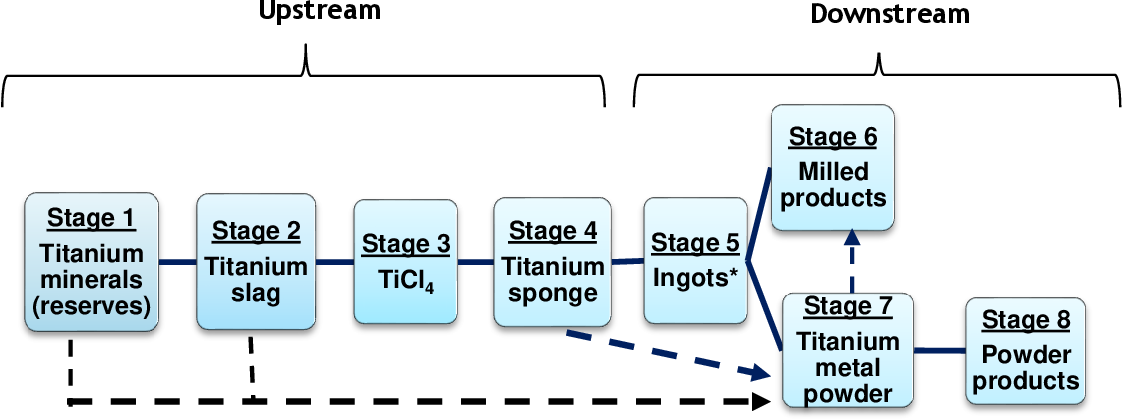
Stage 1: Mining and Concentration (Upstream)
Everything starts with mining mineral sands. As we learned, titanium is abundant, but it's locked in oxide ores.
- Primary Ores:
- Ilmenite (FeTiO₃): More abundant, but contains iron and has a lower TiO₂ content (40-65%). It requires more processing.
- Rutile (TiO₂): A more pure form of titanium dioxide (~95%). It's rarer and more expensive than ilmenite but requires less processing to become a final product.
- Upgrading: Low-grade ilmenite is often "upgraded" through smelting to produce a higher concentration titanium slag or "synthetic rutile." This step removes much of the iron, making the material more suitable for the next stage of processing.
The WIPO Patent Landscape Report provides an excellent overview of the global production landscape.
Production of titanium and titanium dioxide from ilmenite ...
This report from the World Intellectual Property Organization (WIPO), 'Production of titanium and titanium dioxide from ilmenite', offers a detailed look at the global supply chain. We'll start by looking at who mines the ore and who produces the intermediate and final products.
Please read the sections 'Titanium extraction from mineral ores' (page 7) and 'Titanium mining and world production' (pages 8-9). Focus on: The difference between ilmenite, rutile, and titanium concentrate. Which countries are the major miners of ilmenite and rutile (Figure 2). The crucial distinction between countries that only mine, those that only process, and those that do both (Figure 5).
From the reading, you can see a clear geographical division of labor. Countries like China, Australia, and Canada are major players in mining, while others, like Japan and Germany, are major processors without significant mining operations of their own. This global supply chain is a key source of geopolitical and economic risk.
Stage 2-4: The Great Divide
Here, the path splits into the two industries we identified.
Path A: The TiO₂ Pigment Industry
Most of the ilmenite and titanium slag is fed into chemical plants to produce pure TiO₂ pigment. There are two main methods:
- Sulfate Process: An older, cheaper process suitable for lower-grade ilmenite. It uses sulfuric acid but generates more waste.
- Chloride Process: A more modern, efficient process that produces a higher-quality pigment. It requires high-grade feedstock (rutile or slag) and uses chlorine gas.
Path B: The Titanium Metal Industry
The small fraction destined to become metal follows a different route.
- Chlorination to TiCl₄ (Stage 3): High-grade rutile or slag is reacted with chlorine gas and carbon (coke) in a high-temperature reactor. This is the same type of process as the chloride process for pigment, but the output is titanium tetrachloride (TiCl₄), a volatile liquid. This is the essential feedstock for the Kroll process.
- Kroll Process to Sponge (Stage 4): As we touched on in the last lesson, the liquid TiCl₄ is reacted with molten magnesium in an inert atmosphere at ~1000°C. This reduces the TiCl₄ to pure titanium metal, which forms as a porous, spongy mass.
To see this metal production pathway in action, watch the following summary.
The video 'How Is Titanium Made?' gives a concise visual overview of the metal production process, starting from the ore and moving through the Kroll process to the final steps.
Watch from 00:28 to 03:07. This covers the journey from ore, through the Kroll process reaction that produces titanium sponge, and sets up the subsequent melting stage.
Stage 5-8: From Sponge to Product (Downstream Metal)
The raw titanium sponge is not yet usable for making high-performance parts.
- Melting to Ingots (Stage 5): The sponge is crushed, mixed with any desired alloying elements (like aluminum and vanadium for the common Ti-6Al-4V alloy), and melted into a solid ingot. This is done in a vacuum using methods like Vacuum Arc Remelting (VAR) or Electron Beam Melting (EBM) to prevent oxygen contamination. The ingot may be re-melted multiple times to ensure purity and homogeneity.
- Fabrication (Stage 6-8): The solid ingot is then forged, rolled, and machined into final "milled products" like plates, bars, and sheets, or processed into powder for applications like 3D printing.
3. Key Players, Cost Drivers, and Pricing
Now we can overlay the market structure and economics onto our process map. Your background in market analysis will be key here.
Key Players
The titanium market, especially on the metal side, is highly concentrated. Let's return to the WIPO report to identify the key corporate players.
Production of titanium and titanium dioxide from ilmenite ...
The WIPO report also details the major corporate players in both the TiO2 and metal production spheres, based on patent activity which often correlates with market leadership.
Please read these two sections: Start at 'Geographical coverage and key players' for TiO2 production (page 16) and read through page 18. Note the major Chinese and international companies (Pangang, Lomon, DuPont/Chemours, Tronox, Iluka). Then read 'Geographical coverage and key players' for metal production (page 24) and 'Industrial key players...' (page 26). Note the dominance of Japanese companies (Toho Titanium, Osaka Titanium) and Chinese players like Pangang.
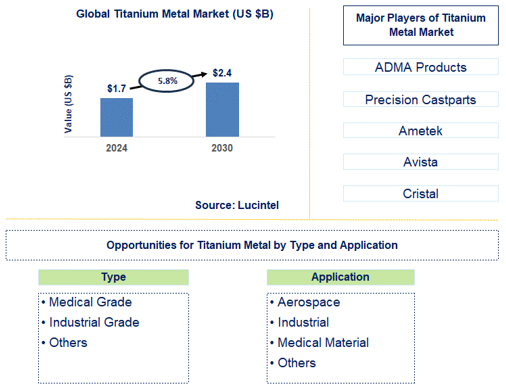
The key takeaway is that the pigment market has several large, global players, whereas the metal sponge market is an oligopoly dominated by a few players in Japan, China, and Russia, with the US having capacity but also relying on imports. This concentration gives incumbent producers significant market power.
Major Cost Drivers & Pricing Mechanisms
Why is a pound of aerospace-grade titanium so much more expensive than a pound of steel? And how is that price determined? The following resource provides an excellent, finance-oriented breakdown.
Price of Titanium Per Pound: An In-Depth Guide - China VMT
The guide 'Price of Titanium Per Pound' from China VMT offers a detailed analysis of the factors influencing titanium's price, with specific dollar figures for different grades and forms.
This is a crucial resource. Please read the following sections: 'Understanding the Price of Titanium in Today's Market' 'What Are the Key Factors Affecting the Price of Titanium?' 'Current Price Analysis: How Much Does Titanium Cost Per Pound?' 'Titanium Ingots and Bars: Price Comparison' Focus on the tables that break down price by grade (e.g., Commercially Pure vs. Grade 5) and form (e.g., scrap vs. plate vs. ingot). This directly addresses the pricing mechanisms.
Let's synthesize the information from the article with our value chain map:
-
Cost Drivers:
- Ore & Feedstock: The price of high-grade rutile vs. lower-grade ilmenite.
- Energy: A massive driver across the entire chain. From smelting ilmenite, to heating the Kroll reactor, to powering the vacuum arc furnaces for melting. Energy price volatility directly impacts production cost.
- Reagents: The cost of chlorine and, critically, magnesium for the Kroll process.
- Capital & Labor: The high cost of specialized reactors and furnaces, and the skilled labor needed to operate them.
- Geopolitics: With production concentrated in a few countries (China, Russia, Japan), trade policies, sanctions, and supply chain disruptions can cause significant price shocks.
-
Pricing Mechanisms:
- TiO₂ Pigment: Behaves like a typical chemical commodity. Prices are quoted per ton and fluctuate with supply and demand from the massive paint and plastics industries.
- Titanium Metal: This is a specialty product, not traded on a public commodity exchange like the LME.
- Contract-Based: Prices are primarily set through long-term agreements between a few large producers and major consumers (e.g., a multi-year deal between a sponge producer and an aerospace company like Boeing or Airbus).
- Price Varies by Form: As the article's tables show, there's a clear value-add at each step. Scrap is cheapest, followed by sponge, then ingots, then finished milled products.
- Price Varies by Grade: Aerospace-grade alloy (like Grade 5, Ti-6Al-4V) is significantly more expensive than commercially pure titanium due to the cost of alloying elements and the stricter quality control required.
Test your understanding!
A large aerospace manufacturer is negotiating a new 5-year supply contract for Grade 5 titanium alloy. From the supplier's perspective, what are the three most significant external risk factors they need to consider when setting the price and terms for this long-term contract?
Show answer
Based on the lesson, the three most significant external risks for the supplier would be:
- Energy Price Volatility: The Kroll process and VAR melting are incredibly energy-intensive. A long-term spike in electricity or natural gas prices could erase the profit margin on a fixed-price contract. The supplier would likely want to include an energy price escalator clause.
- Geopolitical Risk / Feedstock Supply: The supply of high-grade ore, TiCl₄, or even raw sponge is concentrated in a few countries. A new trade tariff, sanction (e.g., on Russian or Chinese suppliers), or export ban could dramatically increase the cost or availability of their raw materials.
- Cost of Key Reagents: The price of magnesium, a key input for the Kroll process, can fluctuate. The supplier's cost structure is directly tied to the market price of this reagent, making it a critical risk to manage in a long-term agreement.
Conclusion
In this lesson, we deconstructed the titanium industry into a concrete value chain.
- Key Takeaways:
- The titanium industry is split into two distinct paths: a high-volume TiO₂ pigment market and a low-volume, high-value titanium metal market.
- The metal value chain is a multi-stage, energy-intensive process: Ore → TiCl₄ → Sponge → Ingot → Milled Product.
- The market is highly concentrated, with different national and corporate players dominating different stages (e.g., Australia in mining, Japan in sponge production).
- Costs are driven by energy, reagents (magnesium), and capital intensity.
- Pricing for metal is opaque, contract-based, and varies significantly by grade (purity/alloy) and form (sponge/ingot/plate), reflecting the value added at each processing step.
You now have a map of the industry, its players, and its economic structure. This provides the context for the next stage of our course. We will now zoom in from the strategic overview to the technical details.
In the next module, Chemical Engineering Fundamentals for Metallurgy, we will start building the tools to analyze these processes quantitatively. The first lesson will introduce the concept of mass balances, which is the fundamental accounting principle for everything that flows into and out of a reactor. This will be the first step toward building the techno-economic model that is a core goal of this course.