Recommended resources
The freely available resources this lesson will direct you to.
Hello! Welcome to the sixth module of our course, where we pivot from retrieving information to taking action. In the previous modules, you learned how to build a powerful Retrieval-Augmented Generation (RAG) system, culminating in our last lesson on using re-rankers to ensure the LLM receives the most relevant context possible. That work focused on making LLMs knowledgeable. Now, we'll focus on making them capable.
This lesson begins our journey into AI Agents. The learning outcome is to define what an AI agent is and how it differs from a simple prompt-response interaction. Understanding this distinction is the foundation for building the autonomous systems that are a key part of your learning goals.
We'll explore:
- The evolution from passive LLMs to goal-driven agents.
- The core components that give an agent its power: reasoning, planning, and tool use.
- The key architectural differences that separate an agent from a simple chatbot.
Let's get started by establishing a baseline with what you already know.
From Passive Responders to Active Doers
So far, you've primarily interacted with LLMs in a prompt-response model. You send a request (a prompt), and the LLM generates a text-based response. Even in a sophisticated RAG system, the LLM is fundamentally a passive component—it answers a question based on the context you provide. It doesn't decide to search for information, update a database, or send an email on its own. It simply responds to the immediate prompt.
This passive nature has two key limitations:
- Limited Knowledge: It only knows what's in its training data and the immediate context window.
- Limited Capability: It can only generate text; it cannot interact with the outside world.
To move beyond these limitations, we introduce the concept of an AI agent.
The following video provides an excellent, non-technical overview of the conceptual journey from a basic LLM, through a human-directed "workflow," to a fully autonomous agent.
This video from Jeff Su, titled 'AI Agents, Clearly Explained', creates a simple 3-level framework to understand this topic. It's a perfect starting point for building our mental model.
Please watch the following segments: Level 1: Large Language Models (00:58 - 02:25): This recaps the passive, prompt-response nature of models like ChatGPT. Level 2: AI Workflows (02:25 - 05:33): Pay close attention to this intermediate step. A workflow is like a script where a human defines a fixed sequence of steps for an LLM to follow. The human is still the 'decision maker'. Level 3: AI Agents (05:33 - 07:45): This is the crucial leap. Focus on the core idea that an agent is created when the LLM replaces the human as the decision-maker in the workflow.
As the video highlights, the most important sentence is: "The one massive change that has to happen in order for this AI workflow to become an AI agent is for me, the human decision maker, to be replaced by an LLM."
The Anatomy of an AI Agent
So, what does it mean for an LLM to become the "decision-maker"? It means we need a new architecture that gives the LLM capabilities beyond text generation. An AI agent is a system built around an LLM, giving it three critical new abilities:
- Reasoning and Planning: The ability to take a high-level goal, break it down into a sequence of steps, and decide what to do next.
- Tool Use: The ability to use external tools (APIs, databases, code interpreters, web browsers) to gather information or perform actions in the world.
- Observation and Iteration: The ability to observe the outcome of an action and use that new information to adjust its plan and decide on the next step.
This creates a continuous loop: Reason → Act → Observe → Reason... until the goal is achieved.
This diagram visually contrasts a simple LLM with the architecture of an AI agent.
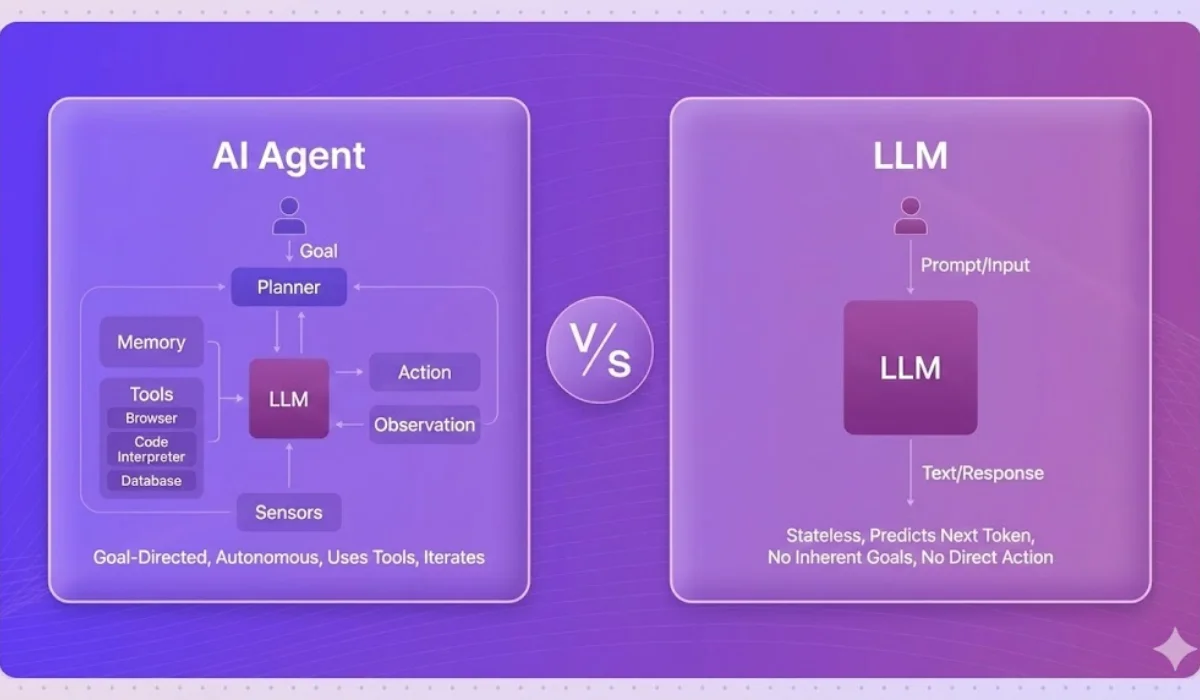
As a software engineer, you can think of this as a paradigm shift.
- A simple LLM interaction is like calling a function: you provide specific inputs (the prompt) and get a direct output. This is an imperative approach where you dictate what to do.
- An AI agent is like giving a high-level objective to a smart system. This is a declarative approach where you state what you want to achieve, and the agent determines how to do it.
The next video, from a channel aimed at engineers, explains this paradigm shift and clarifies the agent's architecture.
What Are AI Agents Really About?
The video 'What Are AI Agents Really About?' from ByteByteGo reinforces these concepts from a more technical perspective.
Please watch these two short clips: Fundamental Differences (00:22 - 01:07): Focus on the explanation of the shift from imperative programming to declarative goal-setting. Agent Architecture (01:59 - 02:45): This clarifies the relationship between the LLM (the reasoning engine) and the agent architecture (the framework for action and tool integration).
Formalizing the Differences
Let's solidify this understanding by looking at some formal definitions and direct comparisons. A simple prompt-response system is often called a "non-agentic" system, while an agent is "agentic."
The following reading from IBM directly contrasts these two.
This article, 'What Are AI Agents?' from IBM, provides clear, concise definitions and a direct comparison between agentic and nonagentic systems.
Please read the section titled 'Agentic versus nonagentic AI chatbots'. It clearly lists the capabilities that agents possess which chatbots lack, such as memory, planning, self-correction, and resourcefulness through tool use.
To give you an even more structured overview, this developer-focused article provides excellent comparison tables. As a software engineer, you may find this format particularly useful for organizing the concepts.
AI Agents — A Software Engineer's Overview
The article 'AI Agents — A Software Engineer's Overview' on DEV Community includes a handy FAQ section with clear comparison tables.
Navigate to the 'Appendix - Frequently Asked Questions (FAQs)' section at the end of the article. Study the two tables: AI Agents vs. AI Models: This table contrasts an agent with a base model on dimensions like function, decision-making, and tool use. AI Agents vs. Chatbots: This provides a practical comparison against a familiar application, highlighting differences in purpose, task handling, and autonomy.
Summary of Key Differences
To bring everything together, here is a summary table that consolidates the distinctions between a simple LLM interaction and an AI agent.
| Aspect | Simple LLM Interaction (Non-Agentic) | AI Agent (Agentic) |
|---|---|---|
| Core Paradigm | Imperative: You tell it how to respond via a detailed prompt. | Declarative: You tell it what to achieve via a high-level goal. |
| Input | A single prompt. | A high-level goal or objective. |
| Process | Reactive & Single-Step: Responds to the prompt and stops. | Proactive & Multi-Step: Plans, acts, and iterates until the goal is met. |
| Decision Making | No independent decisions; follows prompt instructions. | Autonomously decides the next best action based on its reasoning and observations. |
| Capabilities | Limited to text generation based on training data and context. | Can use external tools (APIs, databases, code) to act and gather new info. |
| Autonomy | Low: Requires constant human input for each new step. | High: Can operate independently to complete complex, multi-step tasks. |
| Example | "Summarize this article for me." | "Find the latest research on quantum computing, summarize the key papers, and email the summary to my team." |
This image provides one final, clear visual of the agent's iterative loop, which is fundamentally different from a one-shot LLM call.

Conclusion
In this lesson, you've taken the first and most important step in understanding AI agents. You now know that an agent isn't just a more powerful LLM; it's a completely different architectural pattern that uses an LLM as a core reasoning component.
Key Takeaways:
- A simple LLM interaction is passive and reactive, limited to responding to a single prompt.
- An AI agent is an autonomous system that perceives its environment, makes decisions, and takes actions to achieve a high-level goal.
- The key shift is from a human making decisions in a workflow to the LLM becoming the decision-maker.
- This is enabled by an architecture that gives the LLM access to planning capabilities, external tools, and a memory/observation loop.
In our next lesson, we will dive into the "how." You'll learn about the ReAct (Reasoning and Acting) framework, a foundational technique that provides a structured way for an agent to think and act, forming the backbone of many modern agentic systems.