Recommended resources
The freely available resources this lesson will direct you to.
- Master ALL 20 Agentic AI Design Patterns [Complete Course]www.youtube.com
- MOSAIC: Multi-Agent Orchestration - Emergent Mindwww.emergentmind.com
- [PDF] CTHA: Constrained Temporal Hierarchical Architecture for Stable ...arxiv.org
- Building Effective Agents with LangGraphwww.youtube.com
- This Is REAL Agentic AI (Enterprise Architecture Explained)www.youtube.com
- Deterministic AI Orchestration: A Platform Architecture ... - Praetorianwww.praetorian.com
Hello! Welcome to the next lesson in our module on "Evaluation and Evidence-Based Improvement."
In our last session, we focused on interpreting benchmark results to diagnose the root causes of failure in specific system components like prompts, retrieval, or tools. This post-hoc analysis is essential for understanding what went wrong.
Today, we shift from retrospective diagnosis to proactive, real-time control. Our learning outcome is to incorporate a quality gate into an orchestrator that evaluates agent output against defined standards before proceeding. This is a critical architectural pattern that separates prototypes from production-ready, reliable systems—the kind you can confidently deliver to clients. A quality gate acts as an automated checkpoint, ensuring that errors are caught and handled before they propagate through the workflow or reach the end user.
1. The Core Concept: Verification-Oriented Orchestration
At a high level, a quality gate is a form of "verification." Instead of just generating an output, the system pauses to check its work. This idea is formalized in the concept of verification-oriented orchestration, which treats verification not as an afterthought, but as a core part of the agentic workflow design.
Given your background, you may find the formalisms in the following academic paper useful for structuring your thinking on this topic. It provides a robust framework for different verification strategies.
AI Annotation Orchestration: Evaluating LLM Verifiers to Improve the Quality of LLM Annotations
The paper 'AI Annotation Orchestration' introduces and empirically validates two primary verification strategies that we can adapt into quality gates: self-verification and cross-verification. Understanding these concepts is key to designing effective evaluation logic within an orchestrator.
Please read section 2.3, 'LLM-as-a-Judge, Verification, and Orchestration,' to grasp the formal definitions of self-verification and cross-verification. Then, review section 3.4, 'LLM Annotation and Orchestration Setup,' to see how these concepts were implemented in an experimental setting. Focus on the distinction between a model checking its own work versus another model auditing it.
As the paper discusses, we can implement quality gates using two primary models:
-
Self-Verification: The agent that produced the output is prompted a second time to critique its own work against a set of rules or a rubric. For example: "You provided the following response: [...]. Now, review this response. Does it directly answer the user's question? Is it grounded in the provided context documents? Does it adhere to a JSON schema with fields 'A', 'B', and 'C'?" This is a low-cost method for catching simple errors and reducing variance.
-
Cross-Verification: A separate, specialized agent—an Evaluator Agent or Critic—is tasked with assessing the output of the primary "worker" agent. This creates a separation of concerns and allows the evaluator to be prompted with a different, more critical persona. This is analogous to a code review process. This pattern is generally more robust, as the evaluator is not biased by the same reasoning path that led to the initial output.
Both approaches transform the workflow from a simple linear chain into a stateful graph, where a "verification node" determines the next transition.
2. Architectural Patterns for Quality Gates
Let's explore three architectural patterns for implementing these verification concepts within an orchestrator.
Pattern 1: The Evaluator-Optimizer Loop
This pattern directly implements cross-verification within a state machine, often using a framework like LangGraph. A "generator" agent produces an output, and an "evaluator" agent grades it. Based on the grade, a conditional edge in the graph routes the process to either a "finish" state or back to the "generator" for another attempt, often with the evaluator's feedback included in the prompt.
Building Effective Agents with LangGraph
The LangChain channel provides a clear demonstration of this pattern, which they call the 'Evaluator Optimizer workflow.' This is one of the most common and practical ways to implement a quality gate.
Please watch the segment from 19:39 to 23:25. Pay close attention to how the graph is structured with a generator node, an evaluator node, and a conditional edge that routes the flow based on the evaluator's structured output ('funny' or 'not funny'). This is the fundamental mechanism for an LLM-powered quality gate.
This loop is powerful because it's dynamic. The system can self-correct. The key architectural components are:
- Worker Agent Node: Performs the main task.
- Evaluator Agent Node: Grades the worker's output, typically using structured output (e.g., a Pydantic model or JSON with
gradeandfeedbackfields). - Conditional Edge: Reads the
gradefrom the graph's state and determines the next node. If the grade ispass, it transitions to the end. Iffail, it transitions back to the worker agent. - State Update: The
feedbackfrom the evaluator is added to the state, so the worker agent has context on what to fix in the next iteration.
Pattern 2: Dedicated Governance and Evaluation Agents
In more complex, enterprise-grade systems, quality control is often broken down into multiple specialized agents, each acting as a gate for a different concern.
This Is REAL Agentic AI (Enterprise Architecture Explained)
The video 'This Is REAL Agentic AI' explains an enterprise architecture that includes distinct agents for governance and evaluation. This demonstrates a more sophisticated, layered approach to quality gates.
Watch the segment on the Governance Agent (09:48 - 10:25) and the Evaluator Agent (10:25 - 11:29). Note the different responsibilities: the Governance Agent checks for policy and process compliance, while the Evaluator Agent checks for output quality and correctness.
This layered approach allows you to design a more robust system:
- Governance Agent: This gate focuses on process. It asks questions like: "Is the proposed action allowed by the user's role (RBAC)?", "Does this step comply with company policy?", "Have all prerequisite steps been completed?". This is often a check against a predefined set of rules.
- Evaluator Agent: This gate focuses on quality. It asks: "Is this summary accurate?", "Does this code meet quality standards?", "Is this analysis logically sound?". This is where you would implement the LLM-as-a-judge logic.
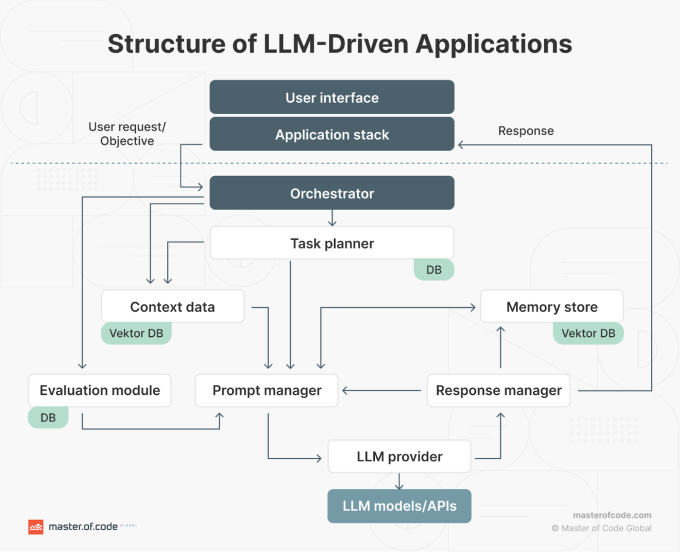
The diagram below shows how an evaluation module fits into a larger LLM application architecture. It receives data from the orchestrator and can feed its results back to influence future prompts or actions.
Pattern 3: Deterministic Hooks for Enforcement
While LLM-based evaluators are powerful, they are still probabilistic. An LLM can be convinced to bypass another LLM. For mission-critical constraints, a more robust pattern is to use deterministic hooks—pieces of conventional code that the LLM cannot ignore.
This is an advanced concept that leverages your expertise in traditional software engineering to build highly reliable agentic systems.
Deterministic AI Orchestration: A Platform Architecture
The Praetorian blog post on 'Deterministic AI Orchestration' details an architecture that uses hooks for enforcement. This is the most rigid and reliable form of a quality gate.
First, read section 5 'The Runtime: Deterministic Hooks' and 5.1 'Defense in Depth' to understand the core concept of hooks as non-bypassable enforcement layers. Then, focus on section 5.3 'The Three-Level Loop System', specifically the description of the 'Level 2: Inter-Phase Loop'. This is a prime example of a deterministic quality gate.
The key insight here is the separation of guidance and enforcement:
- Guidance (Prompts/Skills): You tell the agent what to do (e.g., "You must have your code reviewed before completing the task"). The agent can rationalize its way around this.
- Enforcement (Hooks): You use event-driven code to force compliance. The
feedback-loop-stop.shhook described in the article is a perfect quality gate. It intercepts the agent'sStopevent and checks a state file (feedback-loop-state.json). If the code has been modified (a "Dirty Bit" is set) but thetests_passedflag is nottrue, the hook deterministically blocks the agent from exiting and forces it to retry. The LLM has no choice in the matter.
This pattern is ideal for enforcing security policies, compliance rules, and critical workflow logic where failure is not an option.
3. Designing the Quality Gate's Criteria
A gate is only as good as the rules it enforces. The criteria for your quality gate should be directly informed by the error analysis you conducted in the previous lesson. Your failure taxonomy becomes the checklist for your evaluator agent or deterministic hook.
This diagram illustrates the process of creating an LLM judge, which is analogous to defining your quality gate's logic.

A comprehensive quality gate might check for a combination of factors:
- Schema Compliance: Does the output strictly adhere to the requested JSON or other structured format? (This can and should be a deterministic check.)
- Factuality & Groundedness: Does the output contradict the provided context documents? Does it contain hallucinations?
- Policy Adherence: Does the proposed action or response violate predefined safety or business rules? (e.g., "Do not recommend products over $1,000").
- Completeness & Correctness: Is the output missing required information? Did it follow all the steps in the plan?
- Reasoning Soundness: Is the agent's chain of thought logical? Does it justify its conclusion effectively?
- Tone & Persona: Does the language align with the specified agent persona?
You can design layered gates, using fast, deterministic checks for simple things like JSON validation first, and only invoking a more expensive LLM evaluator for complex checks like reasoning soundness if the initial checks pass.
Conclusion
In this lesson, you've learned how to architect and incorporate quality gates into an agentic orchestrator. This moves your system from a simple "generate and hope" model to a self-regulating, evidence-based workflow capable of real-time quality control.
Key Takeaways:
- Quality gates transition evaluation from a post-hoc analysis to a real-time, in-process control mechanism, which is essential for building reliable, enterprise-grade systems.
- Verification-oriented orchestration provides the theoretical foundation, with self-verification (agent checks its own work) and cross-verification (a critic agent checks the work) as the two main strategies.
- You can implement these gates using several architectural patterns:
- Evaluator-Optimizer Loops (e.g., in LangGraph) for dynamic self-correction.
- Dedicated Governance and Evaluator Agents for a layered, separation-of-concerns approach.
- Deterministic Hooks for non-negotiable, code-enforced rules that the LLM cannot bypass.
- The criteria for your quality gate should be directly derived from your systematic error analysis, turning your diagnostic insights into automated safeguards.
You are now equipped to design agentic systems that are not only powerful but also trustworthy and robust. This is a crucial step towards building complex workflows that can be reliably deployed for clients.
In our next and final lesson of this module, we will close the loop. We'll discuss how to implement and measure the impact of targeted improvements on agent components based on evaluation data, completing the full cycle of measure, diagnose, build safeguards, and improve.