Recommended resources
The freely available resources this lesson will direct you to.
Hello. In the previous lesson, you chose confirmatory tests according to the uncertainty they resolve: repeat a questionable setup, use another method to challenge a platform result, or test for a specific resistance determinant. This lesson applies that reasoning to methicillin-resistant Staphylococcus aureus (MRSA). The clinically consequential question is not simply whether an instrument displays “resistant,” but whether the resistance result belongs to the S. aureus isolate and is supported by valid testing.
You will connect cefoxitin and oxacillin results to PBP2a detection and mecA/mecC testing, then work through what to do when phenotype and genotype disagree. These distinctions will also give you a compact diagnostic workflow for your presentation.
What “MRSA” means—and what each test measures
MRSA is S. aureus with methicillin (oxacillin) resistance. The predominant mechanism is an altered penicillin-binding protein, PBP2a, encoded by mecA. Because PBP2a has low affinity for many beta-lactam antibiotics, the organism can continue cell-wall synthesis despite exposure to drugs that would inhibit ordinary penicillin-binding proteins. The less common mecC gene encodes a related altered protein.
Methicillin is retained in the name for historical reasons; laboratories generally use oxacillin or cefoxitin as test agents. A confirmed methicillin-resistant result has implications beyond those two drugs. Most beta-lactams are not reported as active against MRSA on the basis of an apparently susceptible individual result, although anti-MRSA beta-lactams such as ceftaroline are exceptions that require their own applicable testing and interpretation.
The distinction among the assays is fundamental:
| Test | What it establishes | What it does not establish alone |
|---|---|---|
| Cefoxitin or oxacillin AST | Growth behavior under the specified test conditions | Which gene or mechanism caused resistance |
| PBP2a assay | Detection of the protein targeted by that assay | A complete susceptibility profile |
| mecA/mecC assay | Detection of the genes included in that assay’s targets | That a detected gene is expressed, or which organism carries it in a mixed specimen |
Read the CDC’s laboratory guidance before following the workflow below. It is particularly useful for separating a surrogate susceptibility test from a protein or gene test.
Laboratory Testing for Methicillin (oxacillin)-resistant ...
Read the CDC guidance to establish what MRSA testing detects, why cefoxitin is useful, and which interpretive criteria belong specifically to S. aureus.
In “Overview,” read the opening MRSA definition, then the “Resistance” subsection; focus on PBP2a's effect. Continue through “Testing agents,” particularly “Oxacillin” and “Cefoxitin”; compare their roles. Under “Test methods,” read “Susceptibility test methods” and “Additional methods,” from phenotype to protein. Finally, in “Interpreting results,” read the reporting rule and compare the S. aureus entries in the “Oxacillin” and “Cefoxitin” MIC tables and the “Cefoxitin” disk diffusion table. Notice that other staphylococci have different applicable criteria.
Start with a valid phenotype
For a pure, correctly identified S. aureus isolate, cefoxitin is commonly used as a surrogate marker for methicillin resistance. It induces mecA-mediated resistance effectively and tends to give a clearer disk-diffusion endpoint than oxacillin. Oxacillin MIC testing is also used, including on automated AST platforms. Neither test requires the laboratory to measure susceptibility to methicillin itself.
The organism, method, and breakpoint must be considered together. For example, the CDC page lists a S. aureus cefoxitin disk zone of as susceptible and as resistant under the criteria shown there. That is an illustration of method- and species-specific interpretation, not a threshold to apply to every staphylococcus or to substitute for your laboratory’s current adopted CLSI or EUCAST tables. Similarly, an automated oxacillin MIC is interpreted using the appropriate S. aureus criteria—not criteria for a coagulase-negative staphylococcus.
Before escalating an unexpected result, confirm that the culture is pure, the identification is sound, the selected panel or method is applicable, QC is acceptable, and the current breakpoint and expert rules were used. A reproducible automated oxacillin-resistant result establishes a resistant phenotype; it does not, by itself, prove that mecA is present. Conversely, an apparently susceptible automated result does not settle a credible conflicting gene or protein result.
Why cefoxitin and oxacillin may disagree
Expression of methicillin resistance can be heterogeneous: only part of a population may show readily detectable resistance under particular conditions. Cefoxitin’s stronger induction helps expose some such isolates. One important uncommon pattern is mecC-associated MRSA, which may be cefoxitin resistant yet oxacillin susceptible by MIC testing. A mecA-only molecular assay will miss mecC; assays directed specifically at conventional PBP2a may also fail to detect the related mecC-encoded protein. Never interpret “mecA not detected” as “methicillin susceptible” without considering the test’s target list and the phenotype.
There are also uncommon mec-independent explanations for borderline oxacillin resistance. Thus, the practical sequence is to establish and verify the phenotype first, then choose protein or molecular testing if the mechanism or a discordance needs resolving.
Protein and gene confirmation must be tied to an isolate
A PBP2a latex-agglutination or lateral-flow assay asks whether the tested colonies express the protein recognized by the assay. A targeted nucleic acid amplification test asks whether its specified gene target—mecA, mecC, or both—is detectable. When a pure S. aureus isolate is phenotypically resistant and has a concordant positive PBP2a or mecA result, the interpretation is straightforward.
The harder situation begins with a rapid molecular result directly from a positive blood-culture bottle. If the panel detects S. aureus and mecA, the result may support an urgent provisional MRSA interpretation under the assay’s validated reporting rules. But unless the assay reliably links the marker to S. aureus, it may instead be detecting mecA in a second staphylococcal species. Isolation on solid medium determines what organisms actually grew and allows each to be tested separately.
The following case demonstrates why linking a resistance determinant to a particular colony matters more than simply repeating the direct-bottle molecular test.
Read the S. aureus case in this Journal of Clinical Microbiology review to see how an apparent MRSA result was reassigned after culture, then study its proposed steps for unresolved discrepancies.
Find “STAPHYLOCOCCUS AUREUS CASE STUDY: DETECTION OF AN AMR GENE FROM POSITIVE BLOOD CULTURE BROTH WITH RECOVERY OF AN ISOLATE THAT IS PHENOTYPICALLY SUSCEPTIBLE.” In the case’s first paragraph, begin where the multiplex test on the positive bottle is described and read through the amendment; track which isolate was oxacillin resistant and which was PBP2a negative. In the next paragraph, read the mixed-culture explanation. Then skip the discussion of panel-performance figures and find the paragraph beginning “Among Staphylococcus species”; read from its discussion of mecC-associated strains through its resolution advice. Focus on assay targets, species-specific breakpoints, cefoxitin testing, and what to do if the conflict persists.
In that case, the direct bottle contained S. aureus and S. haemolyticus. Once separated, the S. aureus was oxacillin susceptible and PBP2a negative; the other isolate was oxacillin resistant. The defensible conclusion was MSSA plus methicillin-resistant S. haemolyticus, not a confirmed MRSA isolate. The initial report required amendment and clinical notification. The key correction was attribution of the marker, not dismissal of the original molecular detection as necessarily false.
A practical discordance workflow
The supplied diagram places the S. aureus pathway on the right. Its enterococcal pathway on the left concerns a different resistance question; concentrate on how the right-hand pathway links NAAT findings to cefoxitin or oxacillin results.
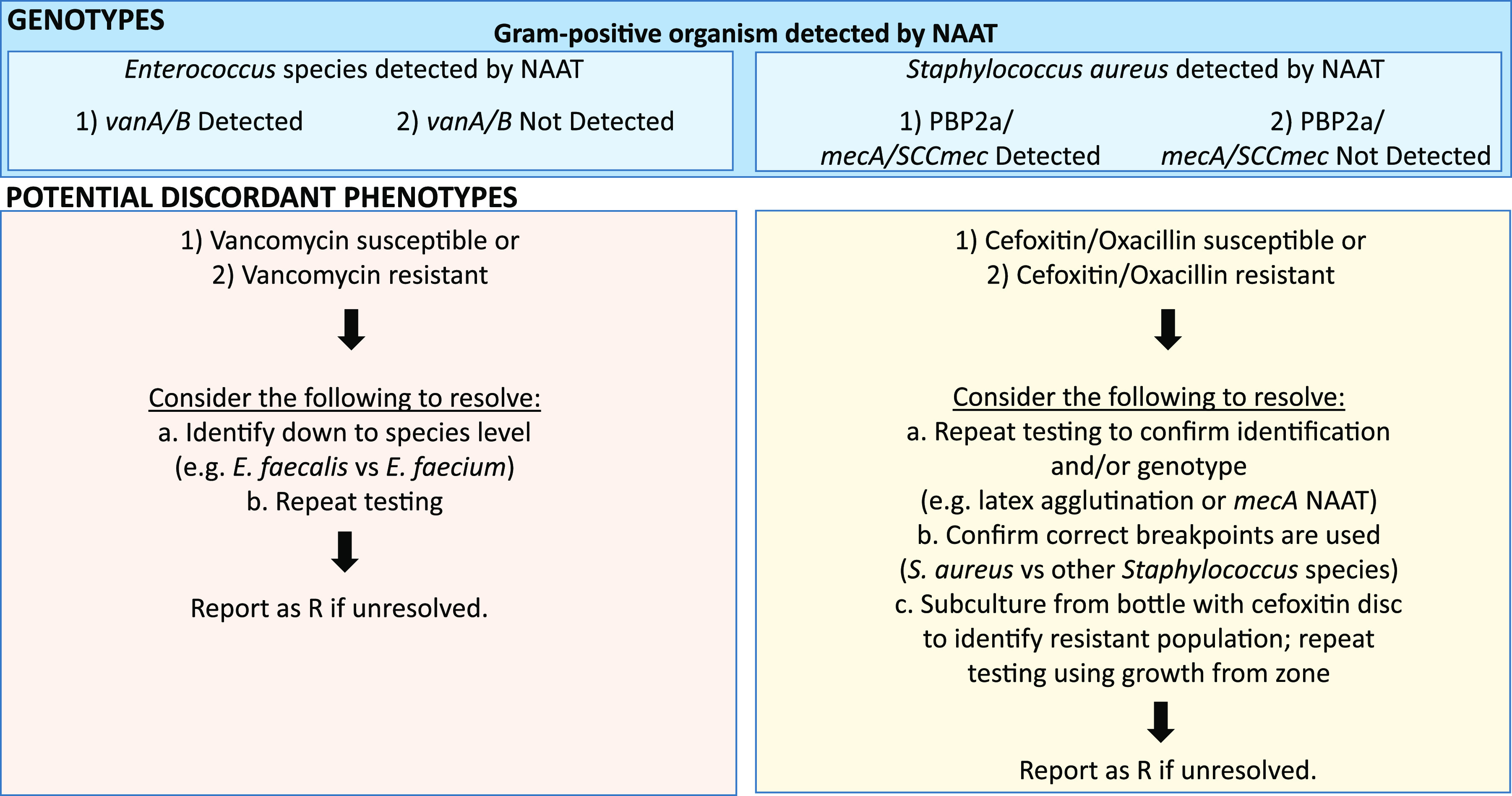
Use the diagram as a troubleshooting aid, not as permission to label every resistant blood-culture bottle “MRSA.” A defensible investigation has five parts:
- Establish attribution. Review the original plate for multiple morphologies; obtain pure colonies and confirm that the isolate under investigation is S. aureus. If the molecular result came from a mixed specimen or bottle, test the recovered species separately.
- Check validity and interpretation. Review QC, inoculum and run flags, method claims, and the appropriate S. aureus cefoxitin or oxacillin breakpoint. Confirm that the gene assay actually targets the gene being inferred.
- Repeat or challenge the phenotype when needed. Repeat from a fresh pure culture and, when appropriate, use a validated independent cefoxitin or oxacillin method. A second identical run on the same automated platform may reproduce a platform limitation as well as a true phenotype.
- Test the unresolved mechanism. Use a validated PBP2a assay and/or a colony-based mecA/mecC assay appropriate to the suspected pattern. If heterogeneous resistance is suspected, investigation of growth near a cefoxitin disk and repeat testing may reveal a resistant subpopulation; follow the laboratory’s validated procedure rather than treating a few colonies as self-interpreting.
- Adjudicate and communicate. Record which result belongs to which isolate, what was confirmed, and which claims remain uncertain. Hold or qualify an unresolved high-consequence result under local policy, and communicate promptly if a released MRSA or MSSA interpretation must change.
Interpreting the main patterns
A phenotypically susceptible isolate with mecA or PBP2a detected requires particular care. First exclude mixed culture and a marker assigned to the wrong species. Then confirm identity, repeat susceptibility testing, and verify the protein or gene result on a pure S. aureus colony. Expression may be heterogeneous; rare nonfunctional genetic remnants or assay-target issues can also create apparent conflicts. Do not quietly release “susceptible” while a credible resistance marker remains unexplained. The CDC guidance and the review recommend resistant reporting when relevant resistance detection is confirmed or an important discrepancy remains unresolved, with laboratory oversight for unusual cases.
A cefoxitin- or oxacillin-resistant isolate with mecA not detected is not automatically a molecular-test failure and is not automatically mecA-mediated MRSA. Check whether mecC is covered, confirm the resistant phenotype by an appropriate method, and assess PBP2a testing in light of that assay’s targets. If resistance remains valid, report the resistant phenotype; describe the mechanism as unconfirmed unless a suitable test establishes it.
Finally, a cefoxitin-resistant, oxacillin-susceptible isolate merits special attention to mecC and method validity. It is precisely the kind of profile for which choosing a test by the question it answers—rather than merely rerunning an automated card—is valuable.
Key takeaways
MRSA is a methicillin-resistant S. aureus isolate, not merely the co-detection of S. aureus and a mec marker in a potentially mixed specimen. Cefoxitin and oxacillin reveal a phenotype; PBP2a assays detect a protein; mecA/mecC assays detect specified genes. Discordance calls for pure-culture attribution, valid species-specific interpretation, and targeted confirmation. A negative mecA test does not exclude mecC or another resistant phenotype, while a positive direct-specimen marker must be linked to the right organism before it establishes an isolate’s mechanism.
For a presentation, the most useful visual is a small set of phenotype–protein–gene combinations, each paired with its next laboratory action and reporting implication. The next lesson moves to another staphylococcal phenotype in which a routine susceptible result can conceal inducible resistance: the D-test.